 TIANQIU
Four dates decide what a portable battery has to look like in the European Union, and none of them is the date the regulation is best known for. Substance ceilings came first, the collection symbol next, the label after that, and the QR code last. A supplier that answers only with the battery passport — which portable cells never carry — leaves three quarters of the calendar unspoken.
That gap matters commercially, because the duties are split. The regulation is written for the party that puts the battery on the EU market, and in a private-label order that party is the brand owner or the importer, not the factory that made the cell. What a factory can do is hold up its half: model data, chemistry, capacity, marking space and the transport documents the buyer’s file rests on.
What does Regulation (EU) 2023/1542 cover?
It covers every battery placed on the EU market or put into service, whatever its shape, size, chemistry or purpose, and it replaced Directive 2006/66/EC rather than amending it. Because it is a regulation and not a directive, the same text applies in every member state without national transposition.
The regulation sorts batteries into five categories, and the category decides everything downstream. A sealed battery weighing 5 kg or less that is not built for industrial use and is not a starting, lighting or ignition battery is a portable battery, which is the category every cell on this site falls into.
Which obligations already apply to a portable cell?
Three of them, and they are live today. The mercury and cadmium ceilings carried over from the directive; a lead ceiling that arrived on 18 August 2024, with portable zinc-air button cells deferred to 18 August 2028; and the separate-collection symbol, which became a marking duty on 18 August 2025.
| What the rule fixes | Where it is written | Live since |
|---|---|---|
| Mercury, up to 0.0005 % by weight | Annex I, point 1 | Carried over from 2006/66/EC |
| Cadmium, up to 0.002 % by weight | Annex I, point 2 | Carried over from 2006/66/EC |
| Lead, up to 0.01 % by weight | Annex I, point 3 | 18 August 2024 — zinc-air until 18 August 2028 |
| Separate-collection symbol | Article 13(4) | 18 August 2025 |
| Cd or Pb symbol, above 0.002 % / 0.004 % | Article 13(5) | With the collection symbol |
Substance limits sit in Annex I and the marking duties in Article 13; the lead line applies to portable batteries whether or not they are built into an appliance.
The collection symbol has its own geometry, which is where printed artwork usually fails. Article 13(4) asks it to cover at least 3 % of the largest side of the battery, capped at 5 × 5 cm, or at least 1.5 % of the surface of a cylindrical cell. Where a cell is so small that the symbol would come out below 0.47 × 0.47 cm, the cell itself is exempt — but the packaging then has to carry one measuring at least 1 × 1 cm.


What has to be on the label from 18 August 2026?
Article 13 turns three separate duties on from 18 August 2026, or 18 months after the implementing act on harmonised specifications if that comes later. One is the general information set in Part A of Annex VI, one is a capacity figure, and one is a duration figure with a plain statement that the cell cannot be recharged.
Part A of Annex VI lists ten items: who the manufacturer is, the category and the model identification, the place of manufacture, the month and year of manufacture, the weight, the capacity, the chemistry, any hazardous substance present other than mercury, cadmium or lead, the extinguishing agent that can be used, and any critical raw material above 0.1 % by weight.
| Label duty | Applies to | Article |
|---|---|---|
| General information, ten items from Part A of Annex VI | Every battery | Article 13(1) |
| Capacity figure | Rechargeable portable cells, plus LMT and SLI batteries | Article 13(2) |
| Minimum average duration in specific applications, and the word non-rechargeable | Non-rechargeable portable cells | Article 13(3) |
Article 13(7) allows the label to move to the packaging and the accompanying documents where the battery itself is too small or its nature does not allow direct marking.
The practical consequence for a private-label order is timing rather than wording: artwork carried over from an earlier season may predate the label plate, and reprinting a running pack is a plate change rather than an edit to a data sheet.
What changes on 18 February 2027?
Two unrelated duties land on that date. Every battery must be marked with a QR code, and products that incorporate a portable battery must be designed so the end user can take that battery out — the second is a design problem, not a paperwork problem, and it is the one to plan around earliest.
For cells without a passport the QR code is not an empty gesture. Article 13(6) requires it to open the label information above, the declaration of conformity, the report under Article 52(3) and the end-of-life instructions in Article 74(1). A code that resolves to nothing is a marking defect on a shipped pack.
When do the performance and due diligence duties start?
Two of the heavier-sounding obligations arrive later, and both have narrow scope. Minimum performance and durability values for portable batteries of general use start on 18 August 2028, or 24 months after the delegated act that sets them, whichever is later — and button cells are excluded from the start.
The battery due diligence policy is the one date that has already moved. It was written to apply from 18 August 2025, and Regulation (EU) 2025/1561 pushed that to 18 August 2027, because the notified bodies and recognised schemes the duty depends on were not yet in place. It binds operators above a net turnover of EUR 40 million, on their own figures or on a group consolidated basis, and it addresses cobalt, natural graphite, lithium and nickel.
What did the waste chapter bring in?
Chapter VIII has applied since 18 August 2025, and it is the part that reaches a brand owner rather than a cell specification. Producers register in each member state where they first make portable batteries available, and finance separate collection, treatment and recycling through a producer responsibility organisation or their own system.
The collection targets behind that financing tighten on a published ladder: 45 % of waste portable batteries by 31 December 2023, 63 % by 31 December 2027 and 73 % by 31 December 2030, calculated under Annex XI. The party liable for them is the one placing the cells on the market.
That is why a brand owner selling loose cells into several member states usually joins a producer responsibility organisation rather than building a system, and why the registration number is asked for on marketplace listings long before a delivery is booked. The regulation also requires end users to be able to hand waste cells in at a collection point free of charge and without buying a replacement, which is a duty on the collection system rather than on the cell.
Which duties sit with you, and which with us?
Almost every obligation in the regulation is addressed to the manufacturer, importer or distributor that places the battery on the market — the producer in the regulation’s language. In an OEM order the cell leaves our plant under your brand, and that is what makes the producer you. The split is worth writing down before the order.
It is not a disclaimer: each side holds a defined half of it, and the two halves are complementary rather than interchangeable. The table below lists what each of us can actually evidence, and the second column is what we put behind a quotation.
| You specify (brand owner / importer) | We deliver (OEM factory) |
|---|---|
| Registration in each member state, and collection financing | Model data behind the registration: family, chemistry, cell format |
| The declaration of conformity and the technical file in your name | Per-model declaration references, listed on request for the model you order |
| The QR code record and where it resolves to | The marking data the record is built from, and the space for a code on the plate |
| Removability of a battery inside your product | Cell dimensions and fit data so the compartment can be designed to be opened |
| Market-specific label wording and language | Printing to the artwork you approve, with the marks positioned to Article 13 geometry |
A summary of who holds which half in an OEM arrangement; the legal text remains the authority on each duty.
What do we supply for the file?
Every model in the range carries its own EU declaration reference in the form TQ-EUDOC-model-date, and model pages list the number the cell ships under. That is a document you can name to a notifying authority or a retailer’s compliance team, rather than a general assurance that the factory is certified.
| Our line | Models | Declaration references |
|---|---|---|
| Alkaline button cells | LR41 through LR1130, in the LR/LRH double naming | 14 |
| Lithium coin cells | CR1025, CR1220, CR2016, CR2025, CR2032, CR2450 | 6 |
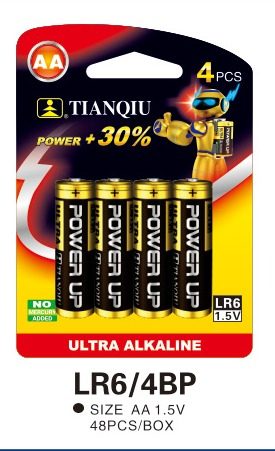
| Alkaline cylindrical cells | LR6, LR03 and 6LR61 | 3 |
| Zinc-carbon cells | R6P, R03 and 6F22 | 3 |
Counts taken from our own declaration register, where each entry carries the model, the reference number and the issue date; the full set is available per model on request.
Alongside the declaration, an order file carries the IEC 60086 test references, the MSDS, and UN38.3 documentation for the lithium models only, since alkaline, zinc-carbon and silver-oxide cells are not dangerous goods. The certificates and documents guide maps each of those to the reader who asks for it, and the EU compliance notes carry the substance, marking and waste statements in the form a procurement reviewer reads them.
Which parts of the regulation leave a primary cell alone?
Four, and knowing them saves a buying team from chasing documents nobody will ask for. Carbon footprint declarations under Article 7 are written for electric vehicle, light means of transport and rechargeable industrial batteries above 2 kWh. Recycled content minimums under Article 8 apply to industrial batteries above 2 kWh, electric vehicle batteries and SLI batteries.
The battery passport in Article 77 covers light means of transport batteries, industrial batteries above 2 kWh and electric vehicle batteries, from 18 February 2027. And the minimum performance values in Article 9 exclude button cells by their own wording, so a hearing-aid or watch cell is not a candidate for a durability threshold. What remains for a primary cell is substances, marking, labelling and the buyer’s own waste registration.
Where the dates and article numbers come from
The calendar above is not our reading of a consultancy summary, and it is not copied from another supplier’s compliance page. Each line can be checked against the same three sources, which are listed so that a buyer, a laboratory or a customs broker can trace a date rather than take it on trust.
- The regulation itself — Regulation (EU) 2023/1542 of 12 July 2023 concerning batteries and waste batteries, published in the Official Journal L 191 of 28 July 2023, ELI
data.europa.eu/eli/reg/2023/1542/oj. Article 96 fixes the general date of application at 18 February 2024, Article 11 at 18 February 2027 and Chapter VIII at 18 August 2025; Articles 9, 11, 13, 59 and 77 and Annexes I and VI supply the rest. - The amendment to the due diligence date — Regulation (EU) 2025/1561 of 18 July 2025, published in the Official Journal of 30 July 2025, which replaces 18 August 2025 with 18 August 2027 in Article 48(1) of Regulation (EU) 2023/1542 and moves the guidelines date in Article 48(5) from 18 February 2025 to 26 July 2026.
- Our own lines and figures — our published product data, the declaration register behind the table above, and the certification matrix that separates seven lithium manganese dioxide models from twenty-two zinc manganese dioxide models.