 TIANQIU
Two questions settle the classification before anyone opens a tariff schedule: can this cell be recharged, and what is inside it. Cells that are used once sit in heading 8506, cells that are charged again sit in heading 8507, and the six-digit number that follows the heading is fixed by the chemistry.
The same two questions apply in every country that uses the Harmonized System, which is the reason a supplier can state a classification for a cell rather than for a shipment. What follows is the code our own lines fall under, checked against the 2026 tariff listings rather than copied from a reseller page.
What is the HS code for a battery?
There is no single code. A cell is classified by whether it stores energy reversibly, which separates accumulators in heading 8507 from primary cells in heading 8506, and then by the chemistry carrying the reaction, which picks the subheading. Size, brand and jacket colour never enter the decision.
The structure is worth knowing because it explains why two suppliers can both be right. The first six digits are international, agreed through the Harmonized System and used identically by every member customs territory. Everything after the sixth digit is national: the European Union and the United States both extend the same six-digit codes, in different ways, which is why a code copied from a foreign invoice may not resolve in your own filing system.
Which heading applies: primary or rechargeable?
The first split is the one buyers most often skip, because a device gives no clue. An alkaline AA and a nickel-metal hydride AA look the same in the hand, and both are sold as AA, yet they fall in different headings, and the description on a commercial invoice has to say which one is inside the carton.
| What is in the consignment | Heading | How to tell them apart |
|---|---|---|
| Cells used once, then discarded | 8506 | The cell or the pack prints a warning against charging |
| Cells that are charged again | 8507 | A charger or a charging circuit is supplied with them |
| Alkaline, zinc-carbon, lithium coin, silver-oxide, zinc-air | 8506 | Every primary chemistry we make |
| Nickel-metal hydride, lithium-ion | 8507 | The accumulator chemistries we make |
Heading 8506 is written for primary cells and primary batteries, whatever the chemistry; heading 8507 is written for accumulators. Our alkaline AA and an NiMH AA of the same size are in different headings for this reason alone.
That distinction also decides who will ask you for documents. A lithium primary cell needs a UN38.3 test summary for transport; the rechargeable cells in 8507 need their own safety file; and the alkaline and zinc-carbon lines need nothing beyond a safety data sheet, because they are not dangerous goods.
Which subheading does each chemistry take?
Inside the two headings the subheadings are named after the chemistry, not after the shape of the can. That means a button cell and a cylindrical cell of the same chemistry share a subheading at six digits, and are separated only where a national schedule chooses to split them.
| Subheading | The chemistry it names |
|---|---|
| 8506.10 | Manganese dioxide — alkaline and zinc-carbon cells, button and cylindrical |
| 8506.30 | Mercuric oxide — the line is still in the nomenclature |
| 8506.40 | Silver oxide — watch and hearing-aid button cells |
| 8506.50 | Lithium — primary lithium, including lithium manganese dioxide coin cells |
| 8506.60 | Air-zinc — hearing-aid button cells |
| 8506.80 | Other primary cells and batteries |
| 8506.90 | Parts of primary cells and batteries |
| 8507.30 / 8507.50 | Nickel-cadmium / nickel-metal hydride accumulators |
| 8507.60 / 8507.80 | Lithium-ion / other accumulators |
| 8507.90 | Parts of accumulators |
Subheadings as listed in the EU Combined Nomenclature for heading 8506 and heading 8507 and in the US tariff schedule; national schedules add further digits below these. We make no mercuric oxide cells — our alkaline button line is declared mercury-free.
The national digits are where a buyer gets caught out. The European Union splits the lithium subheading into cylindrical cells at 8506 50 10 00, button cells at 8506 50 30 00 and other at 8506 50 90, and it does the same for alkaline manganese dioxide, separating cylindrical from other. The US schedule splits lithium primary into a button and coin line against everything else. Both are extensions of the same six digits, so a classification can be consistent and still describe a different line on two invoices.
What code do our own cells ship under?
Every model we publish carries its chemistry in our own product data, which is the input to the table below. Nothing here is inferred from the appearance of the cell: the lithium and alkaline families are separated at the level of the declared chemistry, and the certification matrix behind our certification page uses the same split.
| Our line | Chemistry | Six-digit code |
|---|---|---|
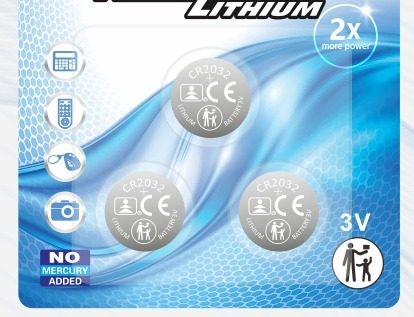
| CR coin cells, CR1025 up to CR2477 | Lithium manganese dioxide | 8506.50 |
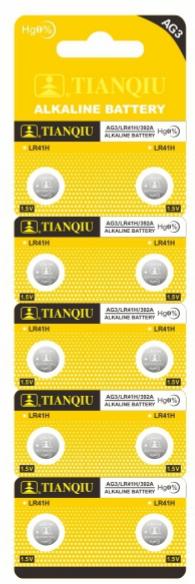
| Alkaline button cells, LR41 up to LR1130 | Zinc manganese dioxide | 8506.10 |
| Alkaline cylindrical, LR6 and LR03 | Zinc manganese dioxide | 8506.10 |
| Zinc-carbon cylindrical, R6P and R03 | Zinc manganese dioxide | 8506.10 |
| 9V and 12V types, 6LR61, 6F22, 23A and 27A | Zinc manganese dioxide | 8506.10 |
| Silver-oxide watch cells | Silver oxide | 8506.40 |
| Zinc-air hearing-aid cells | Zinc air | 8506.60 |
| Rechargeable NiMH AA and AAA | Nickel-metal hydride | 8507.50 |
Six-digit subheadings, taken to national level on the invoice for the destination market. Chemistry per model comes from our published product data; the 23A and 27A 12V cells are stacked alkaline button cells and stay in the manganese dioxide subheading.
Two columns of that table are the ones worth keeping on file. The whole CR line, seven models, is one subheading, so a mixed order of coin cells does not fragment into several codes. And a 9V or a 12V 23A type does not need a code of its own: it is a manganese dioxide cell in a stacked construction, and the description on the invoice says so.
Why is a CR2032 not a lithium-ion battery?
Because a CR2032 cannot be recharged. Lithium-ion batteries are the accumulators in 8507.60; the lithium in a CR2032 names the anode, not the way the cell works, and it is a primary cell in 8506.50. Two different headings share one word, and that is the whole of the confusion.
The practical cost is a delayed entry rather than a debate: the customs description and the packing list disagree with the documentation behind the shipment, and the consignment is held for a correction. It also travels with a different transport file, because our lithium coin cells are UN 3090 when loose and carry a UN38.3 test summary, which no alkaline order has. The rechargeable cell that shares the same 20 mm footprint, the lithium-ion LIR2032, is the opposite case: an accumulator in 8507.60.
Is a battery pack classified by the cells inside it?
Where the pack is no more than cells joined together and cased, customs practice follows the cells. A 2017 US ruling on welded packs built for medical devices classified a pack of manganese dioxide cells in 8506.10 and a pack of lithium cells in 8506.50, while the packs made from lithium-ion and nickel-metal hydride cells went to 8507.60 and 8507.50.
The rule survives because a welded pack does not add a function, only a container. A pack that gains a charging circuit, a case with a connector, or an identity of its own as a device is a different question, and so is a pack holding cells of two chemistries: at that point the answer comes from the essential character of the whole article. That analysis belongs to the importer and the broker, and what we can supply is the chemistry of every cell that goes into the pack.
Does the code change when the cells travel inside a device?
In most cases the device keeps its own heading, and the cells are not declared as a battery consignment at all. A finished article that needs a cell to work is classified as the article, because the cell becomes part of it once it is fitted into the product.
That is why an order that leaves our plant with cells already installed is described by the device rather than by the coin cell inside it. Whether your product is treated that way depends on the article, on how it is packed and on the market filing the entry, so it is not a decision we can take on your behalf. Where the answer matters, the broker who files the entry, or a binding ruling from the customs authority, is the reliable route.
Do the transport rules change with the tariff code?
No. Customs classification and transport classification are separate systems, and neither is derived from the other. The same CR2032 is 8506.50 whether it crosses a border by air or by sea, and its UN number is decided by something else entirely: whether the cells are loose in a carton or fitted inside equipment.
That second system is covered in its own guide. Loose lithium metal cells are UN 3090 and cannot fly as cargo on a passenger aircraft; the same cells fitted in a device are UN 3091; small lithium metal cells move under the sea exemption; and alkaline, zinc-carbon and silver-oxide cells are not dangerous goods and carry no UN number at all. The lithium shipping requirements guide sets out the marks, limits and documents for each mode, and it is the page to send a forwarder.
What has to appear on the invoice and packing list?
Enough for the entry to be filed without a question coming back. In practice that means the model code and the subheading, the chemistry in words, the form of the cell, the quantity with its unit of measure, the net and gross weight of each carton, and the country of origin, which is China for everything we make.
Two details are ours rather than the schedule’s. The description should name the chemistry in words and not only in a model code, because a filing officer reads manganese dioxide far more easily than LR41H; and the marks on the carton should match the packing list line for line, so that a physical check confirms the file instead of reopening it.
The rest of the paper trail is described in the certificates and documents guide, which maps each document to the reader who asks for it: the customs broker gets the invoice, packing list and bill of lading, while the compliance file takes the test reports and declarations. The commercial terms that decide who files the entry, and where the risk sits between the two of us, are set out in our shipping policy.
Can you tell me the duty rate as well?
No, and we would rather say that plainly than print a number that has already moved. A rate is a national decision applied to a classification, and it moves with trade measures, free-trade agreements and the origin of the goods — the same carton can enter one market free and carry a surcharge in another.
Where certainty is needed, most customs authorities issue a binding tariff ruling on request, described against the product and the intended use and valid across the territory that issues it. That request needs exactly what we can provide: the model, the chemistry, the construction and the country of origin. Send us the destination and we will put those details on the quotation, so the ruling can be requested before production rather than after the container is booked.
Where the classification on this page comes from
The headings, the subheadings and the national extensions are not our own convention, and the lines we claim as ours come from our published product data. The list below names the source of each, so a broker, an importer or an auditor can check a code rather than take our word for it.
- The two headings and the subheadings — the Harmonized System, Chapter 85, as published in the Combined Nomenclature of the European Union and reproduced by its TARIC consultation: heading 8506 for primary cells and primary batteries, with the chemistry subheadings 8506.10 manganese dioxide, 8506.40 silver oxide, 8506.50 lithium, 8506.60 air-zinc, 8506.80 other and 8506.90 parts; heading 8507 for accumulators, with 8507.50 nickel-metal hydride, 8507.60 lithium-ion, 8507.80 other and 8507.90 parts.
- The button-cell line inside the lithium subheading — the same TARIC listing, which gives lithium button cells their own code at 8506 50 30 00 against cylindrical cells at 8506 50 10 00.
- The button and coin split used in the United States — the US Harmonized Tariff Schedule entries for heading 8506.50, which separate button and coin cells from other lithium primary cells inside the same subheading.
- Packs classified by the cells inside them — US Customs ruling NY N286124 (2017) on welded battery packs for medical devices: manganese dioxide cells to 8506.10, lithium cells to 8506.50, lithium-ion to 8507.60 and nickel-metal hydride to 8507.50.
- Our own lines and chemistries — our published product data and the certification matrix: 7 lithium manganese dioxide models, 22 zinc manganese dioxide models, and the silver-oxide and zinc-air lines published on our watch and hearing-aid pages, with mercury-free alkaline button cells throughout.
- What we do not publish — duty rates, preferential rates and any measure applied to a specific origin. Those are national, they change, and they are applied to a classification rather than replacing one.