 TIANQIU
Lithium cells are Class 9 dangerous goods, and the paperwork that decides whether a pallet moves or sits at the freight desk is short: one or two pages that name a cell design and show it survived a defined series of transport tests. Buyers meet it under a few different names — UN38.3 summary, UN 38.3 report, transport test summary — and it is the document a forwarder, an airline or a marketplace compliance team asks for by name.
Two misunderstandings around it cost orders time. The first is expecting it for chemistry that is not lithium, where no such document can exist. The second is treating it as a certificate of quality, when what it establishes is narrower: that a design passed the tests in the UN transport manual. Both are worth clearing up before an order is placed rather than after a container is booked.
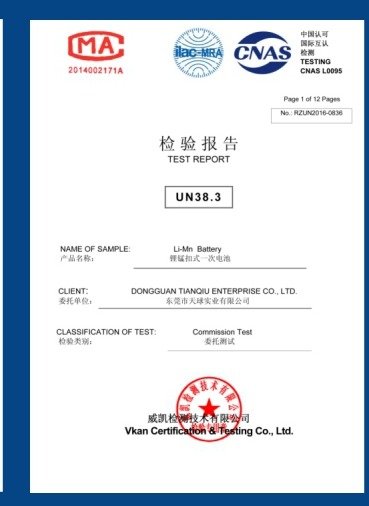
What is a UN38.3 test summary?
A UN38.3 test summary is a short standardised record, defined in paragraph 38.3.5 of the UN Manual of Tests and Criteria, that names the lithium cell or battery design that was tested, the manufacturer, the laboratory, the report behind it, the edition of the Manual applied, and the pass or fail result of each applicable test.
The name comes from where the requirement sits. Part III, sub-section 38.3 of the Manual of Tests and Criteria (ST/SG/AC.10/11) is the testing annex to the UN Model Regulations on the Transport of Dangerous Goods, and it is the section that a lithium cell has to satisfy before it can travel under the ordinary entries for lithium batteries. Every lithium metal and lithium ion design offered for transport is expected to have passed it.
The document itself exists because the full test report is not meant to circulate. Manufacturers and subsequent distributors of cells and batteries are expected to keep a summary available — the UN wording covers cells manufactured after 30 June 2003, the United States text in 49 CFR 173.185 covers cells manufactured on or after 1 January 2008, and both carve out button cells installed in equipment. Availability is what is required, not enclosure with every consignment, and the guidance encourages electronic distribution, which is why suppliers issue the summary as a download or a code on the pack rather than a printed sheaf in the carton.
What are the eight UN38.3 tests?
Eight tests make up the programme, and a summary should show a result against each one that applies to the design being bought.
| Test | What it simulates | Applies to |
|---|---|---|
| T.1 · Altitude simulation | Air transport under low pressure — held at 11.6 kPa or less for at least six hours at 20 ± 5 °C | Cells and batteries |
| T.2 · Thermal test | Rapid temperature cycling between hot and cold extremes | Cells and batteries |
| T.3 · Vibration | Sinusoidal vibration across three axes, as in road and rail transit | Cells and batteries |
| T.4 · Shock | Half-sine mechanical shocks across three axes | Cells and batteries |
| T.5 · External short circuit | A short circuit applied with the sample at elevated temperature | Cells and batteries |
| T.6 · Impact or crush | Mechanical abuse of the cell case — crush for a coin cell, impact or crush by geometry | Cells and component cells |
| T.7 · Overcharge | Charging at twice the maximum continuous charge current | Rechargeable batteries only |
| T.8 · Forced discharge | Forced discharge from a 12 V DC supply at the maximum discharge current | Cells |
Test numbering and titles follow sub-section 38.3 of the UN Manual of Tests and Criteria; the conditions quoted for T.1 and T.8 are the ones written into the test procedures.
Two features of the programme decide how a summary reads. T.1 to T.5 are run in sequence on the same samples, so the results are linked rather than independent. T.7 is a rechargeable-battery test, which is why the summary for a primary CR coin cell normally shows overcharge as not applicable while T.1 to T.6 and T.8 carry results.
What must a UN38.3 test summary contain?
The content list is fixed, and a summary that omits part of it is incomplete however good the test results were.
| Item | What it identifies | Why a buyer checks it |
|---|---|---|
| (a) and (b) | The manufacturer of the cell, battery or product, and its contact details | Tells you whether the document came from the cell maker or from a reseller of the cell |
| (c) and (d) | The test laboratory and a unique report reference | Lets a carrier trace the summary back to a report that exists |
| (e) | The date of the report | Places the test in time relative to the design that was ordered |
| (f) (i) to (v) | Description of the device under test: type, mass, watt-hour rating or lithium content, physical description, model numbers | The line where the summary either matches your part number or does not |
| (g) | List of tests conducted with a pass or fail result against each | Shows which of the eight were run, not merely that testing happened |
| (h) | Reference to the assembled battery requirements, 38.3.3 (f) and (g), if applicable | The item that matters when you buy a pack rather than bare cells |
| (i) | The revised edition of the Manual of Tests and Criteria that was applied, with any amendments | Establishes which vintage of the programme the result belongs to |
| (j) | Signature with the name and title of the signatory | Fixes responsibility for the statements on the page to a person |
Item lettering follows the test summary template published in the lithium battery transport guidance; the commentary column is ours, and reflects the three checks that most often turn up a mismatch during buyer due diligence.
The description line is the one to read first. For lithium metal cells it carries a lithium content figure in grams rather than a watt-hour rating, because the watt-hour measure belongs to rechargeable lithium ion designs — so a summary for a coin cell shows a small mass of lithium and a cross against the watt-hour field, and that is normal rather than a gap.
Is UN38.3 the same as a test report, an MSDS or a certificate?
Four documents end up in the same folder, and only one of them is what the transport rules define as the summary.
| Document | What it is | Who it is for |
|---|---|---|
| Test summary | The standardised extract defined in 38.3.5 — design, laboratory, edition, test results, signatory | Carriers, forwarders, marketplaces, and you |
| Test report | The full record of the testing, including the raw results behind each test | Competent authorities on formal request; not circulated |
| MSDS / SDS | Chemical safety data for the substance shipped, in the format the destination requires | Forwarder, insurer, customs |
| A compliance certificate | A third party's attestation to a product standard, such as IEC 60086 or IEC 62133 | Tenders, retailers, regulators |
Transport testing is not product certification and neither replaces the other: one establishes that a cell design can be moved, the other that the cell is sound as a product.
The word certificate is the one to treat carefully. Neither the UN Manual nor the national texts built on it define a UN38.3 certificate; they define a test report and the summary drawn from it. When a document arrives under that name, the useful questions are the ones on the content list above — which design is named, which laboratory ran it, which edition was applied, and who signed.
Which of our cells does UN38.3 apply to?
Lithium only, which for our lines means one line in and two out.
| Line | UN numbers | UN38.3 position |
|---|---|---|
| Lithium coin cells, Li-MnO₂ (CR series) — 7 models: CR1025, CR1220, CR2016, CR2025, CR2032, CR2450, CR2477 | UN 3090 shipped alone; UN 3091 packed with or contained in equipment | Applies — summary available per model |
| Lithium packs assembled from our cells, including Li-ion modules | UN 3090 / 3091 for lithium metal; UN 3480 / 3481 for lithium ion | Applies — cell and assembly references covered |
| Alkaline button and cylindrical, Zn-MnO₂ — 22 models including LR44, LR41, LR754 and the 6F22 block | Not applicable — not dangerous goods of this class | Does not apply — no report exists |
| Silver oxide coin cells (SR / LR watch numbers) | Not applicable | Does not apply — no report exists |
The model counts are the ones in our own product data, the same figures the certification matrix renders. The UN numbers are the entries the Model Regulations assign to lithium metal and lithium ion batteries.
This is the mismatch we are asked about most often, so it is worth saying plainly: if a supplier offers a UN38.3 report against an alkaline or silver-oxide order, that document did not come from testing the cell you are buying. The safety document for those chemistries is IEC 60086-5, on top of the framework and specification parts, alongside a per-model EU declaration — which is what the certification matrix sets out line by line.
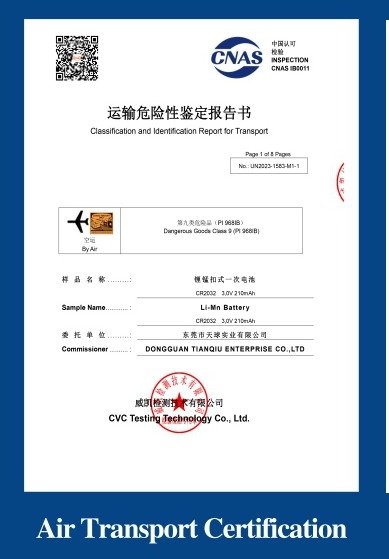
Do button cells need UN38.3?
The answer turns on whether the coin cell is shipped loose or already fitted to a device, and the two cases are treated differently.
- Shipped on their own, as bare cells. This is how a coin-cell order normally moves, and the cell is a lithium metal cell offered for transport under UN 3090. The design has to have passed the tests and the summary has to be available on request. Our seven CR models are covered on that basis.
- Installed in equipment, including circuit boards. Where the only button cells in a package are already fitted to equipment, both 49 CFR 173.185 and the IATA guidance except them from the duty to make a test summary available. The lithium battery mark is also not required for a package whose only cells are button cells installed in equipment, or for a consignment of two packages or fewer holding no more than four cells or two batteries installed in equipment.
For an OEM order the distinction matters commercially rather than academically. Cells we supply loose need the transport file; the same cells that reach a buyer already inside a key fob, a watch or a board may not, which is one reason a device programme can move faster than the component shipment it depends on. A button cell is defined in the guidance as a small round cell whose overall height is less than its diameter — the shape our coin cells, and the retail numbers under them, follow.
What should a buyer check on a supplier’s summary?
Five checks catch nearly every problem, and all five can be done from the page itself.
- Match the model numbers. The description item lists the models covered, sometimes including equivalent part numbers of the same type. The design on the paper has to be the design on the purchase order.
- Confirm which tests were run. A pass against each applicable test is the point of the document; overcharge shown as not applicable is expected for a primary cell, but a missing forced-discharge line is not.
- Read the edition. The summary names the revision of the Manual applied. An older edition is not automatically wrong, but it should be a conscious answer to a question rather than something you notice later.
- Check the lithium content or watt-hour figure. It should be plausible for the cell in front of you, and it is the fastest way to spot a summary reused across unrelated products.
- Look for the signature. The name and title of the signatory is part of the required content; a summary that ends without one is a page of assertions without an owner.
The certificates and documents guide places these papers next to the factory certificates and customs documents that travel with the same order, and the IEC 62133 guide covers the product-safety standard that rechargeable chemistry is assessed against instead.
How do you get the summary for an order?
Tell us at the enquiry stage whether the order is bare cells or an assembled pack, since a pack brings the battery assembly references into scope, and whether the cells will ship loose or installed. First orders with us begin at 50 cartons per product line, and the document pack is prepared per model rather than per order, so the papers for a mixed carton follow the models inside it. The shipping policy sets out what accompanies a shipment and what we send ahead of it.
Where every claim here comes from
Every figure and every rule above can be traced to a named text, and where the statement concerns our own lines it comes from our published data.
- The test programme, the test numbers and the conditions quoted — sub-section 38.3 of the UN Manual of Tests and Criteria, Part III, including the altitude condition for T.1 and the 12 V supply for T.8.
- The content list for the summary and its lettering — the test summary template in paragraph 38.3.5 of the same Manual, as published in the lithium battery transport guidance.
- The duty to make a summary available, and the button-cell exception — 49 CFR 173.185 for the United States, and the UN wording carried in the IATA guidance, which also sets out the marking exceptions for button cells installed in equipment.
- UN 3090, UN 3091, UN 3480 and UN 3481 — the entries the UN Model Regulations assign to lithium metal and lithium ion batteries.
- The change limits that make a design a new type — paragraph 38.3.2.2 of the Manual.
- Seven CR models, twenty-two Zn-MnO₂ models, the per-model EU declarations and the standards declared against each line — our own product data, the same figures rendered on the certification matrix.