 TIANQIU
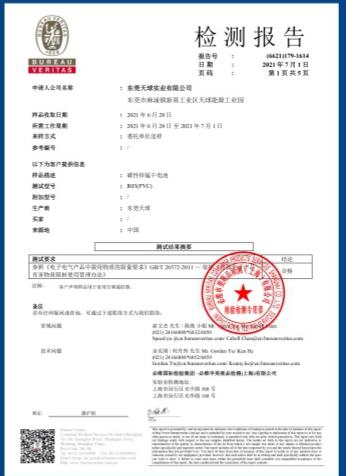
IEC 62133 is quoted in almost every rechargeable battery inquiry we receive, and it is quoted loosely. A buyer asks for “the 62133 report”; a supplier sends a certificate for a different chemistry, an older edition, or the assembled pack rather than the cell inside it.
This guide sets out what the standard actually is, which of its two parts applies to which chemistry, what it deliberately leaves out, and the six things worth confirming before a safety report becomes part of your purchase file.
What is IEC 62133?
IEC 62133 is the international safety standard for portable sealed secondary (rechargeable) cells and batteries containing alkaline or other non-acid electrolytes. It specifies requirements and tests for safe operation under intended use and reasonably foreseeable misuse. Since the 2017 revision it has been published in two parts: Part 1 for nickel systems and Part 2 for lithium systems.
Both parts carry the same long title and differ only in their subtitle, which is why the part number is the meaningful half of the reference. It is a cell-and-battery standard rather than an end-product standard — its own scope notes that it is not, by itself, generally suitable for evaluating the safety of a finished device — and it is the document a test laboratory works to when it issues a CB test report for a rechargeable battery.
For a buyer the practical question is not “do you have 62133?” but “which part, which edition, and does it name the cell or pack I am buying?”
Which part applies: IEC 62133-1 or IEC 62133-2?
The chemistry decides, not the format. A sealed nickel cell — NiMH or NiCd, including the rechargeable AA and AAA cans — is tested to Part 1; a sealed lithium cell with a non-acid electrolyte is tested to Part 2. A button cell, a cylindrical can, a prismatic cell and a battery assembled from any of them are all judged by the chemistry inside them.
| Part | Systems covered | Current edition | Applies to | In our range |
|---|---|---|---|---|
| IEC 62133-1 | Nickel systems | 2nd edition, 2026 — the 2017 first edition was withdrawn on 6 March 2026 | Sealed NiMH and NiCd cells and batteries with alkaline electrolyte | Rechargeable AA and AAA cells — HR6 and HR03 — and nickel packs |
| IEC 62133-2 | Lithium systems | 1st edition, 2017; consolidated with Amendment 1, 2021 | Sealed lithium cells and batteries with non-acid electrolyte | Lithium-ion battery packs built to a customer specification, with BMS |
Both parts were issued on 7 February 2017 and together replaced the second edition of IEC 62133 published in 2012 — the nickel systems were separated into Part 1 and the lithium systems into Part 2.
What changed when IEC 62133 was split in 2017 — and since?
The 2017 revision turned one standard into two and refreshed what each part asks for. Two things matter to a buyer: button and coin cells were brought into the requirements explicitly, and the way cells are assembled into a battery was updated — the clause relating to the assembly step is one reason a cell report is not the same document as a battery report.
Part 1 has moved again since: its second edition, IEC 62133-1:2026, was published on 6 March 2026 and replaced the 2017 text, so a nickel-system order placed now has to establish which of the two it is buying against.
| Edition | What it introduced |
|---|---|
| IEC 62133-1:2017 | Separation of the lithium systems into a separate Part 2; inclusion of button cell requirements |
| IEC 62133-1:2026 | Second edition of Part 1 — the definitions of 'secondary battery', 'portable battery' and 'portable cell' removed; 'room temperature' replaced by 20 °C ± 5 °C in 7.2.3; Figure 1 modified |
| IEC 62133-2:2017 | Separation of the nickel systems into a separate Part 1; inclusion of coin cell requirements; update of the assembly of cells into batteries; mechanical tests for vibration and shock; IEC TR 62914 added to the bibliography |
| IEC 62133-2:2017 + A1:2021 | Amendment 1, consolidated in the 2021 edition of Part 2 |
Paraphrased from the abstracts IEC publishes for each part. A report whose stated basis is 'IEC 62133:2012' rests on the superseded edition that the two parts replaced.
What does IEC 62133-2 test on a lithium system?
Part 2 works through a defined charging procedure and then tests the cell or battery in two groups: behaviour in normal use, and behaviour under reasonably foreseeable misuse. The second group is the reason the standard exists — external short circuit at cell and battery level, free fall, thermal abuse, crush, overcharge and forced discharge are cases a lithium cell has to survive or fail predictably.
The normal-use block covers continuous charging and enclosure stress, and the 2017 edition added mechanical tests for vibration and shock. The standard also sets out how cells are assembled into a battery, which is the step where a pack differs from the bare cell. The thresholds and acceptance criteria live in the standard text itself, so the part of a report a buyer should read is the conclusion line per test rather than the cover page.
What does IEC 62133-1 test on a nickel system?
Part 1 applies the same intent to sealed nickel cells and batteries: requirements and tests for safe operation under intended use and reasonably foreseeable misuse. It is the part that covers the rechargeable AA and AAA cans most buyers are ordering, where the rechargeable designation is HR6 or HR03 and the single-use alkaline counterpart of the same can is LR6 or LR03.
That distinction is exactly where inquiries go wrong. A NiMH order is a nickel system, so it is a Part 1 question; a Part 2 lithium report cannot stand in for it, however similar the two documents look. The designations, the 1.2 V nominal voltage and the capacity bands for those cans are covered in the NiMH rechargeable guide, and the formats available in the rechargeable range.
Which batteries are outside IEC 62133?
Single-use cells are outside the standard altogether. Alkaline, zinc-carbon, lithium coin and zinc-air primary cells are governed by the IEC 60086 series, which fixes dimensions, designation, performance and the safety requirements for each chemistry. Also outside: cells for industrial and stationary applications, vehicle traction batteries, and the finished device the cell is fitted into.
| What you are buying | What applies instead |
|---|---|
| Primary (single-use) cells — LR6, LR03, CR2032, 6LR61, zinc-air | IEC 60086 series — dimensions, performance and safety by chemistry |
| Sealed nickel secondary cells and batteries | IEC 62133-1 |
| Sealed lithium secondary cells and batteries | IEC 62133-2 |
| Cells for industrial and stationary applications | IEC 62619 |
| Vehicle traction batteries | Standards for traction batteries |
| The finished device | The end-product standard — IEC 62133 is a cell and battery standard |
Our own primary lines are declared to IEC 60086-1, -2, -3, -4 and -5 model by model; which standard each line carries is set out on the certifications page rather than assumed from the family name.
How does IEC 62133 relate to the CB Scheme and national adoption?
IEC 62133 is operated under the IECEE CB Scheme, so a single test report can be recognised across member countries, and each country adopts the text under its own reference with its own national differences. Part 1 entered the IECEE system on 3 April 2017 and Part 2 on 18 May 2017.
| Country | National reference listed by IECEE |
|---|---|
| Canada | CAN/CSA E62133:13 (Part 1) · CSA C22.2 No. 62133-2:20 (Part 2) |
| United States | ANSI/UL 62133-2-2024 (Part 2) |
| Japan | J62133-2(2021) (Part 2) |
| Saudi Arabia | SASO-IEC-62133-1 · SASO-IEC-62133-2 |
The adopters IECEE lists for each part, each carrying national differences. In Europe the same text is adopted as EN 62133-1 and EN 62133-2 — the reference a lithium battery's CE file will name.
The takeaway for an order is that a report has to name three things to be useful: the part, the edition, and the national differences of the market you sell into. A document that says only “IEC 62133” is missing all three.
Is IEC 62133 the same as UN38.3?
No — they answer different questions. IEC 62133 is a product safety standard: it tests a sealed rechargeable cell or battery against misuse. UN38.3 is a transport test: it establishes that a lithium cell can be shipped by air or sea. A lithium pack order commonly needs both, and neither replaces the other.
| Question | IEC 62133 | UN38.3 |
|---|---|---|
| What it establishes | Safe operation under intended use and foreseeable misuse | Safe transport of a lithium cell by air or sea |
| Applies to | Sealed secondary cells and batteries — nickel (Part 1) or lithium (Part 2) | Lithium cells and batteries |
| Document issued | Test report and CB test certificate | Test summary and test report |
| Single-use cells | Outside the standard entirely | Not applicable — the cell is not lithium |
The split matters at the shipment stage: our own UN38.3 position is lithium lines only, and there is no UN38.3 report for an alkaline or silver-oxide cell. The transport paperwork for air and sea freight is covered in the baggage and shipping guide.
What should an order ask for?
Six confirmations turn a vague request for “the 62133 certificate” into a document that actually covers your purchase:
- The part — nickel system or lithium system. Chemistry decides, and it is the first thing a supplier should be able to state without checking.
- The model — the report should name your cell or pack, not the family it belongs to.
- The edition — IEC 62133-1:2026 for nickel systems (the 2017 edition is withdrawn), or IEC 62133-2:2017 with Amendment 1 where that version has been adopted.
- The level tested — the cell alone, or the assembled battery. The 2017 edition updated the assembly step, so the two are not the same report.
- The national differences — the reference the report follows for the market you are selling into, from the table above.
- The model list the document covers — so the cell you receive is inside the scope of the paper filed against it.
Tell us the cells or packs in your project and the market you are selling into, and we will confirm which part applies to those models and what documentation travels with them. The certifications page sets out our lines, each model’s declared standards and how to request the document pack; the EU compliance page covers the per-model declaration side. First orders run from 50 cartons per product line, with samples built against the signed specification.
Where the figures on this page come from
The standard titles, the change lists, the issue dates and the IECEE inclusion dates are as published by the IEC and by the IECEE CB Scheme for IEC 62133-1, including the 2026 second edition that replaced the 2017 text, and for IEC 62133-2:2017; the national adopter references are the ones IECEE lists for each part. The statements about our own lines come from our published certification matrix. Nothing on this page is presented as a test result or a certificate we hold for a specific model — those documents are issued per model, and we will tell you which ones apply to the cells you are ordering.