TIANQIU
Rechargeable batteries are the part of the range where the label and the buyer’s expectation drift apart most often. The cell a buyer pictures is “an AA, in rechargeable”, but a rechargeable AA is not a 1.5 V cell with a different can: it is a 1.2 V nickel-metal hydride cell with its own IEC designation, its own endurance requirement and its own documentation.
This is the specification side of that range: what the standard fixes, which numbers move against each other, and what an OEM or wholesale order for a rechargeable line has to state.
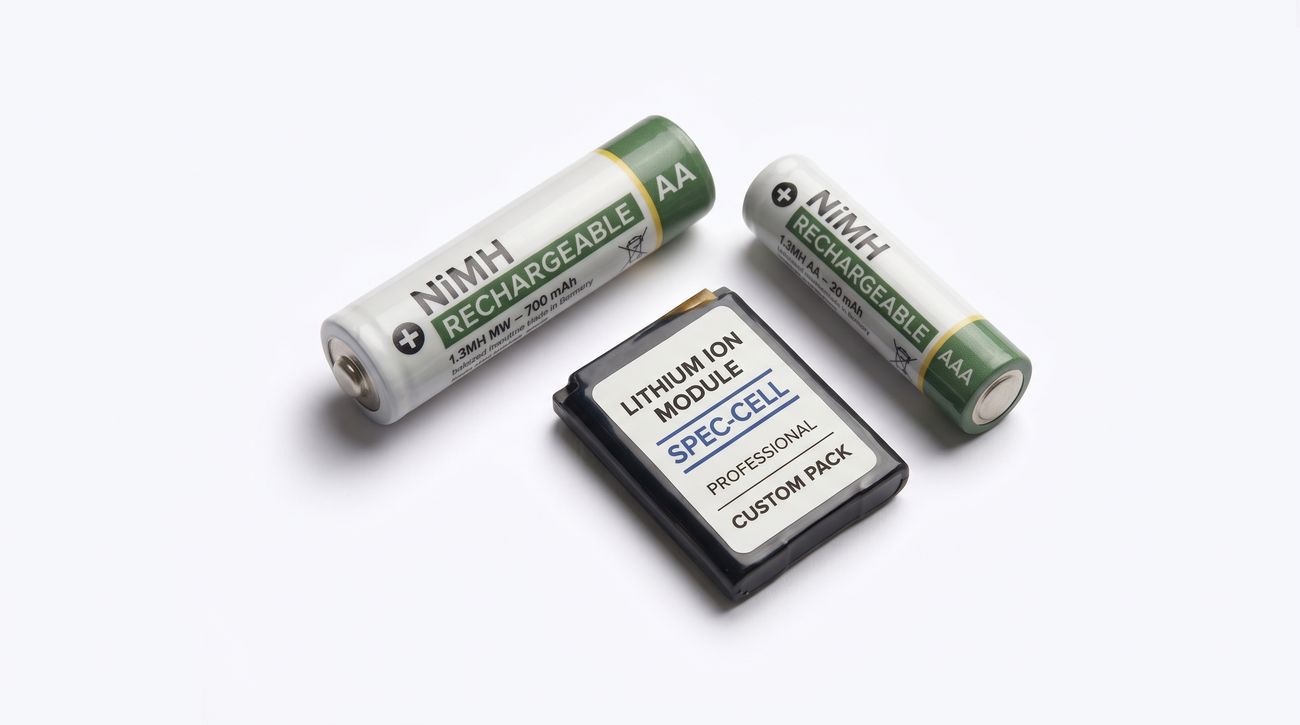
What is a NiMH rechargeable battery?
A NiMH (nickel-metal hydride) battery is a sealed rechargeable cell with an alkaline electrolyte whose nominal voltage is 1.2 V per cell, as defined in IEC 61951-2. In the AA can its designation is HR6 and in the AAA can HR03 — the rechargeable counterpart of the LR6 and LR03 codes carried by the single-use cells of the same size.
The chemistry replaced nickel-cadmium in most consumer applications, which is why the rechargeable cells on retail shelves today are almost all NiMH. The standard that governs the range — marking, designation, dimensions, tests and requirements — is IEC 61951-2, and it is written for portable sealed cells in the cylindrical, prismatic and button formats.
| Size | Rechargeable — IEC 61951-2 | Single-use — IEC 60086 | Nominal voltage |
|---|---|---|---|
| AA | HR6 | LR6 (alkaline) · R6 (zinc-carbon) | 1.2 V rechargeable · 1.5 V single-use |
| AAA | HR03 | LR03 (alkaline) · R03 (zinc-carbon) | 1.2 V rechargeable · 1.5 V single-use |
| C | HR14 | LR14 (alkaline) | 1.2 V rechargeable · 1.5 V single-use |
| D | HR20 | LR20 (alkaline) | 1.2 V rechargeable · 1.5 V single-use |
The letter pair tells you what you are holding: H identifies the nickel-metal hydride system, R the cylindrical shape code; LR6 is the single-use alkaline cell of the same size and R6 the zinc-carbon one. Our rechargeable programme runs on the AA and AAA formats — the model list for a project is confirmed with the data sheet.
What voltage is a NiMH cell, and what does the label declare?
1.2 V is the nominal voltage of a single NiMH cell. It is the value the cell is identified and designed by, not the voltage it reads off the charger: nominal, open-circuit and cut-off voltage are three different numbers, and the label carries the nominal one. Series connections multiply it exactly.
| Cells in series | NiMH nominal (1.2 V each) | Alkaline nominal (1.5 V each) | Typical case |
|---|---|---|---|
| 1 | 1.2 V | 1.5 V | Single cell |
| 2 | 2.4 V | 3.0 V | Two-cell device, small remote |
| 3 | 3.6 V | 4.5 V | Three-cell flashlight |
| 4 | 4.8 V | 6.0 V | Four-cell toy or lantern |
| 6 | 7.2 V | 9.0 V | 9 V alkaline block (6LR61) |
| 7 | 8.4 V | — | 9 V rechargeable block |
Arithmetic of the label, not a performance claim: a battery's nominal voltage is the cell's nominal voltage multiplied by the number of cells in series. The same case can hold six alkaline cells or seven NiMH cells and still be sold as a 9 V block.
Whether a device tolerates the lower nominal voltage is a device question, not a cell question, and it is covered in the alkaline versus rechargeable comparison. The voltages above, the cut-off values and the chemistry-by-chemistry table sit in the battery voltage guide.
Which designation goes on the order: HR6 or LR6?
HR6 and LR6 are the two codes most often swapped in an inquiry, and the swap produces the wrong cell. LR6 is the primary alkaline AA; HR6 is the rechargeable nickel-metal hydride cell in the same envelope. They share a holder and the same 1.5 V-versus-1.2 V difference in nominal voltage, and nothing else — the coded order is the one that prevents a production run of the wrong chemistry.
The designation is also what the cell itself has to carry. IEC 61951-2 requires a cell to be durably marked with its designation, its polarity, the date of manufacture (a code is acceptable) and the manufacturer’s name or registered trademark. A battery — the assembled pack, not the cell — carries its rated capacity, nominal voltage, date of manufacture and a chemistry identification under IEC 62902.
For an OEM order that marking is not a detail: if your brand goes on the cell or the pack, the mandatory marks and your artwork have to coexist on the same surface, and the designations are what a customs or retail reviewer reads first. Our certification matrix sets out which documents travel with which product line.
How much capacity should a rechargeable AA or AAA have?
Capacity in milliampere-hours (mAh) is the charge a cell can deliver on a defined discharge, and it is only meaningful together with the conditions it was measured at. IEC 61951-2 measures discharge performance at 20 °C, and the low-rate reading is taken at 0.2 It to a 1.0 V cut-off — so two cells quoted at different rates, temperatures or cut-off voltages are not being compared at all.
That is why the first question to ask about a “3,000 mAh AA” is which test produced the number, and why we quote declared capacity on the data sheet with the cell in hand rather than on a web page. Ask for the data sheet with your inquiry and we return the declared capacity, the test basis and the dimensions.
High capacity, or low self-discharge?
This is the real decision in a rechargeable line, because the standard itself treats the two ends of the range differently. IEC 61951-2’s endurance requirement for cylindrical cells that are dimensionally interchangeable with the AA and AAA primary cans is 200 cycles below a capacity line and 100 cycles at or above it.
| Cell | Standard-capacity band | High-capacity band | Endurance the standard requires |
|---|---|---|---|
| AAA · HR03 | Below 800 mAh | 800 mAh or more | 200 cycles · 100 cycles |
| AA · HR6 | Below 2,100 mAh | 2,100 mAh or more | 200 cycles · 100 cycles |
Read it as the standard's own statement of the trade-off: pack more capacity into the same can and the endurance requirement halves. Cells in the high-capacity band are the right answer when runtime per charge matters most; the standard-capacity band is the right answer when the cell will be cycled hard for years.
Self-discharge is the other lever. A standard NiMH cell loses its charge over months of storage, which is why the 2022 amendment to IEC 61951-2 added an “I” designation for the low self-discharge type (and an “F” designation for high-recovery cells) — the property is a marked cell type now, not a slogan. A low self-discharge cell is what you specify when the product sits before use: retail stock on a shelf, a spare set in a drawer, a device charged by a small solar panel.
How long does a rechargeable battery last?
Two clocks run at once. The cycle count is how many charge and discharge cycles the cell survives, and the standard’s minimums are the table above — 200 cycles for a standard-capacity AA or AAA, 100 for a high-capacity one; a well-matched charger and a shallow discharge are what keep a cell at the good end of that range. The calendar clock is how long the cell holds a useful charge while it is not being used, which is where self-discharge decides.
Temperature affects both. The window quoted for AA/AAA NiMH cells is 0 °C to +40 °C for charging and 0 °C to +50 °C for discharging (the figure carried on the cell data sheet); charging a cell below freezing is where a rechargeable product is most often damaged, and the behaviour of different chemistries in the cold is set out in our guide to batteries in freezing conditions.
Does a NiMH cell need a special charger?
Yes — a charger built for NiMH cells. Charging a sealed cell is a controlled process, which is why IEC 61951-2 tests charge acceptance, overcharge and permanent-charge endurance, and defines rapid-charge (R) cells with their own discharge tests. A charger designed for a different chemistry, or for a different cell count, will either undercharge the cell or heat it, and a cell that is charged outside its published temperature window ages faster than its cycle rating suggests.
USB-rechargeable cells take the charger question off the table: the charging circuit is built into the cell, so the product charges from any USB port with no separate charger. Those are a separate line in our range — the USB rechargeable page covers the formats. One rule is absolute in either case: a primary cell, alkaline or lithium, must never be put in a charger, and the reasons are covered in the leakage guide.
Does a NiMH battery need UN38.3?
No. UN38.3 is the lithium transport test, and lithium is the only line in our range where it applies — a NiMH cell is a nickel system, not a lithium one. The safety requirements for the rechargeable range come from IEC 62133-1, which covers portable sealed nickel systems, while lithium secondary cells are covered by Part 2 of the same series, IEC 62133-2.
For the EU market the Regulation (EU) 2023/1542 documentation set applies per model, and the same principle as our primary cells holds: tell us the cells in your project and we return the current declaration and information file for those models. Which document answers which question — factory certificates, product test reports, customs papers and the EU file — is set out in our certificates and documents guide and the EU compliance page.
What should an OEM order for a rechargeable line specify?
The cells, the capacity basis and the product they go into. An inquiry that carries these six lines gets a quotable answer the same day:
- Designation and size — HR6 or HR03, plus the envelope you need (a plain AA-size cell, or a cell with solder tabs for a pack).
- Declared capacity and the test basis — the mAh you are targeting, and whether it is the standard-capacity or high-capacity band from the table above.
- Self-discharge type — standard, or the low self-discharge “I” type if the product will sit before its first charge.
- Cell or pack — single cells for a retail range, tagged or tabbed cells for a device manufacturer, or a finished pack built to your voltage.
- Packaging and brand — bulk carton, blister card or printed box, and whether your brand is printed on the cell itself.
- Market and quantity — the countries you are selling into, because the marking and documentation set follows the market.
We build the rechargeable range on our own lines under ISO 9001, alongside the primary cells, so a program can carry AA and AAA alkaline, button cells and rechargeable cells from one supplier and one documentation file set. The order mechanics are the same as the rest of the range: samples built after the specification is signed off — usually one to two weeks — and first orders from 50 cartons per product line, with the MOQ arithmetic explained in the MOQ guide. Packaging formats, artwork and the proof cycle are on the private-label guide, and the full process from spec to shipped container is on the OEM / ODM page.