 TIANQIU
A smoke alarm battery is not a general-purpose purchase, even though the cells behind it are ordinary ones. Most household alarms run on a 9V block, one to three AA cells, or a sealed 10-year lithium pack — and the only cell an alarm will thank you for is the type printed on its own label. This guide sets out which cell goes where, how the 9V codes work, how long each one really lasts, and what a buyer sourcing 9V and AA cells for an alarm programme has to document.
What battery does a smoke alarm take?
Three formats cover almost every household smoke alarm: a replaceable 9V block, one to three AA cells, or a sealed 10-year lithium pack. Hardwired alarms usually keep a 9V or AA cell as their backup. The back label and the manual name the exact cell, and that is the one to buy.
The format is decided by the alarm’s own holder, not by preference: a 9V alarm ends in a snap connector with two prongs, an AA alarm has slots for one to three cylindrical cells, and a sealed alarm has no accessible compartment at all. First Alert’s advice is the same one the format implies — 9V was the battery of choice for many years, and two or three AA cells are now more common, so read the label before you buy a replacement.
| Alarm type | Cell it takes | What the user replaces |
|---|---|---|
| Battery-only, 9V | 9V block — IEC 6LR61 (alkaline) or 6F22 (zinc-carbon) | The 9V cell, at least once a year |
| Battery-only, AA | One to three AA cells — IEC LR6 | The AA cells, at least once a year |
| Sealed 10-year unit | Lithium pack, non-replaceable by design | Nothing — the whole alarm at 10 years |
| Hardwired with backup | 9V block or AA cells as the standby supply | The backup cell, at least once a year |
Maintenance intervals follow the U.S. Fire Administration's household guidance and the alarm makers' own instructions; the label on your unit decides which row applies.
Why does the alarm maker’s specified cell matter?
Because the alarm is built around the cell’s voltage curve and capacity, not around the case size. A smoke alarm’s low-battery signal is timed to the drain of the cell it ships with, so a lower-capacity chemistry fitted into the same holder can shorten the warning window rather than extend it.
Two habits matter more than any brand argument:
- Fit the chemistry the manual lists. A 9V holder accepts alkaline, zinc-carbon, NiMH and lithium blocks alike — they are the same size, and they are not interchangeable in a life-safety device. The device only has to survive one fire, and it is judging the cell by its discharge curve.
- Do not mix cells within one alarm. In a multi-cell alarm, cells of different brands, ages or states of charge share the load unevenly, and the weakest one sets the runtime. Replace the whole set at once.
- A chirp is a battery message, unless the unit is old. A repeating chirp means low battery; on a unit that is ten years old or more, the makers’ and NFPA guidance is to replace the alarm itself, because the sensor has reached its rated life.
How do you read a 9V designation — 6LR61, 6F22, 1604A or PP3?
They are four naming systems for one case size, and only the IEC code tells you the chemistry. IEC 6LR61 is the alkaline block, IEC 6F22 is the zinc-carbon block, ANSI/NEDA 1604A and 1604D are their American designations, and PP3 or 006P describe the case. Buy by the IEC code and the chemistry stops being a guess.
| What you see printed | What it means | Where we verified it |
|---|---|---|
| IEC 6LR61 (also printed 6LF22) | Alkaline 9V block — 9.0 V nominal | Energizer 522 datasheet (also prints ANSI 1604A) · Duracell MN1604 datasheet (ANSI 1604A, IEC 6LR61) |
| IEC 6F22 | Zinc-carbon 9V block — 9.0 V nominal | Eveready 1222 datasheet (ANSI 1604D, IEC 6F22) · Varta Super Heavy Duty, IEC reference 6F22 |
| ANSI / NEDA 1604A | The alkaline designation | Energizer 522 · Duracell MN1604 |
| ANSI / NEDA 1604D | The carbon-zinc designation | Eveready 1222 |
| ANSI 1604LC | Lithium 9V (Li-MnO2) — not a line we make | Energizer L522 datasheet |
| PP3 · 006P · transistor battery | Trade names for the same case — no chemistry implied | Common retail usage; the IEC code is the one that binds |
Every designation above is quoted from a manufacturer datasheet (Energizer 522 / 1222 / L522, Duracell MN1604, Varta Super Heavy Duty). The case is a maximum of 48.5 × 26.5 × 17.5 mm with a miniature snap terminal, which is why an outright wrong cell will still clip on.
That last point is the practical risk. A 9V holder is mechanically forgiving — the terminal is a snap, so a zinc-carbon block, an alkaline block, a NiMH block and a lithium block all fit the same alarm. What separates them is what is inside, and that is exactly what the IEC code on the can tells you.
How much capacity does a smoke alarm actually need?
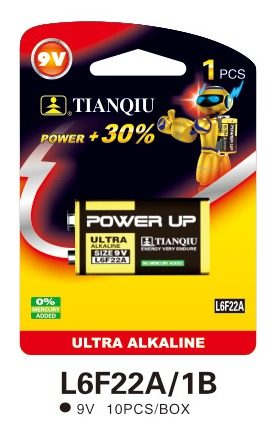
Enough for a year of standby plus the alarm’s own test cycles — which is decided by the drain, not by a headline number, and it is why a cheap 9V block disappoints. Our own declared figures for the two 9V chemistries show the gap on an identical test protocol.
| Model | Chemistry | Declared capacity | Energy (mAh × nominal V) | Radio test: 620 Ω, 2 h/day to 5.4 V |
|---|---|---|---|---|
| 6LR61 (9V) | Alkaline Zn-MnO₂ | 620–640 mAh | 5.6–5.8 Wh | 50–52 hours |
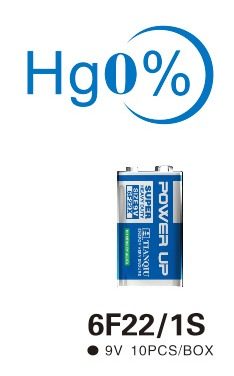
| 6F22 (9V) | Zinc-carbon Zn-MnO₂ | 320 mAh (2.88 Wh) | 2.9 Wh | 24 hours |
| LR6 (AA, for AA alarms) | Alkaline Zn-MnO₂ | 2150–2600 mAh | 3.2–3.9 Wh per cell | Not run on this protocol |
Our declared figures, as printed on the 6LR61 and 6F22 data sheets and EU technical documentation. Watt-hours are arithmetic on the declared capacity and the nominal voltage (9.0 V for the 9V blocks, 1.5 V for the AA cell) — the honest way to compare cans of different sizes.
Both 9V models are documented model by model, so the figures can be checked against the source rather than a range average: see the 6LR61 data sheet and the 6F22 data sheet.
The arithmetic is worth doing once. One 9V alkaline block carries about 5.6–5.8 Wh, three of our AA cells carry roughly 9.7–11.7 Wh between them, and a 9V zinc-carbon block carries 2.9 Wh. That is why a “heavy duty” 9V cell in a smoke alarm is a false economy — on our own radio test it lasts about 24 hours against 50–52 hours for the alkaline block of the same size. Zinc-carbon belongs in the low-drain clock, radio or toy that gets little use; an alarm runs continuously for a year.
How often should a smoke alarm battery be replaced?
At least once a year, and the whole alarm ten years after its manufacture date. That is the U.S. Fire Administration’s household guidance, and it covers a 9V alarm, an AA alarm and the backup cell in a hardwired unit; the user tests the alarm monthly in between.
First Alert, for its own alarms, advises changing the cells every six months or at the clock change at daylight saving — a rule of thumb for a battery alarm, not a replacement for the unit’s own manual.
For a buyer, “once a year” turns into a stocking and date question:
- Shelf life is part of the specification. Our 6LR61 is declared with five years under normal storage conditions; the 6F22 zinc-carbon is declared with two. Stock rotates, and a dated cell that sits two years in a warehouse starts its year of service short.
- Date-code the pack. Our 9V cells print production dating on the body in the format you specify — PD MM-YYYY, PD MM/YYYY or PD MM/YY — so a retail programme can print a “replace by” line that agrees with the cell inside.
- Sell the alkaline line for alarms. Section above: the zinc-carbon block lasts roughly half as long on the same test, and an alarm that chirps early is a support call, not a saving.
Why are American alarms moving to sealed batteries?
Because the most common failure mode was the human one. First Alert states that some areas of the United States now require a 10-year sealed battery smoke alarm and recommends the format regardless. New Jersey’s fire code, for example, has required a ten-year sealed battery-powered alarm, listed to ANSI/UL 217, in one- and two-family dwellings since January 1, 2019. A sealed alarm deletes the annual cell change.
What that leaves for replaceable cells is still a large market:
- The installed base. A 9V or AA alarm stays on the ceiling until its ten-year date, and it is fed replacement cells in the meantime — including in states where the sealed rule applies only to new sales, rentals or a change of occupancy.
- Hardwired alarms. These keep a replaceable backup in many models and jurisdictions, replaced yearly.
- Markets without that rule. Where no sealed-battery rule applies, the 9V and AA retail alarm remains the mainstream format — and the alarm’s own manual still decides the cell.
- The sealed pack itself is a lithium cell. Long-life 9V blocks are lithium: the Energizer L522 datasheet lists Li-MnO2 chemistry, ANSI 1604LC, a 10-year shelf life and a working range of −40 °C to 60 °C. Lithium is also where the transport paperwork changes — UN38.3 is the lithium transport test and applies to lithium cells and packs, not to the alkaline and zinc-carbon 9V blocks we make. See battery certifications for how we file the two families separately.
Can you use a rechargeable or lithium 9V cell in an alarm?
Only if the alarm’s manual lists one, and the numbers explain why makers are cautious. A 9V NiMH block is seven 1.2 V cells in series — 8.4 V nominal — and Energizer’s HR22 rechargeable datasheet rates it at 175 mAh at a 0.2C discharge, against 620–640 mAh declared for our alkaline 6LR61. It also self-discharges in storage.
Lithium 9V blocks are the better long-life answer where a maker lists them: the Energizer L522 datasheet gives a 10-year shelf life, −40 °C to 60 °C operation and up to 1000 mA continuous discharge — useful in a cold garage or an unheated hallway. Neither chemistry is a decision the buyer gets to make on the alarm’s behalf: the alarm’s low-battery logic is timed to the cell it was listed with, so a swap changes when the warning arrives, not just how long the unit runs.
Where else is the 9V cell used?
Everywhere a device wants a compact block with a snap terminal: multimeters, guitar effects pedals, toys, clocks and radios, test instruments, stud finders and older controls. Our own voltage guide lists the 9V block alongside the 6LR61 / 6F22 split and the rest of the chemistry range.
One distinction saves a wasted purchase: the wireless push-button on many doorbells and garage remotes does not take a 9V block at all — it takes a 12 V 23A cylinder, a different can with a different holder and a different voltage. They are sold side by side in retail and confused constantly; the 23A battery page sets out that cell’s own equivalents and uses.
How do you buy 9V or AA alarm cells in volume?
Both 9V chemistries and the AA and AAA alkaline cells are in our own range, so an alarm programme — or a retail range that carries alarm cells next to general-purpose ones — can be quoted as one order. What the programme has to pin down is chemistry, dating and the document set for the market where the cells are sold.
What we supply and what we ask for:
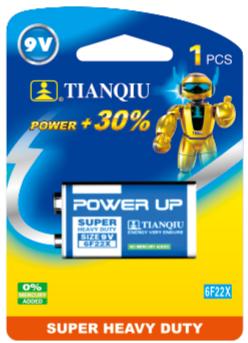
- The cell, per model. 9V alkaline 6LR61 (620–640 mAh declared) and 9V zinc-carbon 6F22 (320 mAh declared), plus AA LR6 (2150–2600 mAh, the cell most AA alarms take — see our AA battery page) and AAA LR03 alkaline cells. Ask for the technical data sheet for the exact model rather than a range average.
- The EU file, per model. 6LR61 and 6F22 each carry an EU declaration of conformity — TQ-EUDOC-6LR61-20260701 and TQ-EUDOC-6F22-20260701 — with the IEC 60086-1, -2 and -5 standards listed against them. The full list is on battery certifications and EU battery compliance.
- The transport file, per chemistry. These 9V blocks are alkaline and zinc-carbon, not lithium, so UN38.3 does not apply to them; lithium cells and packs are the ones that travel with that report.
- The pack format. Blister, card or shrink, printed and packed in our plant under your own label, with the dating line you specify and the warnings your market requires — the same artwork and proof cycle as any private-label battery packaging run.
- The minimum order. First orders run from 50 cartons per product line, and mixed-SKU cartons are possible for retail programmes; wholesale batteries explains how that is quoted.