 TIANQIU
Private-label batteries are a packaging business with a battery inside. The cell is the easy part — the same CR2032 comes off the same line for everyone. What your customer takes off the shelf is your artwork, your card and your box, and that is where the order is won or lost.
This is the practical side: what can be printed, what to send us, and what the packaging decision does to the pallet.
Which packaging formats can you print?
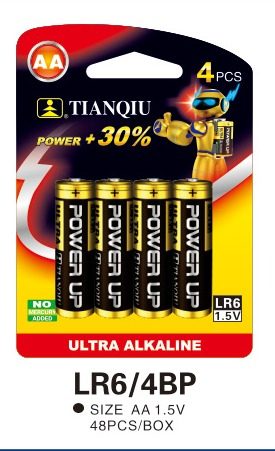
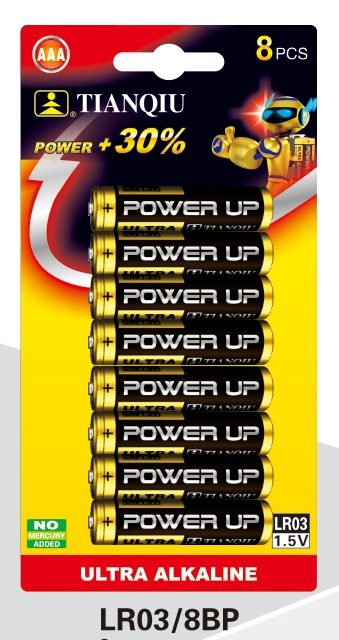
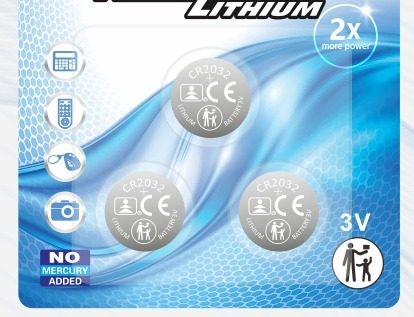
| Format | Typical use | Notes |
|---|---|---|
| Bulk / industrial carton | Distributors, OEM feed lines, repackers | No print run — the lowest-cost route to a first order |
| Single-cell blister card | Coin cells at retail and at the checkout | The workhorse format for CR and LR button cells |
| 2 / 4 / 6 / 8-piece blister card | Carded multi-packs | Share one dieline family across sizes |
| Shrink pack | Value packs and promotional bundles | Cheapest multi-pack per unit |
| Printed box (2BP / 4BP / 8BP) | Premium retail, gifting | Full artwork area on every face |
| 10-piece strip | Trade packs, refill channels | Compact, easy to hang or shelf |
| 9V and 12V cards | Cylindrical 9V and 23A / 27A | Card format sized to the taller cell |
| Promotion display box | Seasonal and aisle displays | Built for the shelf, shipped flat or assembled |
Every format above is printed with your artwork and your barcode. Formats combine — a distributor order often mixes cards and bulk cartons in one container.
There is also the cell itself. Your logo and brand can be printed directly on the cell, on the wrap or the negative electrode, which is what makes a bulk carton look like your product rather than a generic one. Ask for the cell marking options with your specification sheet.
What should you send with the artwork?
- Vector artwork — AI, EPS or PDF. A JPEG or a screenshot will not print cleanly at blister-card resolution.
- The barcode, not a picture of the barcode. Send the EAN or UPC number as data, so it is generated at the right size and contrast. Barcodes that fail to scan at the till are the most common retail packaging defect.
- The languages and the warning text. Different markets require different mandatory wording on the pack. Tell us the countries you are selling into and we will tell you what has to appear — including the separate-collection symbol under EU Regulation 2023/1542.
- The dieline, if you already have one. Reusing an existing card or box means a reprint, not a new print project, which is usually a lower minimum and a faster schedule.
- Your brand rules — colour references, clear space, the approved logo lock-up. Send them once; we keep them on file for repeat orders.
How does the proof cycle run?
Packaging is approved before it is printed, and the sequence is short if the artwork is complete:
- We issue a dieline and the copy requirements for your market.
- You return the artwork placed on the dieline.
- We send back a proof — a digital proof first, and a printed physical proof where the colour matters.
- You sign the proof off, and the plates are made.
- First production run and the packaging go together; the approved proof becomes the reference for every repeat.
Nothing is printed before the proof is signed. That is not a formality: it is what protects both sides if a card comes back with a colour or a barcode that does not match the brief.
How do cartons and pallets affect the container?
The packaging decision reaches all the way to the ship.
- Cartons are labelled with the model, the quantity and the lot, so a mixed shipment can be received without opening every box. Heavy or bulky formats — a display box, a large card — change the carton count for the same number of cells.
- Pallets are shrink-wrapped and strapped on request, and palletising happens at dispatch rather than at packing, so a late change to the pack format can still be absorbed if it is agreed before the goods leave.
- Mixed pallets for a distributor or a retail chain are worth ordering deliberately: tell us the split with the order and we build them before dispatch instead of leaving you to sort it in your own warehouse.
- Container loading. Full container (FCL) is the economical route for volume; less-than-container (LCL) suits mixed or partial orders. We quote on EXW, FOB, CIF or DDP so you can compare the landed cost rather than the factory price. The full set of terms, lead times and transport documents is on the shipping policy page.
Does packaging set the minimum order?
This is the part buyers find hardest to accept. The cell minimum is usually achievable; the packaging minimum is the real one, because a card or a box has to be printed before it can be packed. Two ways round it:
- Take the first order in bulk with your brand printed on the cell, then move to full retail packaging once the product is selling.
- Spread the packaging over several models that share one dieline, so one print project covers a family of cells.
Our OEM program runs from the cell to the sealed container and includes the artwork proof cycle, the declaration paperwork and the packaging itself — the full process is described on the OEM / ODM page. Send us the model, the pack format and your artwork, and we will come back with a proof timeline and an MOQ that reflects what you actually need.