 TIANQIU
Battery OEM & ODM Manufacturing
Your brand on the cell, the blister and the box — we manufacture the cells, print them with your logo and pack them for the shelf: button cells, AA/AAA/C/D, 9V, zinc-air and battery packs.
Reply times are working days (Mon–Fri, excluding Chinese public holidays).
Which product lines do you manufacture?
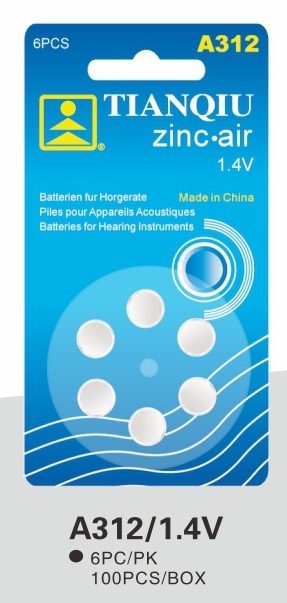
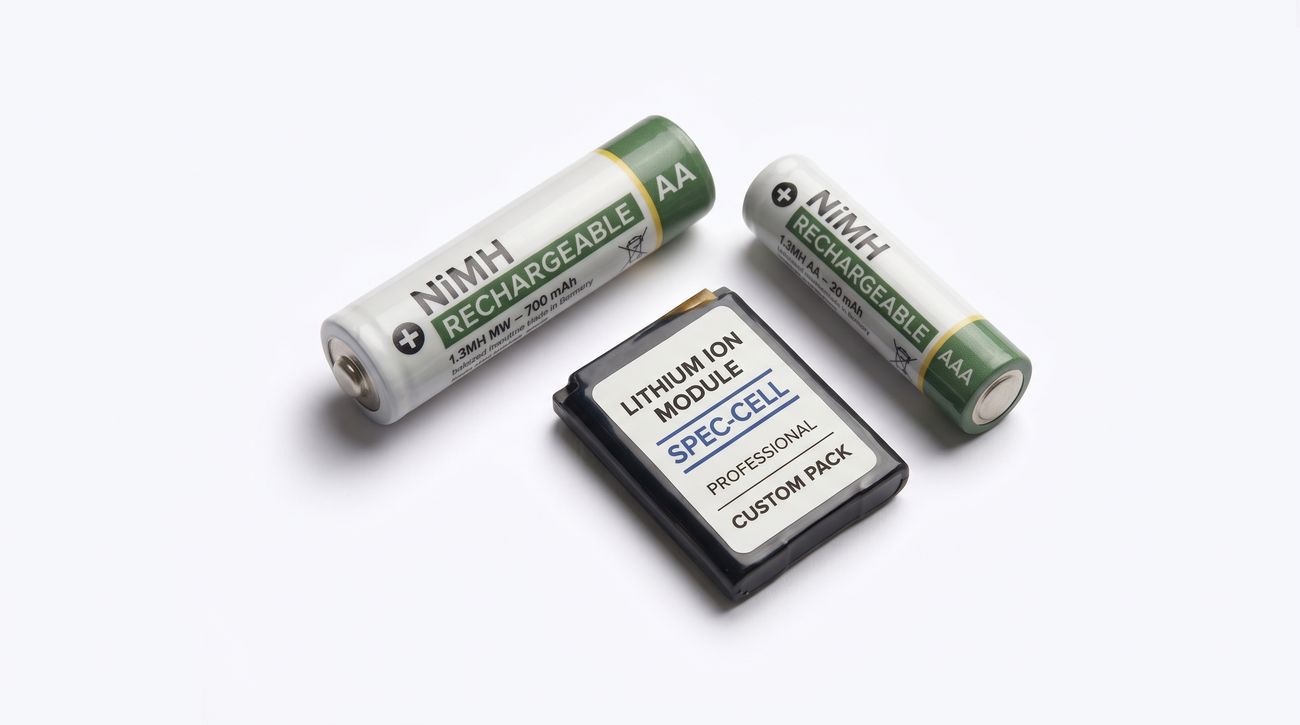
Every line below is produced in our own plants and can carry your brand: button cells in CR lithium and LR/AG alkaline, cylindrical AA, AAA, C, D and 9V, zinc-air hearing-aid cells, NiMH rechargeables and custom battery packs. First orders start from 50 cartons per product line.
Which packaging should I choose for my market?
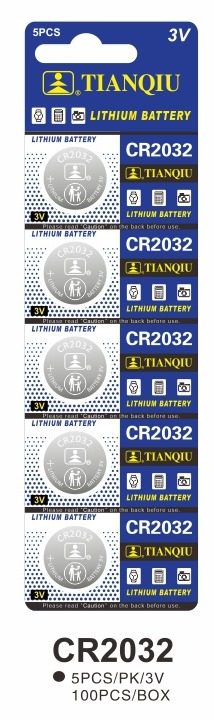
Pick the format your retailer and your market require, not the other way round. Below are the 12 formats we produce ourselves — blister cards from one to eight cells, shrink packs, printed boxes, strips, 9V and 12V cards, display boxes and bulk cartons — each printed with your artwork, barcode and languages. Mixed formats in one order are fine.
 Single-cell blister card1 pc card — the workhorse format for coin cells at retail.
 2-piece blister cardTwin pack, printed with your brand and EAN barcode.
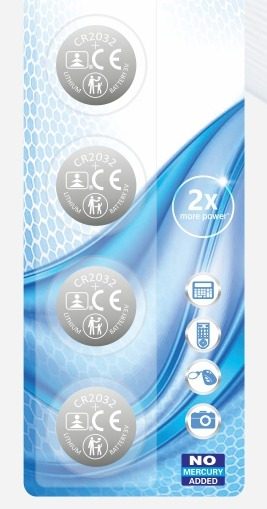 4-piece blister cardMulti-pack for key fobs, watches and CMOS replacement.
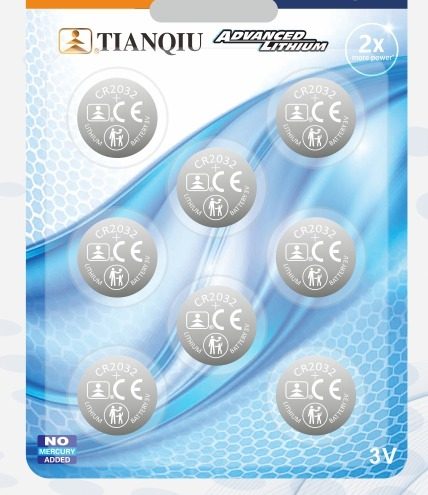 8-piece blister cardValue pack — best price per cell at the shelf.
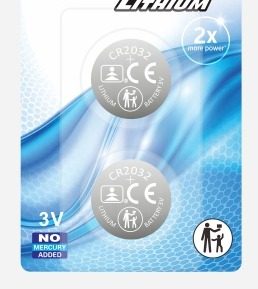 Shrink packLow-cost shrink wrap for industrial and refill packs.
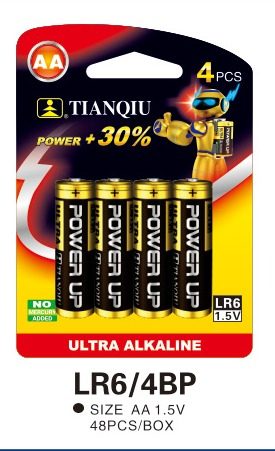 Printed box — 4 pc (AA)Cardboard 4-pack box, your artwork on all faces.
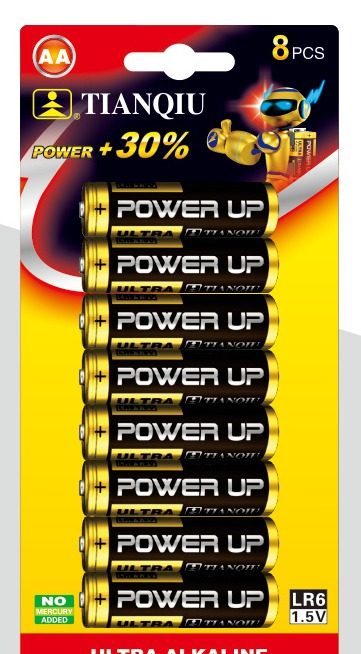 Printed box — 8 pc (AA)Family pack box; also available 2BP and 4BP.
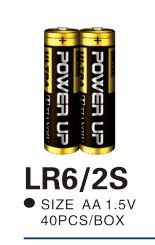 Cylindrical shrink pack2 / 4-piece shrink for AA and AAA cells.
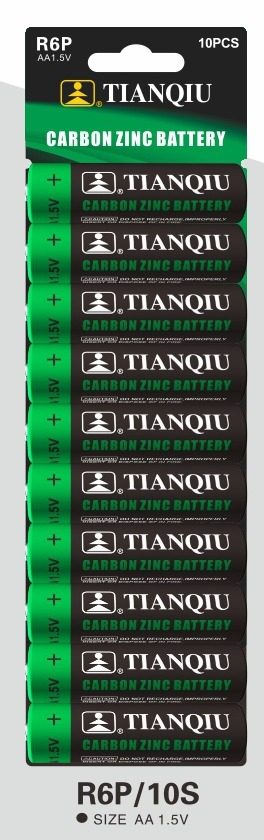 10-piece strip / bulkStrip or bulk box for distributors and industrial users.
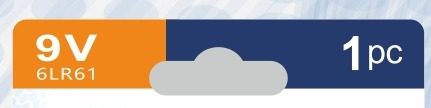 9V card pack9V 6LR61 / 6F22 single-cell card with your label.
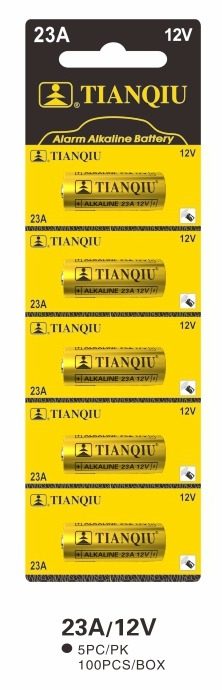 12V card pack23A / 27A photo and remote batteries in card packaging.
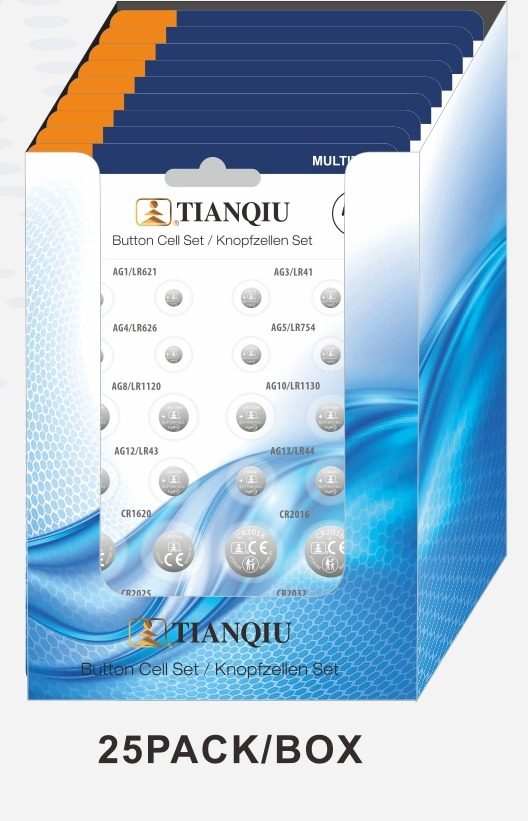 Promotion & display boxAssorted button-cell sets in a counter display box.
- Child-resistant and retail-ready blister cards available (EU 2023/1542 labelling).
- Your artwork, barcode (EAN / UPC), country of origin and multilingual warnings printed to your dieline.
- Send AI / PDF / vector artwork — we return a packaging proof for approval before production.
How is the cell printed for my market?
Four things get printed on or around your cells: your logo and model number on the cell jacket or negative electrode, a production date code we can trace back to the batch, the barcode and compliance markings your retailer asks for, and an instruction sheet in your languages.
Brand & model printing
Your logo, brand name and model number printed on the cell jacket / negative electrode — plus "0% Hg" and voltage marking where required.
Production date code
Printed on the battery negative electrode to customer requirement, format Y-M: for example 64 = 2026-04, 6X = 2026-10, 6Y = 2026-11, 6Z = 2026-12.
Barcode & retail compliance
EAN / UPC barcode, multilingual warnings and separate-collection (EU 2023/1542) symbols placed to your dieline. For button cells sold in the United States, child-resistant packaging must be built to a design that has passed ANSI/UL 4200A-2023 testing — see US button battery packaging law.
Instruction sheet & languages
Printed insert or back-card in your languages — English, German, French, Spanish, Italian, Dutch, Japanese and more.
How does an OEM order run from spec to container?
Six steps, each ending with something concrete in your hands rather than a status update: a written spec sheet with unit price, samples built to that spec, a packaging proof with your artwork, a production run on our own ISO 9001 lines, then the document set your forwarder needs before the container is booked.
 1
1Send your spec
Model or device, annual quantity, packaging idea — or just send a sample.
Reply in 24 h 2
2Quote & spec sheet
Written spec sheet — voltage, capacity, size, chemistry — plus unit price.
Spec sheet 3
3Sample & test
Samples built after spec sign-off, with capacity and dimension checks.
1-2 weeks4Artwork & proof
Blister card or box dieline and a proof with your logo, barcode and languages.
Your approval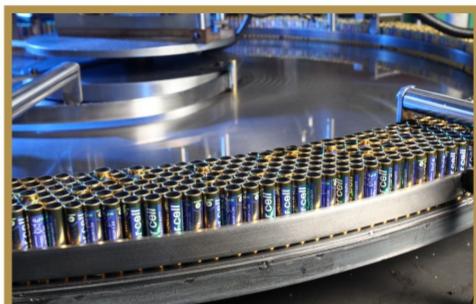 5
5Mass production & QC
Run on our own lines under ISO 9001, with final electrical test and inspection.
ISO 9001 line 6
6Documents & shipping
UN38.3 (lithium cells), MSDS, transport certificates and commercial documents, then booking.
UN38.3 · MSDSOEM or ODM — which model fits my project?
There are two ways to buy from us. Under OEM we build the cell or pack to your specification and print it with your brand. Under ODM you take one of our existing cell designs, add your brand and packaging, and skip the development stage. Both run on the same lines.
| OEM — built to your spec | ODM — our cell, your brand | |
|---|---|---|
| Who defines the design | You do — we produce to your spec sheet or drawing. | Our catalogue cell — you choose the model and the packing. |
| What can change | Voltage, capacity, dimensions, chemistry, tab or connector, and BMS on packs. | Model, quantity, packaging format and languages. |
| Development stage | Spec confirmed, samples built and approved, then mass production. | None — the cell is already in production. |
| Branding | Your logo on the cell, your dieline on the pack. | Your logo on the cell, your dieline on the pack. |
| Typical starting point | A device that no standard cell fits. | A private-label retail programme. |
What are the common problems with battery OEM sourcing — and how do we handle them?
Six objections come up in almost every first conversation with a new buyer. Below is what we do about each one — the same answers for a first-time importer and for a retail programme manager sourcing under their own brand.
“No standard cell matches the size or voltage I need.”
Send the drawing or the operating conditions — voltage, capacity, dimensions, tab or connector. You get a written spec sheet stating what we will build, and the price, before anything is produced. If a requirement cannot be met, we say so in the quote rather than shipping a compromise.
“I do not know which cell my device takes.”
Send a photo of the old cell, or the marking printed on it. We identify the equivalent IEC number — LR6, CR2032, LR44 — and the ANSI and manufacturer numbers that cross to it. Our battery cross-reference tool lists each equivalent against the vendor document it came from, so you can check it yourself.
“My packaging has to satisfy my market, not my preference.”
Two regimes catch most buyers. For the United States, child-resistant packaging for button cells must be built to a design that has passed ANSI/UL 4200A-2023 testing. For the EU, the pack carries the (EU) 2023/1542 marking and separate-collection symbol in your languages. We print to your tested design and your dieline — the design and its testing are yours to own, as in any OEM relationship. See US button battery packaging law.
“How do I know batch two matches batch one?”
Every cell carries a production date code printed on the negative electrode, which traces the batch it came from. Production runs on our own ISO 9001 lines, with a final electrical test and inspection before the cells are packed.
“The minimum order is larger than my first order.”
First orders start from 50 cartons per product line, and mixed-SKU cartons are possible for retail programmes. Trial production below MOQ can be discussed for a first order.
“My forwarder and customs broker want documents I do not have.”
The file set ships with the order: ISO 9001 and ISO 45001 certificates, MSDS / SDS, air and sea transport certificates, and UN38.3 test reports for the lithium cells. UL documentation is provided per product line. The full list is under what documents ship with my order.
Which chemistry suits which product?
Chemistry follows the device. Alkaline covers everyday 1.5V loads, lithium CR cells hold 3.0V for key fobs, CMOS and sensors, silver oxide keeps watch rates stable at 1.55V, zinc-air powers hearing aids, and carbon-zinc or NiMH fill the value and rechargeable lines. Unsure? Send the device or the old cell markings.
| Chemistry | Typical models | Voltage | Best for |
|---|---|---|---|
| Alkaline (Zn-MnO₂) | LR44 / AG13, LR41, LR626, AA, AAA, C, D, 9V | 1.5V | Everyday devices, 0% mercury |
| Lithium (Li-MnO₂) | CR2032, CR2025, CR2016, CR2450, CR1632, CR927 | 3.0V | Key fobs, CMOS, medical, IoT |
| Silver oxide (Ag₂O) | SR44, SR626SW, 377, 371, 364 | 1.55V | Watches — stable voltage |
| Zinc-air (Zn-Air) | A10, A13, A312, A675 | 1.4V | Hearing aids, medical |
| Carbon-zinc (Zn-C) | R6P, R03, R14P, R20P, 6F22 | 1.5V / 9V | Value lines, industrial bulk |
| NiMH & Li-ion packs | AA / AAA NiMH, custom lithium packs with BMS | 1.2V / 3.7V | Rechargeable products, e-bikes, UPS |
What are your MOQ, pricing and lead times?
First orders start from 50 cartons per product line, and that entry point is the same for button cells, alkaline cells and printed packaging. Volume pricing is quoted per project once we know the model, quantity and packaging format, and the lead time is confirmed in the written quote.
| Product line | MOQ | Notes |
|---|---|---|
| Button cells (CR / AG / SR) | 50 cartons | Flexible for OEM & private label |
| AA / AAA alkaline | 50 cartons | High-volume, fast turnaround |
| D / C carbon-zinc | 50 cartons | Industrial & heavy-duty |
| Zinc-air (hearing aid) | 50 cartons | Tabbed or untabbed |
| Rechargeable NiMH / PACK | Project-based | Custom design & BMS |
What documents ship with my order?
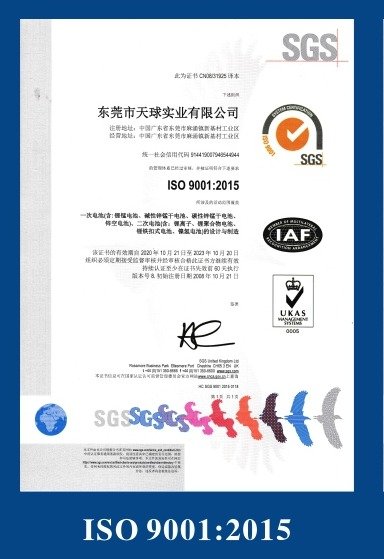
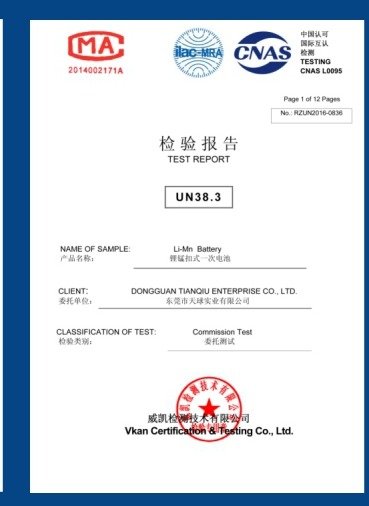
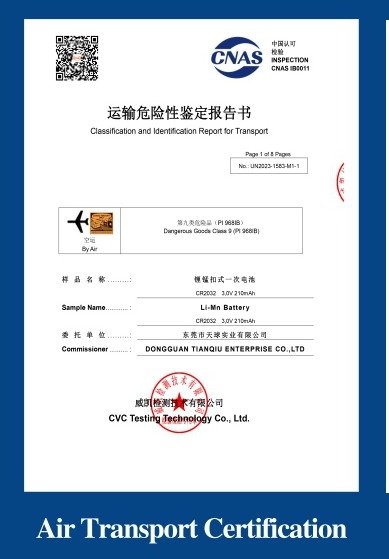
These are the papers your customs broker, freight forwarder and EU importer will ask for, prepared before the container leaves: quality and social-compliance certificates, an MSDS, CE and RoHS declarations, air and sea transport certificates, and for lithium cells the UN38.3 test report. The full list and scans are below.
- ISO 9001:2015 quality management certificate
- ISO 45001:2018 occupational health & safety certificate
- amfori BSCI social compliance audit
- UN38.3 lithium transport test report
- MSDS / SDS (material safety data sheet)
- CE & RoHS declarations of conformity
- EU Regulation 2023/1542 compliance file
- IEC 60086 battery performance test data
- China test report & CNAS laboratory report
- Maritime and air transport certificates
What are your factory facts?
The short version: batteries have been made by the same company at the same site since 1994 — one 100,000 m² industrial park that holds the cell workshop, the printing lines, packing and the warehouse. Licensed and authorised OEM relationships include PHILIPS, MITSUBISHI ELECTRIC and SEIZI, and the plants are audited to ISO 9001, ISO 45001 and amfori BSCI.
Making batteries since 1994 — same company, same plants.
One industrial park: cell workshop, printing, packing, warehouse.
PHILIPS · MITSUBISHI ELECTRIC · SEIZI · SOXEY.
ISO 9001 / ISO 45001 / amfori BSCI, with UL documentation per product line and UN38.3 test reports for the lithium cells.
Not sure what to send? The battery quote checklist lists every detail we need to prepare a quotation — the cell or device, quantity per model, your market and the pack format you want.
Guides that answer the first OEM questions
Factory vetting, wholesale terms, pack formats and the model specifications buyers ask us to confirm in writing.
How to vet a battery factory
The certificates, audits and sample documents to ask for before you place a first order.
Read the guide →Wholesale batteries
How wholesale terms work when you buy direct from the factory that makes the cells.
Open the page →Custom battery packs
Voltage, capacity, connector and BMS options for a pack built to your device.
Open the page →LR41 battery
Specification, equivalent part numbers and bulk supply for the LR41 button cell.
Open the model →How to test a battery
How to check a sample shipment with voltage and load tests before it goes to market.
Read the guide →How do I start a custom battery project?
Tell us your spec — voltage, capacity, size, label & packaging. We reply with a full quote and timeline within 24 hours on working days.
What do buyers ask about battery OEM?
The eight questions below are the ones that come up in the first email from most new buyers — MOQ, label printing, packaging formats, sampling, lead time, customisation, EU documents and what we need from you to start. All eight answers are also published as structured data on this page, so search engines and AI assistants can quote them directly.