 TIANQIU
Most battery sourcing mistakes are not manufacturing failures. They are verification failures: the supplier was never quite what the buyer assumed. The good news is that the checks that separate a factory from a trading company are cheap, take an afternoon, and do not require a factory visit.
This is the checklist we would use ourselves if we were buying.
1. Do all the documents show the same legal name?
Ask for the business licence, then compare the registered name against the name on the quotation, the invoice you will pay, and the addressee on every certificate.
Three different names in those four places is a finding. It usually means documents are being borrowed from a related company, and it is exactly the pattern a customs officer or an importer’s compliance team will pick up. A straightforward supply relationship has one legal entity doing the selling, holding the certificates, and appearing on the invoice.
2. Have you asked for a live walk-through?
Factory photos are cheap and, increasingly, generic. Ask for a short live video call walking from the raw material store to the line to the finished-goods area, with someone answering questions as they walk.
What to watch for:
- Cells being made, not just packed. A repacker is a legitimate business, but it is not a factory, and it cannot change your cell chemistry.
- The line matches the product. If you are buying button cells, you want to see button-cell equipment.
- The person walking knows the process. Someone who cannot explain the changeover cannot commit to your delivery date either.
3. Have you read the certificates properly?
- Look for a number and an expiry date on every certificate and test report. Both are checkable with the issuing body, which is the single highest-value five minutes in the process.
- Check the scope. ISO 9001 issued to a sales office does not cover a production line.
- Check the validity. An expired certificate still displayed on a website, or an authorisation letter whose validity period ended years ago, is a real finding — and it is the kind of thing that looks much worse after a dispute than before an order.
- Distinguish a logo from a certificate. A CE mark or a recycling symbol pasted into a brochure is not evidence of anything.
4. Did you get a specification sheet with numbers on it?
Ask for the specification before you ask for the price: chemistry, nominal voltage, dimensions with tolerances, capacity and the discharge conditions the capacity is measured at.
A capacity figure without test conditions is a marketing number. A supplier who will not put the conditions in writing will not be accountable when the cells arrive and underperform in your device. This is true at every scale — the same discipline applies whether you are buying 10,000 cells or a container.
5. Does the minimum order match the capacity?
A common illusion: a supplier who quotes a very low minimum order and a very high monthly capacity. Those two claims describe different businesses.
A high-volume line needs volume to make sense; a low minimum usually means a smaller or more flexible operation. Neither is wrong — but the combination of both is usually a sign that the capacity figure is aspirational.
6. Do you know what the declaration number will be?
For European sales, ask which EU declaration of conformity will accompany the shipment and what its number is. A supplier with a real compliance file can answer immediately, per model. A supplier without one will offer a generic letter.
7. Have you agreed the sample before the terms?
- The sample should arrive with its specification sheet, and the mass-production cell should match the sample.
- Samples are usually chargeable and often credited against the order. Get that in writing before you pay.
- Payment terms are a risk statement. A supplier who will only work on full prepayment for the first order is telling you something about their working capital — and a supplier who will not discuss terms at all is telling you something else.
- Ask for two references in your region and actually call them. One conversation tells you more about delivery reliability than any brochure.
What are the red flags to watch for?
- An expired certificate, authorisation or test report presented as current.
- Certificates or authorisation letters addressed to a different company than the one quoting you.
- A logo presented as a certificate.
- No declaration number per model for the EU market.
- A specification with a capacity figure but no discharge conditions.
- A very low MOQ combined with a very high claimed capacity.
- A MOQ that grows after the deposit.
- Cells with no lot or date code — you cannot trace a problem batch, and neither can they.
What does a properly vetted factory look like?


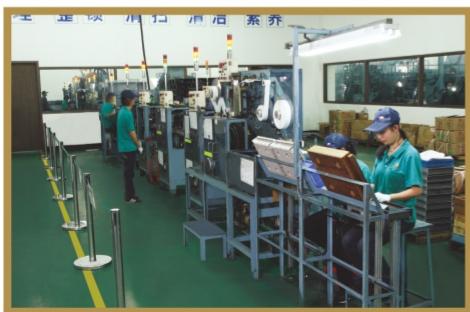
A supplier worth appointing answers all seven sections without hesitating: one legal name across the paperwork, a line you can see running, certificates with checkable numbers and current dates, a specification with test conditions, a declaration number per model, and references that pick up the phone.
Our own details are on this site for exactly that reason — the certifications page collects the factory certificates and trademark registrations, the about page covers the park and the production lines, and the declaration and datasheet route is described on the OEM page. If you would rather verify than read, ask us for the file set and a walk-through for the model you are considering.