 TIANQIU
Alkaline and rechargeable nickel-metal hydride (NiMH) cells both come as AA and AAA, and both fit the same holder — but they are not interchangeable for every device. The short answer: alkaline wins where a device sits unused for months; rechargeable NiMH wins where a device is used hard and often. What the device’s own label allows decides the rest.
Are rechargeable batteries better than alkaline?
Neither chemistry is better in the abstract — the duty cycle decides. A device that is used daily and drains a set of cells every few weeks is the case rechargeables were built for. A device that sits on a shelf for a year and then asks for one small burst of power is the case alkaline was built for.
Four questions settle almost every buying decision:
- How fast does the device drain a cell? High-drain devices (toys, cameras, controllers, flashlights) get more value from a rechargeable; very low-drain devices (wall clocks, remotes, sensors) do not.
- How often is the device used? Daily use makes recharging practical. Monthly use tends to leave a rechargeable sitting empty when it is needed.
- What does the maker specify? Some manuals name alkaline or lithium only, and a few specify single-use cells. The device label overrides the general rule.
- What happens if the cell fails? For a smoke or carbon-monoxide alarm, the consequence is not a toy going quiet — follow the alarm maker’s stated chemistry.
How do rechargeable and alkaline batteries compare?
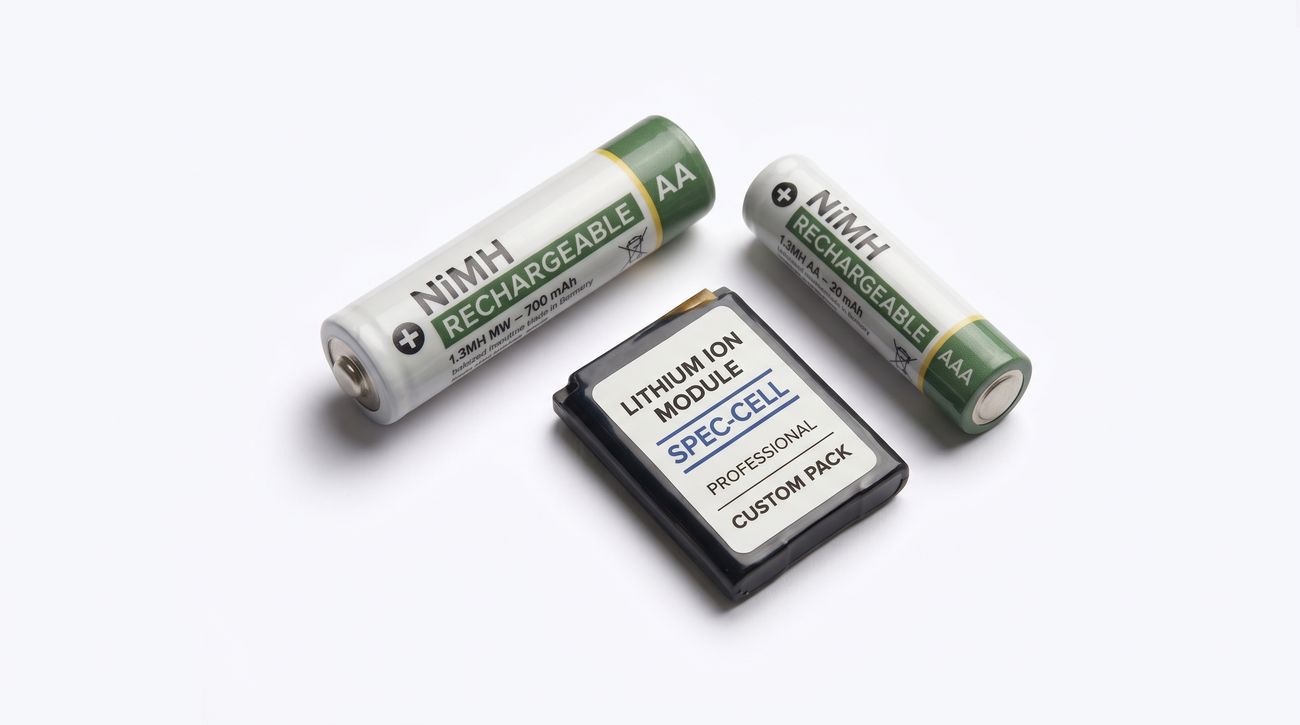
The differences that matter are nominal voltage, how the cell behaves in storage, and how many times you get to use it. NiMH is 1.2 V nominal against 1.5 V for alkaline, and NiMH cells self-discharge in storage while alkaline cells keep their charge on the shelf for years.
| Alkaline (single-use) | NiMH (rechargeable) | |
|---|---|---|
| IEC code — AA | LR6 | HR6 |
| IEC code — AAA | LR03 | HR03 |
| Nominal voltage | 1.5 V | 1.2 V |
| Declared capacity, our lines | AA 2150–2600 mAh · AAA 1020–1260 mAh | Set per project — ask for the datasheet |
| Storage behaviour | Keeps its charge for years on the shelf | Self-discharges; low-self-discharge types hold far longer |
| Discharge curve | Sags steadily through its life | Flatter under load, then falls away quickly |
| Reuse | Used once, then recycled | Charged and reused many times |
| Best for | Clocks, remotes, alarms, standby devices | Daily-duty devices such as toys, controllers and cameras |
Capacities are the figures we declare for our own alkaline cells; NiMH capacity and cycle life are set per project, so ask for the datasheet instead of assuming a number. IEC codes are printed on the cell — where a marking differs, the print on the cell wins.
What does 1.2 V versus 1.5 V mean in a real device?
Cell voltages add when cells are wired in series, so the gap widens with every cell in the holder: two alkaline cells give 3.0 V against 2.4 V for two NiMH cells, and four alkaline cells give 6.0 V against 4.8 V. Most devices tolerate that; devices with a strict cut-off misbehave.
What that looks like in practice:
- Torches and motors run visibly weaker at the bottom of the NiMH curve — the device works, it simply has less to work with.
- Devices with a battery gauge may report low before the cell is empty, because the gauge is calibrated to the alkaline curve.
- Devices with a hard minimum voltage (some flashes, some instruments, some medical meters) can refuse to start at 1.2 V per cell even though the cell is full. Check the maker’s stated chemistry.
The arithmetic behind series and parallel wiring — and the voltage each chemistry actually reads fresh and under load — is set out in our AA battery voltage guide.
Where should you not use rechargeable batteries?
Three categories are best left on single-use cells: devices whose maker specifies alkaline or lithium, safety devices such as smoke and carbon-monoxide alarms, and equipment that sits idle for months. A rechargeable that has quietly self-discharged gives no warning as it goes.
Keep these cases on the chemistry the manufacturer names:
- Smoke and carbon-monoxide alarms. The low-battery chirp is timed around the alkaline or lithium discharge curve, and these are life-safety products. Follow the alarm maker’s label.
- Medical devices and instruments. Where a reading or a dose depends on voltage, a cell change is not the place to test tolerance.
- Emergency kits and rarely used tools. A cell that has to deliver after six months in a car or a cellar should be one that held its charge.
- Anything with a hard cut-off that the maker documents — check the manual before substituting.
Two rules apply whatever you choose: never mix rechargeable and single-use cells in the same device or the same series string, and never place a single-use cell in a charger. Our EU battery information carries the same warning for every non-rechargeable cell we ship — attempting to recharge one can cause leakage or rupture.
Do rechargeable batteries save money?
Whether rechargeables save money is arithmetic rather than a claim, and the arithmetic is easy: compare what a year of single-use cells costs against the one-off price of the rechargeable pack plus its charger, spread across the cycles the pack actually completes.
Work it out in five steps:
- Count the cells the device consumes in a year on single-use chemistry.
- Multiply by the price per cell in your market — that is the annual single-use cost.
- Add up the rechargeable pack price and the charger price, if a charger is needed at all.
- Estimate the cycles you will realistically complete in a year, and divide that into the cell’s rated cycle life to see how many years the pack serves.
- Compare the two annual figures, and remember that a rechargeable loses some capacity over its life.
We deliberately do not publish a break-even number here: prices differ by market and pack size, and cycle life is a rating that depends on how deeply a cell is discharged. Ask for the quote and the datasheet and the calculation takes two lines.
What is a USB rechargeable cell, and when is it the better buy?
A USB rechargeable AA or AAA has the charging circuit and connector built into the cell, so there is no separate charger to buy, pack or lose. Our USB rechargeables are NiMH cells at 1.2 V nominal, in AA and AAA, with capacity and cycle life set per project.
They suit different jobs from a charger-based set:
- Travel and field kits — one USB port replaces a charger and its cable.
- Retail packs — a self-contained cell reads as a finished gift or starter product, so it merchandises well on a blister card.
- Low-count users — you can charge the one cell that is flat, rather than waiting for a set.
The full comparison of the cell types we make is on the USB rechargeable battery page, and the charger-based line is on the rechargeable battery page.
What changes when a rechargeable line goes into a retail programme?
For a retail or private-label programme, chemistry is only half the decision — the rest is packaging, capacity choice and documentation. A typical battery range carries an alkaline line for everyday and standby use plus a rechargeable NiMH line, with an optional charger or USB cells alongside.
What that means in production terms:
- SKU pairing. The cell label, the blister and the box are printed for both lines together, so the range looks like one family on the shelf. See how the artwork cycle runs in our guide to private-label battery packaging.
- Capacity choice. NiMH capacity and cycle life are set per project, so decide the mAh you want before artwork is signed off, and ask for a sample carrying your own label.
- Minimum order. First orders run from 50 cartons per product line, and mixed-SKU cartons are possible for retail programmes — see wholesale batteries.
- Documentation. NiMH cells are not lithium cells, so the UN38.3 transport report that applies to our lithium coin cells and lithium packs is not the document your rechargeable line needs. The required file set depends on where the product is listed — tell us the market and we confirm it by model. Start from battery certifications.
We build both chemistries on our own lines, so the alkaline and rechargeable halves of a range can be quoted together with one packaging programme — the OEM process is set out under OEM battery manufacturing.