 TIANQIU
The two cells get confused for one reason: they are both 1.5 V. Put a C and a D on a bench and the meter agrees, so the question becomes whether the smaller one is “the same battery in a shorter can”. It is not — and the difference shows up in runtime, in carton weight and in whether the cell will actually be held against the contacts of the compartment you are trying to fill.
Both formats sit in our cylindrical range. This comparison sets out the designations, the dimensions and the capacity basis of each, the mechanical limits of swapping one for the other, and what an OEM or wholesale order for either format has to state.
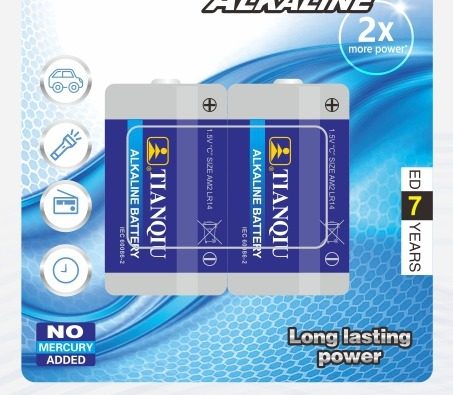
What is a C battery?
A C battery is a 1.5 V cylindrical cell measuring 26.2 mm in diameter and 50.0 mm long. In IEC nomenclature the alkaline version is LR14 and the zinc-carbon version R14; the North American designation for the alkaline cell is ANSI/NEDA 14A. The rechargeable nickel-metal hydride cell in the same can is HR14.
The C is the middle of the lettered cylindrical family, one step up from the AA and one step down from the D. That position is what it is used for: medium-drain portable devices where an AA would run flat too quickly but the bulk and the freight cost of a D are not justified. Toys, portable radios and boomboxes, flashlights and small musical instruments are the familiar cases.
| Common name | IEC designation | ANSI/NEDA | Nominal voltage |
|---|---|---|---|
| C (alkaline) | LR14 | 14A | 1.5 V |
| C (zinc-carbon) | R14 | — | 1.5 V |
| C (rechargeable NiMH) | HR14 | — | 1.2 V |
The letter pair in the IEC code states the system: L for an alkaline electrolyte in a zinc-manganese dioxide cell, R for the rectangular section profile in the round can, and H for the nickel-metal hydride system in the rechargeable version. The can is the same item in all three rows; the chemistry inside it is not. ANSI/NEDA codes are quoted for the alkaline cells, where the makers' data sheets agree on them.
What is a D battery?
A D battery is the largest of the lettered cylindrical sizes, at 34.2 mm in diameter and 61.5 mm long. As with the C, the prefix follows the chemistry rather than the size — LR20 for the alkaline cell, R20 for the zinc-carbon one and HR20 for the nickel-metal hydride one, with ANSI/NEDA 13A for the alkaline version.
A D is specified where the device has to run for a long time on one set and the compartment can carry the bulk. In our own range the alkaline LR20 is declared at 18,000 mAh, and the full specification sits on the D battery page and on the LR20 model page.
| Common name | IEC designation | ANSI/NEDA | Nominal voltage |
|---|---|---|---|
| D (alkaline) | LR20 | 13A | 1.5 V |
| D (zinc-carbon) | R20 | — | 1.5 V |
| D (rechargeable NiMH) | HR20 | — | 1.2 V |
The same naming rule as the C applies one size up. Our own manufactured line is the alkaline LR20, declared at 18,000 mAh; the zinc-carbon R20 is the heavy-duty budget option, and the NiMH code HR20 identifies a rechargeable cell in the same envelope.
C battery vs D battery: how do the numbers compare?
The two formats sit one step apart in the same family, and the structural difference is only the can. Both are 1.5 V nominal in the alkaline version, both are cylindrical with a flat positive pip, and the C is smaller in both dimensions — 8 mm narrower in diameter and 11.5 mm shorter.
| Measurement | C battery (LR14) | D battery (LR20) |
|---|---|---|
| Diameter (max) | 26.2 mm | 34.2 mm |
| Height (max) | 50.0 mm | 61.5 mm |
| Typical alkaline weight | 66 g | 139 g |
| Typical volume | 27 cm³ | 56 cm³ |
| Nominal voltage (alkaline) | 1.5 V | 1.5 V |
| Operating temperature (published) | −18 °C to +55 °C | −18 °C to +55 °C |
| Shelf life (published, 21 °C) | 10 years | 10 years |
| Declared capacity | Per model — request the data sheet | 18,000 mAh (our LR20) |
Dimensions, weight, volume and temperature are the values published by Energizer in its data sheets for the alkaline C (E93) and D (E95) cells, and they agree with the maximum dimensions Duracell prints for its MN1400 C cell. Read the last row as an order instruction rather than a gap: capacity is declared per model and per test condition, so our own figure is the LR20's and the LR14's comes with the data sheet.
Why do C and D batteries have the same voltage but different capacity?
Nominal voltage is a property of the chemistry, not of the can. An alkaline C and an alkaline D are both zinc-manganese dioxide cells, so both are labelled 1.5 V nominal; what separates them is how much active material the can holds, and that follows the internal volume of the can.
Published data sheets put the D at about twice the volume of the C — 56 cm³ against 27 cm³ — and about twice the mass, 139 g against 66 g. Stored energy scales with that volume, so at the same load the D runs roughly proportionally longer. Nothing in the electronics has to change: a device built around four D cells will show 6.0 V nominal whether the designer thinks in C or D, and the voltage guide works through the arithmetic of cells in series.
| Quantity | C (LR14) | D (LR20) | Ratio |
|---|---|---|---|
| Internal volume | 27 cm³ | 56 cm³ | ≈ 2.1 × |
| Typical mass | 66 g | 139 g | ≈ 2.1 × |
| Nominal voltage | 1.5 V | 1.5 V | identical |
| External size | 26.2 × 50.0 mm | 34.2 × 61.5 mm | D larger in both axes |
The ratio column is the plain arithmetic of the published numbers: within the same chemistry, capacity and runtime track volume, and volume roughly doubles between the C and the D can. It is also why two cells quoted at the same mAh are not automatically comparable — capacity is only meaningful with the discharge rate, temperature and cut-off voltage it was measured at.
Can you use a C battery in a D device?
Only with an adapter sleeve, and only where the sleeve holds the cell firmly against the contacts. Both cells are 1.5 V, so nothing electrical prevents the substitution, but the C is 8 mm narrower and 11.5 mm shorter than a D and will sit loose in a D compartment.
A loose cell makes intermittent contact. In a single-cell device that shows up as a light that flickers or a radio that cuts out; in a series string it is worse, because one cell that is not seated interrupts the whole chain and the contact resistance at the joint generates heat. A sleeve is a stop-gap, not a specification: if a product is being designed around an available cell, design it around the one the label lists.
Can you use a D battery in a C device?
No. The D is larger than the C compartment in both diameter and length, so it cannot be fitted without forcing the holder or the spring, and forcing either is how a battery compartment gets damaged. There is no adapter that makes the larger cell fit the smaller compartment — the direction of that trick only runs one way.
The same rule applies to the other formats in the family: an AA will not reliably fill a C compartment either, and the AA versus AAA comparison works through why matching the compartment, and not the voltage, is the first check.
Which format should you specify?
Match the compartment first, then the drain. A C cell suits a product that draws moderate current and has to stay light and portable; a D cell suits a product that must run for weeks on one set and can carry the bulk and the freight of the larger can.
For a buyer that becomes an order question rather than an electrical one. Two cells at the same voltage can differ two-fold in weight, so the carton weight and the pallet count move with the format before anything else does. Both LR14 and LR20 leave our lines as bare cells or in a retail pack — two-piece blister or shrink pack — with the printing on the cell, the blister card and the box done in the same plant, and first orders from 50 cartons per product line — the mechanics are the same ones set out in the MOQ guide and the private-label packaging guide.
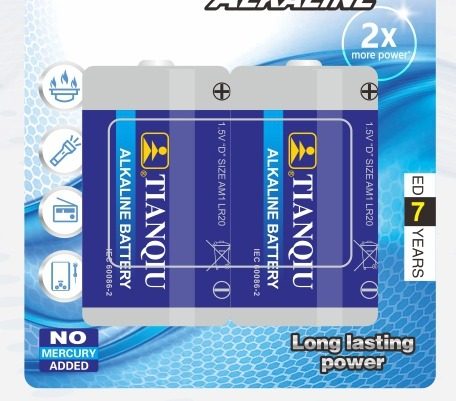
What are the LR14 and LR20 battery equivalents?
Both sizes are sold under several numbering systems at once, and a buyer holding a part number needs the match before the order goes out. LR14, C, R14 and 14A all point at the same can; so do LR20, D, R20 and 13A. The rechargeable versions of the same two cans are HR14 and HR20.
Brand type numbers sit on top of that. Duracell’s alkaline C is MN1400 and its alkaline D is MN1300; Energizer’s are E93 and E95. Those codes identify a specific product line, not just a size, which is why a cross-reference is a starting point and the cell data sheet is the answer — the cell cross-reference tool resolves a code to the standard size and then to our model page. One warning worth keeping: a single letter “C” also appears in electrical work as C-rate and on Type-C connectors, and neither has anything to do with a C cell.
Sourcing C and D cells from the factory
We produce the LR20 — and the shorter LR14 — on our own lines with 0% mercury added, and ship either format as a bare cell or in a retail pack printed with your artwork. Cell, blister card and box are printed in the same plant, so the artwork proof and the cell specification move together.
Documentation follows the chemistry, not the format. Both are alkaline cells, so they ship with UL documentation for the covered lines plus the EU Regulation (EU) 2023/1542 paperwork, and UN38.3 — the lithium transport test — does not apply to them. Tell us the market you are selling into and we return the current file for the models in your order; the certification matrix shows which document answers which question, and the EU compliance page covers the declaration route.
Where the figures on this page come from
Every number above is quoted from a document you can check, and none of it is estimated. Where a figure is a maker’s declared value rather than a standard dimension, the source is named so you can verify it or ask us for the file:
- Dimensions, weight, volume, temperature and shelf life — the Energizer data sheets for the alkaline C (E93) and D (E95) cells. Duracell’s MN1400 drawing agrees on the maximum dimensions of the C (26.2 mm diameter, 50.0 mm height).
- Designations — the IEC system for the LR/R/HR codes and the ANSI/NEDA codes carried on the same data sheets.
- Our LR20 declared capacity and the 0% mercury statement — our own published data for the models we manufacture, on the D battery page and the LR20 model page.
- Capacity in general — declared per model and per test condition by each maker, which is why this page asks you to order against the data sheet rather than against a rounded web figure. The reasoning behind that is set out in the amps and capacity guide.