 TIANQIU
A 23A and a 27A look like the same battery on a shelf and behave differently in your hand. Both are 12 V miniature alkaline cylinders built from eight stacked cells, both are used in remotes and doorbells, and neither one is interchangeable with the other in a holder that was tooled for its neighbour. The difference comes down to a single number — the diameter — and everything else follows from it: capacity, runtime, what fits, and what the cross-reference codes actually mean.
This guide sets out the two cells side by side from our own technical data sheets, quotes the manufacturer data sheets behind the industry dimensions, explains how to tell which one your device needs, and covers what a buyer sourcing 12 V remote cells for a retail or OEM programme has to document.
What is the difference between a 23A and a 27A battery?
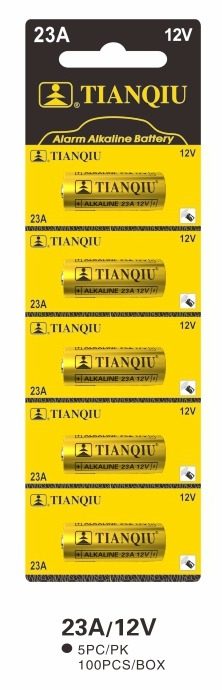
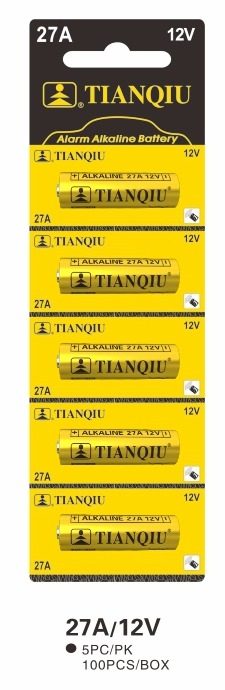
The difference is the diameter, and it decides the capacity. Our 23A is 10.3 mm across and 28.5 mm long with a declared 50 mAh; our 27A is 8.0 mm across and 28.2 mm long with a declared 20 mAh. Voltage, chemistry and contact layout are identical.
That is the whole comparison in one paragraph. Everything below is the detail behind the numbers: what each figure is measured against, and where it came from.
| Specification | 23A — our model | 27A — our model |
|---|---|---|
| Nominal voltage | 12 V | 12 V |
| Chemistry | Alkaline Zn-MnO₂ (non-rechargeable) | Alkaline Zn-MnO₂ (non-rechargeable) |
| Diameter | 10.3 mm | 8.0 mm |
| Length | 28.5 mm | 28.2 mm |
| Declared capacity | 50 mAh | 20 mAh |
| Declared MAD (20 kΩ continuous to 7.2 V, 20 ± 2 °C) | 95.0 hours | 40.0 hours |
| Approx. weight | 7.9 g | 4.8 g |
| Construction | Eight miniature cells stacked in series | Eight miniature cells stacked in series |
| Trade / IEC-style code | 23A · A23 · MN21 · 8LR932 · 1181A | 27A · A27 · MN27 · L828 · 8LR732 |
| Standards listed against the model | IEC 60086-1, -2, -3, -5 | IEC 60086-1, -2, -3, -5 |
| EU declaration number | TQ-EUDOC-23A-20260701 | TQ-EUDOC-27A-20260701 |
Capacity, weight and MAD are the figures we declare on the two technical data sheets; the MAD test condition is printed with them (20 kΩ continuous discharge to 7.2 V at 20 ± 2 °C). Diameters are the industry dimensions: Energizer publishes 10.30 × 28.50 mm for the A23 and 8.00 × 28.20 mm for the A27.
Two figures on that table deserve a warning before you compare them with anything else you read online.
- Capacity depends on the end voltage. Our 27A is declared at 20 mAh to 7.2 V. Energizer declares 22 mAh for the A27 — but tested to 6.0 V, a lower stop point, which always yields a larger number. The ANSMANN A27 data sheet splits the same cell into a 20 mAh rating and a 50-hour nominal discharge time to 6.0 V. Same cell, three honest numbers, three test conditions.
- MAD is the number that answers “how long”. Minimum average duration is the service time on a defined load, and it is the only figure that compares two cans of different sizes fairly. On our own test the 23A runs 95.0 hours and the 27A 40.0 hours.
Are a 23A and a 27A interchangeable?
Electrically yes, mechanically only where the holder grips the slimmer can. Both cells present 12 V across two flat contacts, so a device will usually work with either — but the 27A is 2.3 mm narrower, and a rigid plastic cradle tooled around a 10.3 mm cell will not hold an 8.0 mm cell firmly.
The failure mode is not dramatic, which is what makes it worth stating. A 12 V remote draws a short pulse when the button is pressed; if the cell sits loose, that pulse can drop out intermittently — the doorbell that works from the porch and not from the gate, the fob that needs two presses. A spring-contact holder can absorb the difference; a moulded sled cannot.
Working rule, in order:
- Read the old cell. The number is printed on the can, and it is the specification the device was built around.
- If it is unreadable, measure. 10.3 mm against 8.0 mm is easy to see against a ruler, and the difference is far bigger than any manufacturing tolerance.
- If the device is new to you, use the cross-reference tool. Our cross reference tool takes a printed code and returns the equivalents and the devices we list for it.
- Never force a cell. A thinner cell rattles, a thicker one cracks the cradle, and neither is a warranty conversation you want.
What actually changes if you fit the wrong one?
Runtime and fit, in that order. On our own MAD test the 23A delivers 95.0 hours against 40.0 hours for the 27A — roughly 2.4 times the service life on the identical load — so a doorbell or fob specified for a 23A will empty a 27A noticeably sooner. The arithmetic is not a guess: both numbers come from the same declared test condition.
Where the wrong cell is only slightly loose, the more common complaint is not “it stopped working” but “it works sometimes”. Intermittent contact in a remote reads to the user as a dead battery, and it is the first thing to check before buying another cell.
On the other side of the coin, capacity is not a reason to fit a wider cell where it does not belong. A 23A in a cradle tooled for a 27A will not seat at all, and forcing it damages the holder long before it powers the device.
Which devices take a 23A, and which take a 27A?
The devices overlap; the holder decides. Our own product data lists the 23A for car key fobs, garage door remotes, wireless doorbell push-buttons, alarm remotes and lighters, and lists the 27A for smaller remotes and doorbells. The table below is the same information arranged by device, with the note that matters in each case.
| Device | Cell our data lists | What to check |
|---|---|---|
| Wireless doorbell push-button | 23A | The push-button transmitter takes the 12 V cell — the chime unit runs on mains or its own supply |
| Garage door remote | 23A | Most handheld remotes; read the old cell before ordering |
| Car key fob / car remote | 23A | Proximity-entry fobs that recharge are not coin or 12 V cells at all — check the fob |
| Alarm remote / keypad fob | 23A | Panic buttons and arm/disarm fobs take the 12 V cylinder |
| Electronic lighter | 23A | The igniter draws a short high-current pulse |
| Smaller remotes and doorbells | 27A | Narrower housings tooled around the 8.0 mm can |
| 9V-block devices | Neither | A 9V block (IEC 6LR61 / 6F22) is a different can with a snap terminal — see the smoke alarm guide |
Applications are the ones our own product data publishes for each model; a device's manual or its old cell always overrides a general list like this one.
One confusion is worth killing early, because it costs people a wasted purchase every week: the wireless push-button on a doorbell or a garage remote is not a 9V device. A 9V block (IEC 6LR61 alkaline or 6F22 zinc-carbon) is a completely different can with a snap terminal, and it belongs in smoke alarms, multimeters and radios. The smoke alarm guide covers that family; the 12 V cylinder is this one.
Why is the 23A wider? Reading 8LR932 and 8LR732
Because the small cells stacked inside it are wider. A 23A is eight miniature cells in series inside one steel can, and the IEC-style designation spells that out: the leading 8 is the number of stacked cells, and the remaining digits are the sub-cell’s own size code — 8LR932 for the 23A against 8LR732 for the 27A.
The same naming logic runs through the whole range, and it is visible in cells you already know: LR44 is also written LR1154, which reads as 11 mm across and 5.4 mm high. So when a cross-reference chart gives you 8LR932 or 8LR732, it is telling you the internal build, not a brand — which is why both codes describe cells made by any number of factories to the same dimensions.
Two practical consequences:
- The eight-stack limits the current. Eight tiny cells in series give 12 V but very little energy, which is why these cells suit pulse loads — a remote, a bell push, a lighter — rather than anything continuous.
- The 12 V label is nominal. Open-circuit voltage on a fresh stack sits above 12 V, as the ANSMANN A27 data sheet shows (12.3–12.9 V new, 12.2–12.9 V after a year of storage at 20 °C). A device expecting a 12 V rail at low current is unbothered by that; a 9 V device is not a candidate at all.
What are the equivalent codes for each cell?
The codes fall into two groups: the maker’s own number for the same cell, and the cross-reference numbers buyers meet on a shelf. For the 23A, our model page already publishes the full chain with its sources; for the 27A, the manufacturer data sheets give four names and the rest are retail trade names.
| Printed code | What it is | Where we verified it |
|---|---|---|
| 23A | Our model number, printed on the cell | Our 23A technical data sheet |
| A23 · MN21 | Energizer and Duracell numbers for the same cell | Energizer A23 data sheet (ANSI-1181A, 12 V, 55 mAh) · Duracell cross-reference |
| 8LR932 | The IEC-style code: eight stacked LR932 cells | Duracell (IEC type) — listed on the 23A model page |
| 1181A | The ANSI/NEDA designation | Energizer A23 data sheet |
| V23GA · LRV08 · E23A · GP23A · 3LR50 | Other trade names in the same chart | Duracell, Rayovac and Panasonic columns |
| 27A | Our model number, printed on the cell | Our 27A technical data sheet |
| A27 | Energizer number for the same cell | Energizer A27 data sheet — 8.00 × 28.20 mm, 12.0 V, 22 mAh to 6.0 V |
| MN27 · L828 | Duracell number and the Japanese-market name | ANSMANN A27 data sheet 701381 (A27; 27A; MN27; L828) |
| 8LR732 | The IEC-style code: eight stacked LR732 cells | Market cross-reference codes — check the maker sheet you are buying against |
| GP27A · G27A · V27A · A27BP | Retail trade names for the same cell | Retail cross-reference listings — treat as unconfirmed until a datasheet confirms it |
We only mark a number as confirmed when a maker's own datasheet or cross-reference guide carries it. Where a code appears only in retail listings, we say so rather than merging it into the confirmed list — the full sourced chains are on the 23A model page and the 27A data sheet.
If you are matching a device to a cell rather than a code to a cell, the 23A model page and the 27A data sheet carry the same numbers with their declarations, and the cross-reference tool covers the rest of the range by printed code.
How should a 12 V stack be stored and disposed of?
Treat it as what it is: a non-rechargeable alkaline cell that will leak if abused, and one that must not be recharged. Store the cells in their retail pack at room temperature, keep the contacts from touching anything metal, and never charge one — a 12 V stack has no charge acceptance, and a charger will simply heat it until it vents.
Three rules cover almost every case:
- Do not mix old and new, or two brands. In a device that takes one cell this is moot; in a drawer of spares, keep the packs intact and dated.
- Do not carry loose cells with keys or coins. A short across a 12 V stack is a hot cell and a damaged remote. Keep the blister card or tape the contacts.
- Recycle it, do not bin it. Alkaline batteries should not go into general waste in most markets, and a 12 V stack is no exception. Our battery disposal guide covers the storage, taping and hand-over routine for used cells of every chemistry.
Our declared shelf life for both models is one year under normal storage conditions, so a retail programme should date the pack to the market it sells into rather than stockpiling — the same dating discipline we describe for private-label packaging.
How do you buy 23A and 27A cells for a retail or OEM programme?
Both cells are in our own range and both are stocked in the format retail programmes need: a 5-piece printed blister card, 100 pieces per inner box and 1,000 pieces per export carton, with OEM body printing and your own artwork on the card. What the programme has to pin down is the cell count, the dating line and the document set for the market.
What we supply and what we ask for:
- The cell, per model. The 23A at a declared 50 mAh and the 27A at a declared 20 mAh, each with its own technical data sheet rather than a family average.
- The EU file, per model. Both carry an EU declaration of conformity — TQ-EUDOC-23A-20260701 and TQ-EUDOC-27A-20260701 — with IEC 60086-1, -2, -3 and -5 listed against them. The document set is set out on battery certifications and EU battery compliance.
- The transport question, answered early. These are alkaline cells, not lithium, so UN38.3 does not apply to them. Lithium cells and packs are the ones that travel with that report, and mixing the two families on one order means two document sets.
- The pack and the print. Blister card, printed box or bulk, made and packed in our plant under your label, with the production date printed on the body in the format you specify — the same artwork cycle as any private-label packaging run.
- The minimum. First orders run from 50 cartons per product line, and mixed-model cartons are possible for a retail range that carries both 12 V cells; wholesale batteries explains how that is quoted.