 TIANQIU
An LR521 is the smallest button cell we run: a 1.5 V alkaline zinc-manganese dioxide cell 5.8 mm across and 2.1 mm high. It travels under several names at once — LR521, AG0 and LR63 all point at the same can — and the silver-oxide cell built in that can is the SR521SW, which the trade sells almost everywhere as the 379. This page sets out which number is which, what a 379 actually contains, and why a same-diameter cell from the next step up the ladder will not sit down in the holder.
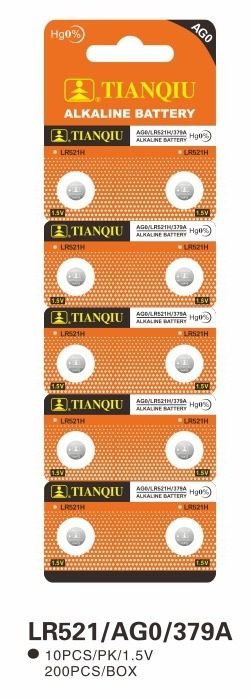
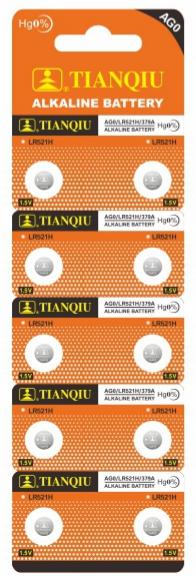
What is an LR521 battery?
An LR521 is a 1.5 V alkaline button cell 5.8 mm in diameter and 2.1 mm high, and our own data sheet rates it at 7 mAh. It is a primary cell, replaced rather than recharged, and it sits at the foot of our AG strip ladder as AG0 — the smallest diameter we produce.
The chemistry is the ordinary alkaline system: zinc and manganese dioxide. That is the same pair that runs a torch or a wall clock, scaled down to a 5.8 mm can, and the amount of active material a can that size can hold is what puts the capacity in single-digit milliamp-hours rather than the hundreds a cylindrical cell carries.
| Item | LR521 | Where the figure comes from |
|---|---|---|
| System and voltage | Zn-MnO₂, 1.5 V nominal, primary | Our data sheet for the model, republished on the LR521 model page |
| Size | 5.8 mm diameter × 2.1 mm high | Our own packing data for the AG0 strip — the smallest in the ladder; Renata prints 5.8 mm × 2.1 mm for the silver-oxide cell in this can |
| Declared capacity | 7 mAh | Our data sheet — 68 kΩ continuous to a 1.2 V cut-off at 20 ± 2 °C |
| Median discharge time | 350 hours | Same test condition as the capacity figure |
| Approx. weight | 0.2 g (only for reference) | Our data sheet |
| Declared storage | One year under normal storage conditions | Our storage statement for this model |
| Materials | Manganese and graphite | The model's technical file |
| EU declaration | TQ-EUDOC-LR521-20260701 | Our declaration of conformity, tested to IEC 60086-1:2021, -2:2021, -3:2021 and -5:2021 |
The values above are the ones our own technical file carries for this model, at the test condition printed with them. Where a manufacturer document adds a figure for the same can it is named in the tables below instead of being folded into ours, so that two data sheets are never quoted as though they described one product.
The full specification set — materials list, storage statement and the document references — is on the LR521 model page. What that page does not carry is a cross-reference table, which is why the codes are set out here instead.
What is an LR521 battery equivalent to?
At 5.8 mm there is only one alkaline cell, so the alkaline codes in circulation all name the same can: our model LR521, our own strip code AG0, and the retailer codes LR63, 179 and 379A. The question then splits by chemistry rather than by size, because that can is also built in silver oxide.
| Code you may see | What it is | Source status |
|---|---|---|
| LR521 / LR521H | Our own model code, and the code printed on the cell | Confirmed — our data sheet and the model page |
| AG0 | The strip code we build the 5.8 mm cell on, and the AG-series name retailers use for it | Confirmed as our own strip code; the AG names are catalogue conventions, not IEC or ANSI designations |
| LR63 | Retailer code for the alkaline 5.8 mm cell | Trade listings only — we did not find it in a manufacturer cross-reference chart |
| 179 | Retailer code for this size, and a term buyers search for next to the alkaline cell | Trade listings only — treat as unconfirmed; read the marking on the cell in front of you |
| 379A | Retailer code seen beside the AG series for this size | Trade listings only — treat as unconfirmed |
| SR521SW | The silver-oxide cell in the same can, and the standard watch fit at this size | Confirmed — Renata's cross-reference guide prints SR521SW in the Maxell, Panasonic, Murata and Toshiba columns |
| 379 | The number the same silver-oxide cell is retailed under | Confirmed — Energizer's 379 data sheet, designation ANSI/NEDA-1191SO |
Every manufacturer cross-reference guide we hold documents the silver-oxide code for this can and not the alkaline one: makers chart their own cells against each other, and our alkaline strip is charted against our own part numbers only. That is why the AG, LR and numeric codes above are marked as trade usage rather than quoted as manufacturer designations.
Hold one of those codes and want the size behind it? The cross-reference tool maps a code to the dimensions it implies, and the button cell hub lists every button size we produce.
Is a 379 the same as an LR521?
No. The 379 is the silver-oxide cell built in the same 5.8 mm × 2.1 mm can, and it is a different product at a different voltage: 1.55 V rather than 1.5 V, with a flatter discharge and roughly twice the capacity of the alkaline version in the identical space.
Renata’s guide is the clearest evidence that the number and the can are separate things. One page for its own 379 (OEM) lists the same 5.8 mm × 2.1 mm cell under SR521SW for Maxell, Panasonic, Murata and Toshiba, 379 for Energizer Eveready and Rayovac, V379 for Varta, D 379 for Duracell, 280-59 for Citizen, SB-AC/DC for Seiko and JA for Timex — the same physical cell, nine different shop codes.
| Document | Declared capacity | Condition and other figures printed with it |
|---|---|---|
| Our LR521 data sheet (alkaline) | 7 mAh | 350 h median discharge at 68 kΩ to 1.2 V at 20 ± 2 °C; 0.2 g |
| Renata 379 (OEM) product page | 16 mAh | 1.55 V; 0.23 g; 5.8 mm diameter × 2.1 mm |
| Energizer 379 data sheet | 18 mAh to 1.2 V | 805 h at 68 kΩ continuous at 21 °C; 0.21 g; 0.06 cm³; 20–60 Ω impedance at 40 Hz |
Two silver-oxide documents, two capacities for one can — 16 mAh and 18 mAh — because the load and the temperature printed beside a number are part of the number. Our alkaline cell sits lower again, and that gap is the practical point: for a device drawing a steady few microamps, silver oxide carries materially more energy in the same space.
The consequence shows up in timekeeping rather than in fit. A quartz movement designed around a silver-oxide cell expects a voltage that stays near 1.55 V for most of the cell’s life, and an alkaline cell tapers from about 1.5 V downwards the whole way — so a watch can start losing time long before the cell reads empty. Where the device was specified for silver oxide, fit silver oxide; where it was specified for alkaline, the LR521 is the cheaper and perfectly serviceable answer.
Which cells will not fit a 5.8 mm holder?
Diameter settles the question before height even gets a vote. Every step up our strip ladder is wider than the compartment a 5.8 mm cell was cut for, and at this size a millimetre is not a tolerance problem — a cell that much wider simply will not enter the holder.
| Cell you might be offered | Size | Why it does not replace an LR521 |
|---|---|---|
| LR621 / AG1 | 6.8 × 2.1 mm | 1.0 mm wider; the height matches the LR521 exactly, which is what makes it the tempting wrong answer |
| LR626 / AG4 | 6.8 × 2.6 mm | Wider and taller — two mismatches at once |
| LR721 / AG11 | 7.9 × 2.1 mm | Same 2.1 mm height, 2.1 mm wider; a 7.9 mm can will not drop into a 5.8 mm recess |
| LR41 / AG3 | 7.9 × 3.6 mm | 2.1 mm wider and 1.5 mm taller |
| LR1130 / AG10 | 11.6 × 3.1 mm | Twice the diameter, and 1.0 mm taller than the recess a 2.1 mm cell sits in |
| SR521SW / 379 | 5.8 × 2.1 mm | The one row that does fit — same can, different chemistry, so check the voltage the device expects before swapping |
Sizes are from our own packing data for these strips, the same figures the button cell hub publishes. Height is the second test, not the first: two of the rows above share the LR521's height exactly and still will not fit, because the diameter is wrong.
Can a lithium coin cell replace an LR521?
No — a lithium coin cell is a 3.0 V part and the LR521 is a 1.5 V cell, so the two are not interchangeable even if a 5.8 mm lithium cell existed. It does not: our lithium button range starts at 10.0 mm and runs upwards from there.
That gap matters because “coin cell” is used loosely for both chemistries. A device built around an LR521 expects roughly 1.5 V, and a 3.0 V cell pushed into the same holder would be over-voltage rather than a replacement — the same mistake in reverse when a device that wants 3.0 V is fed an alkaline button. The lithium coins that look similar in a photograph sit at 10.0 mm and above, as the CR2032, CR2025 and CR2016 comparison and the CR1025 model page set out. Match the voltage first and the can second, in that order.
Which devices take an LR521?
The trade references for this size list small watches, toys, calculators and remotes, and Energizer’s own 379 data sheet carries the line “designed for use on continuous low drain”. A 5.8 mm cell is built for a small housing drawing very little current.
That is worth holding on to when a device misbehaves after a replacement. A cell this size has no surplus to give: it is specified for a movement or a low-drain fob, not for a lamp, a motor or a backlight, and a device with any of those will flatten it quickly and then read as a fault rather than as a flat battery. Two habits keep replacements honest — read the code off the cell you are taking out rather than out of the manual, because a manual is reprinted across model years while the cell fitted can change without it, and confirm the chemistry the device expects before you buy, since the same can comes in both alkaline and silver oxide. The watch battery replacement guide covers the hand tools and the case-back sequence for the watch side, and the button cell guide sets out how the LR, CR and SR families differ.
Can an LR521 be recharged?
No, and no charger setting changes that. The LR521 is a primary zinc-manganese dioxide cell, and driving current back through it can make the can leak or burst in a sealed compartment — so a rechargeable coin cell has to be a different product with its own chemistry, not the same cell put back on a charger.
A button cell also carries a risk that outlives its charge: a flat cell is still a burn hazard if a child swallows it, so keep loose and used cells in their packaging, well out of reach, and hand them in at a collection point instead of adding them to household waste. The disposal guide sets out which routes accept button cells and how to tape a spent cell’s terminals so it cannot short against another.
Is the LR521 covered by the EU battery regulation?
Yes. The cell and the pack it is sold in fall under Regulation (EU) 2023/1542, and each LR521 consignment ships with its own EU declaration of conformity, reference TQ-EUDOC-LR521-20260701, tested against IEC 60086-1:2021, -2:2021, -3:2021 and -5:2021, plus an MSDS.
Because the LR521 is an alkaline cell rather than a lithium one, UN38.3 does not apply to it — that test belongs to the lithium cells in the range. If you need to match a document to a question, whether for a customs file, a retailer’s compliance pack or a tender, the certification matrix shows which paper answers which, and the EU battery regulation page covers the marking, warnings and waste duties that apply to a button cell and its packaging.
What does an LR521 order have to state?
An LR521 order turns on four variables: which cell, which pack, which market and how many. On an OEM programme the brand carried by the cell and the card belongs on that list as well, because the label is part of the order and not something bolted on at the end.
The cell runs on our own alkaline button lines with no mercury added, and leaves the plant either bare or dressed for retail — a blister card or a printed box — with the printing done on the same site that makes the cell, so artwork proofs and specification changes travel together. A first order is quoted from 50 cartons per product line and a retail programme can mix models inside a carton; the MOQ guide explains what sets that floor, and the wholesale page carries the terms for the button range.
Where the figures on this page come from
Every number here is quoted from a document you can check or ask for — our own published data for the LR521, the manufacturer data sheets and cross-reference guide named below, and our own packing data for the button-cell strips.
- Capacity, discharge time, weight, materials, storage, the standards list and the EU declaration — our own documentation for the LR521 we manufacture, published on the LR521 model page and in the technical file behind it, tested at 20 ± 2 °C.
- The 5.8 mm × 2.1 mm size for this can — our own packing data for the AG0 strip, the same figures the button cell hub publishes, plus the Renata 379 (OEM) product page, which prints 5.8 mm × 2.1 mm for the silver-oxide cell in the identical can.
- 16 mAh, 1.55 V, 0.23 g and every maker code in the equivalent table — Renata’s 379 (OEM) product page and its cross-reference guide, which names Maxell, Panasonic, Murata, Toshiba, Energizer Eveready, Varta, Rayovac, Duracell, Timex, Citizen and Seiko against their own codes.
- 18 mAh to 1.2 V, 805 hours at 68 kΩ, 0.21 g, 0.06 cm³, the 20–60 Ω impedance and the ANSI/NEDA-1191SO designation — Energizer’s 379 product data sheet (Form 379GL0720), published at data.energizer.com.
- The 6.8 mm, 7.9 mm and 11.6 mm comparison rows, and the 10.0 mm lithium floor — our own packing data for the AG1, AG4, AG11, AG3 and AG10 strips, the same figures published on the button cell hub, and our own lithium button range, whose smallest size is the 10.0 mm cell on the CR1025 model page.
- The swallowing hazard, the non-rechargeable statement and the collection duty — the safety note printed on the manufacturer data sheet for this can and the marking duties summarised on the EU battery regulation page.