 TIANQIU
An LR721 is a button cell 7.9 mm in diameter and 2.1 mm high, built in alkaline zinc-manganese dioxide at 1.5 V nominal. It is the shallowest rung of the four-height ladder we run at that diameter, and most buyers reach it from the other end of the trade: holding a cell stamped 362, 361, AG11 or SR721SW and needing to know whether the number in hand describes the cell they are about to fit or a different chemistry entirely.
Two questions sit under the one word equivalent. Fit is a matter of the can — 7.9 mm across, 2.1 mm high — and nothing else. Behaviour is a matter of chemistry, and the two chemistries sold into this can do not discharge alike. This page separates them, names the documents each number comes from, and flags the neighbours that fit the holder without belonging in it.
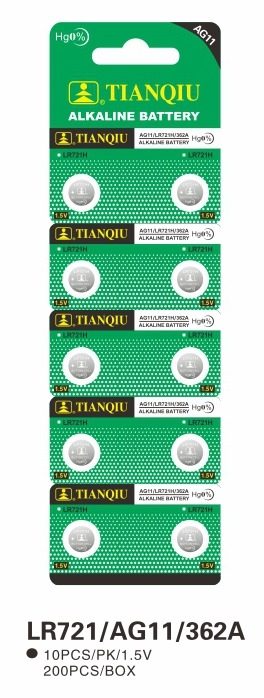
What is an LR721 battery?
The LR721 is a primary alkaline cell — zinc and manganese dioxide, 1.5 V nominal, 7.9 mm across and 2.1 mm high. It is replaced when flat rather than recharged. We print it as LR721/LR721H: the trailing H is a second spelling for the same cell rather than a second product, and both forms appear on our packaging and paperwork.
What the dimensions mean in practice is easier to see than to describe. At 2.1 mm the cell is thin enough to sit under a case back without a spacer, which is why this size turns up in flat devices — a card calculator, a slim remote, a thermometer, a watch at the low end of the movement range. The chemistry chosen for it is the inexpensive one: alkaline gives up voltage steadily from the first hour, which is acceptable in a device that simply runs until it stops.
Our declared figures for the model, as carried on the model page and the sheet behind it:
| Property | Our LR721 / LR721H |
|---|---|
| IEC code | LR721 |
| Chemistry | Alkaline zinc-manganese dioxide (Zn-MnO₂), non-rechargeable |
| Nominal voltage | 1.5 V |
| Size | 7.9 mm diameter; carried on our AG11 strip code at 2.1 mm high |
| Declared capacity | 13 mAh |
| Approx. weight | 0.35 g (only for reference) |
| Declared discharge time | 460.0 hours to a 1.2 V cut-off at 47 kΩ, 24 h/day, 20 ± 2 °C |
| Storage, as declared | Twelve months in normal storage |
| Materials | Manganese and graphite, 0% mercury |
| Standards relied on | IEC 60086-1, -2, -3 and -5 (2021) |
| EU declaration | TQ-EUDOC-LR721-20260701 (alkaline button family) |
These are our documented figures for the cell we build, not estimates: the weight is approximate because it moves with the seal and the can lot, and the capacity belongs to the load and cut-off printed beside it. If a number is going onto a customer's specification, take it from the data sheet for that model rather than from this page.
The model page carries the same rows, together with the materials breakdown and the document references. What it does not carry is a cross-reference table — that is the gap this article is written to close.
The codes an LR721 answers to
Four naming systems meet on this one can, and a buyer holding any single one of them usually needs the others before an order can be placed. The table below sorts the codes by what each name actually is, because a wholesale strip label, an IEC designation and a maker’s retail number are three different kinds of claim.
The split that matters most runs down the middle of it: everything in the alkaline block describes our cell, and everything in the silver-oxide block describes a different product that happens to be built to the same 7.9 × 2.1 mm outline.
| Code you may see | What it is | Source status |
|---|---|---|
| LR721 | The IEC designation for this 1.5 V alkaline size | Confirmed — from the standards themselves and from our own data sheets |
| LR721H | Alternative designation for the identical cell | Confirmed — our product name, printed as LR721/LR721H |
| AG11 | Catalogue number used for this 7.9 mm size; the A-and-G series is a trade convention, not an IEC code | Our own packing data carries the strip as AG11SP10 at 7.9 × 2.1 mm; the maker charts index this size by silver-oxide codes instead, so treat AG11 as a label rather than a standard |
| L721, SB-AK and other 7.9 mm numbers on retail packs | Retail labels that group watch battery numbers together | Listings rather than maker documents — the SB-AK code in particular belongs to the silver-oxide cell, not to the alkaline one |
| SR721SW | Low-drain silver-oxide designation for the same can at 1.55 V | Confirmed — Maxell chart, Murata selection guide, Renata cross-reference guide |
| 362 | Retail number for the SR721SW | Confirmed — Energizer, Duracell, Rayovac, Varta and Renata columns of the charts cited below |
| SR721W | High-drain silver-oxide designation for the same can at 1.55 V | Confirmed — Maxell chart and Murata selection guide, on a separate row from the SR721SW |
| 361 | Retail number for the SR721W | Confirmed — Energizer, Duracell, Rayovac and Varta columns of the Maxell chart |
| SB-AK, 280-29, 601 | Seiko, Citizen and Bulova codes for the 362 / SR721SW | Confirmed — the same three columns of the Maxell chart, corroborated by Renata's cross-reference guide |
| SB-BK, 280-53 | Seiko and Citizen codes for the 361 / SR721W | Maxell chart, Seiko and Citizen columns of the 361 row |
Numbers we could not trace to a maker's own document are labelled as listings so that a code on a pack in your hand is still recognisable. The A-and-G series is applied inconsistently across the trade, and vendors disagree about which of the 7.9 mm heights each letter denotes, which is why the strip code is given with its measurement every time.
Given a code and needing its measurement, the cross-reference tool turns a name into dimensions, and the button cell hub lists every button size we make.
Is a 362 the same as a 361?
Not the same product: one can, two silver-oxide cells, divided by the drain each was characterised for rather than by any dimension. The Maxell chart carries them on separate lines at an identical 7.9 × 2.1 mm and files the 362 under watch low drain and the 361 under watch high drain — a distinction a one-line chart destroys completely.
The practical rule is the one the manufacturer’s own split implies. A continuous load with a modest draw — a watch movement, a thermometer, a standby clock — belongs with the low-drain 362. A device that pulses current, such as a movement with a lamp or an alarm, is the case the high-drain 361 was characterised for.
| Source | SR721SW / 362 | SR721W / 361 |
|---|---|---|
| Maxell cross-reference chart (issue October 2017) | One row at 7.9 × 2.1 mm beneath watch low drain: 362, D362, 362, S, V362, 362, 601, SB-AK, 280-29 across the Energizer, Duracell, Rayovac, Timex, Varta, Renata, Bulova, Seiko and Citizen columns | One row at the same size beneath watch high drain: 361, D361, 361, X, V361, 361, SB-BK, 280-53 across the same columns, with the Bulova cell left blank |
| Murata watch battery selection guide | Lists SR721SW at 7.9 mm × 2.1 mm, 1.55 V, 25/29 mAh, against the JIS (IEC) designation SR58 | Lists SR721W at the same 7.9 mm × 2.1 mm, 29 mAh, on the high-drain table under the same SR58 designation |
| Renata cross-reference guide for its 362 | Names the cell SR721SW at Maxell, Panasonic, Murata and Toshiba; Eveready 362 at Energizer; V362 at Varta; 362 at Rayovac; 280-29 at Citizen; SB-AK/DK at Seiko; S at Timex | Entered in the same table as Duracell D 361/362 — one line, two drain ratings, which is exactly how the pair comes to look interchangeable |
Read this as three makers agreeing on the size and disagreeing on how much of the pair to show you. Whoever supplies the device put one of these two cells in it; supply the number the device asks for rather than the one that happens to be in the drawer.
Is an LR721 the same as an SR721SW?
The can matches; the chemistry inside it does not, and only one of the two cells is the one the device was built for. The alkaline LR721 is a 1.5 V zinc-manganese dioxide cell; the SR721SW is silver oxide at 1.55 V, and the small difference in nominal voltage is the least of what separates them.
What an owner notices is how the voltage behaves as the cell empties. Silver oxide stays close to nominal for most of its working life, which is why a movement or an instrument that reads battery state from voltage keeps performing on it. Alkaline descends from the moment it is loaded, so the same holder gives a different experience depending on which cell is in it — and the capacity figures printed by the two supply chains are not measured the same way.
| Property | LR721 / LR721H (alkaline) | 362 / SR721SW (silver oxide) |
|---|---|---|
| Voltage, nominal | 1.5 V | 1.55 V |
| Chemistry | Zinc-manganese dioxide | Zinc–silver oxide (monovalent), low-drain type |
| Can | 7.9 mm diameter, 2.1 mm high on our AG11 strip code | 7.9 mm × 2.1 mm — Renata prints the same measurements for its 362 |
| Capacity, as declared | 13 mAh on our sheet, over 47 kΩ to a 1.2 V cut-off | 23 mAh on Renata's product page for the 362, with its data sheet qualifying the figure as a discharge over 34.8 kΩ at 20 °C to a 0.9 V cut-off; the cell weighs 0.39 g |
| Approx. weight | 0.35 g (our data) | 0.39 g (Renata) |
| Temperature range | Not declared for this model; ask us for the sheet | -10 °C to +60 °C on the maker's data sheet for this number |
| Discharge curve | Steps down from the first hour of load | Holds near nominal for most of the discharge |
| Typical duty | Devices run flat and replaced | Watches and instruments, where voltage has to stay steady |
Two mAh figures appear here from two different documents and they are not comparable: ours is measured over a heavier load than the silver-oxide figure, and a heavier load returns a smaller number for the same cell. Compare capacities only between tests run at the same load and the same cut-off.
So a 362 drops into an LR721 holder and powers the device — that is fit, and fit is settled. Whether it behaves as the device expects is a separate question, and it is answered by whichever chemistry the maker specified on the drawing.
Does a 364 replace an LR721?
No, and this is the substitution worth naming because retail charts invite it. Several put 364 and LR721 on the same line, and both are watch-trade numbers, which makes the pairing look authoritative. Measured, they are not the same cell at all.
The 364 is an SR621SW and measures 6.8 × 2.15 mm — 1.1 mm narrower than the 7.9 mm LR721. In a well cut for 7.9 mm, a 6.8 mm cell sits loose and never reaches positive contact, so the device behaves as though the battery were flat while the battery itself is untouched. Height is what makes the error easy to miss: 2.15 mm against 2.1 mm is close enough that a side-by-side glance tells you nothing.
| Number on the pack | Cell it really is | Dimensions | Why it does not belong here |
|---|---|---|---|
| 364 | SR621SW, silver oxide at 1.55 V | 6.8 × 2.15 mm (Maxell chart; Murata guide) | 1.1 mm too narrow — no positive contact in a 7.9 mm well |
| 379 | SR521SW, silver oxide at 1.55 V | 5.8 × 2.15 mm (Maxell chart; Murata guide) | 2.1 mm too narrow; a common mix-up wherever 364 is confused with 362 |
| 377 | SR626SW, silver oxide at 1.55 V | 6.8 × 2.6 mm (Maxell chart; Murata guide) | Narrower and thicker at once — fails on both measurements |
| LR726, LR41, LR754 | Our own alkaline cells at this 7.9 mm diameter | 2.6 mm, 3.6 mm and 5.4 mm high respectively | Correct diameter, too tall: the back will not seat on a compartment cut for 2.1 mm |
All of the first three fit their own holders correctly — the fault is in the chart, not in the cell. When a number arrives without a device to go with it, measure the cell that came out: diameter first, then height, then read the code off the can.
The watch battery replacement guide covers the measuring side of this, and the LR726 guide walks the same diameter one rung up, at 2.6 mm.
Which devices take an LR721?
Maxell files this size under watch batteries and Renata rates its 362 as a low-drain watch cell, so the movement is where most of these cells end up. The 2.1 mm height also puts the LR721 inside flat, low-drain devices where a thicker cell would push the case apart: card calculators, slim remotes, digital thermometers and small toys.
Whichever device you are feeding, one habit prevents most bad replacements — read the number off the cell you take out, never off a manual. A manual is printed for a production run that has usually ended, and the cell actually fitted can change between runs without a new edition of the book appearing. Where the device specifies a silver-oxide number, order that chemistry: an alkaline LR721 will seat in the holder, but it will not hold the calibration the movement was adjusted to.
Is the LR721 covered by the EU battery regulation?
It is. Regulation (EU) 2023/1542 reaches both the cell and the pack it is sold in, and each LR721 consignment is issued with its own declaration of conformity for that regulation — TQ-EUDOC-LR721-20260701 — citing test work to IEC 60086-1:2021, -2:2021, -3:2021 and -5:2021, with an MSDS alongside.
UN38.3 tests the transport of lithium cells, so it has no bearing on this chemistry; the lithium items we make are the ones that carry that report. Where a compliance file has to be assembled — for a customs broker, a retailer’s onboarding pack or a tender — the certification matrix pairs each document with the question it answers, and the EU battery regulation page sets out the marking, warning and take-back duties that follow a button cell and its packaging.
A spent button cell is still hazardous, and the hazard has nothing to do with remaining charge: a swallowed cell can burn through tissue in a child. Keep loose and spent cells out of reach, tape the terminals of a dead cell before it goes into a collection box, and return it to a collection point rather than the household bin — the disposal guide lists the routes that accept button cells.
What does an LR721 order have to state?
Four things have to be settled before a button-cell order can be priced: which cell, in which pack, for which market and at what quantity. A private-label programme adds two more — the brand printed on the cell itself and the artwork on the card. Both are part of the purchase, not decoration bolted on afterwards.
The cell leaves our alkaline button lines at 0% mercury, and it can be dressed as bare cells, a printed blister card or a boxed presentation. Because cellmaking and printing sit in the same plant, an artwork proof and a specification change move together instead of being chased between two suppliers. First orders begin at 50 cartons per product line, and a retail programme may mix several SKUs inside one carton; the MOQ guide explains what fixes that floor and the wholesale page gives the terms across the button range.
Where a market regulates button-cell packaging, say so at the enquiry stage: the obligation follows the retail pack rather than the cell, so a child-resistant card or a printed warning has to be built into the design before the first proof is signed off. The packaging guide sets out that print cycle and the US button-cell packaging law note covers the American requirement.
Where every figure here comes from
Every figure above can be traced to a named document. Where a value comes from one manufacturer rather than from a standard, that manufacturer’s sheet is the source quoted. Ask us for any of these files and we will send them.
- Capacity, discharge time, weight, storage, materials and the EU declaration — our published data for the LR721 / LR721H we build, matched on the LR721 model page, tested at 20 ± 2 °C.
- The 7.9 × 2.1 mm measurement and the AG11 strip code — our own packing data, which matches the sizes shown on the button cell hub; the same file carries the AG2, AG3 and AG5 strip codes at this diameter.
- 23 mAh, 1.55 V, 0.39 g and the 7.9 mm × 2.1 mm body for the silver-oxide cell — Renata’s product page for its 362, with the maker’s data sheet (rev. 362MF.04) printing the same 23 mAh against the test condition it belongs to: a 34.8 kΩ discharge at 20 °C to a 0.9 V cut-off.
- The cross-reference names for the 362 — Renata’s cross-reference guide for that number, which places the same cell at Maxell, Panasonic, Murata and Toshiba as SR721SW, at Energizer as Eveready 362, at Varta as V362, at Rayovac as 362, at Duracell as D 361/362, at Timex as S, at Citizen as 280-29 and at Seiko as SB-AK/DK.
- The two rows at 7.9 × 2.1 mm, the drain headings and every maker code listed beside them — the Maxell Micro Battery Cross Reference and Replacement Guide, issue dated October 2017, where the SR721SW and SR721W occupy separate rows at one size and the chart’s alkaline section carries no LR721 row at all.
- SR58 and the second set of maker codes — Murata’s watch battery selection guide, which gives both silver-oxide cells at 7.9 mm × 2.1 mm and prints SR58 as the JIS (IEC) designation for each.
- The 6.8 × 2.15 mm and 5.8 × 2.15 mm measurements used in the substitution table — the same two charts, on the SR621SW and SR521SW rows.
- The swallow hazard, the warning against recharging and the take-back duty — the statements our own product and compliance pages publish for button cells, and the duties described on the EU battery regulation page; the collection and marking obligations come from the regulation rather than from the cell.