 TIANQIU
An LR726 is a button cell 7.9 mm in diameter and 2.6 mm high, built in alkaline zinc-manganese dioxide at 1.5 V nominal. It occupies the middle rung of a four-step height ladder we run at that diameter, and most people meet it sideways — through the silver-oxide cell of the same size that the watch trade sells under a different number. Buyers arrive holding a 397, a 396, an AG2 or an L726 and want one question settled: will the cell in my hand work here? The honest answer has two parts, because fit is decided by the can and behaviour by the chemistry.
Below: the codes the LR726 answers to, the split that separates a 397 from a 396, the same-diameter cells that fit the hole without holding contact, and the four details an OEM enquiry has to carry. Each number is tied to the document it came from, and we will send that document on request.
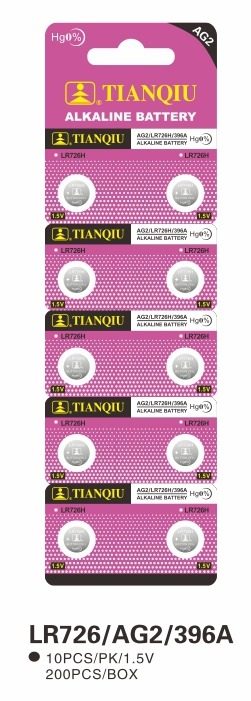
What is an LR726 battery?
The LR726 is a primary button cell — zinc and manganese dioxide, 1.5 V nominal, 7.9 mm across and 2.6 mm high — and it is replaced, never recharged. We print the model as LR726/LR726H: the trailing H is not a second product but an alternative designation for the same cell, and both spellings appear on our packaging and data sheet.
Chemistry sets both the nominal voltage and the way the discharge curve falls. Geometry settles whether the cell enters the compartment at all. Shrink the familiar zinc-and-manganese-dioxide couple down to a 7.9 mm can and what you get is a cell that surrenders its capacity along a gently descending curve instead of holding a plateau — which is precisely why it is the cheap, sensible choice in a device built to be run flat and thrown away.
Our declared figures for this model, as carried on the model page and the sheet that backs it:
| Property | Our LR726 / LR726H |
|---|---|
| IEC designation | LR726 |
| Chemistry | Alkaline zinc-manganese dioxide (Zn-MnO₂), non-rechargeable |
| Nominal voltage | 1.5 V |
| Size | 7.9 mm diameter; packed on our AG2 strip, carried at 2.6 mm high |
| Declared capacity | 17 mAh |
| Approx. weight | 0.43 g (only for reference) |
| Declared discharge time | 430.0 hours to a 1.2 V cut-off at 33 kΩ, 24 h/day, 20 ± 2 °C |
| Declared storage | Twelve months in normal storage |
| Critical materials | Manganese and graphite, 0% mercury |
| Test basis | IEC 60086-1, -2, -3 and -5 (2021) |
| EU declaration | TQ-EUDOC-LR726-20260701 (alkaline button family) |
These rows are our own documentation for the cells we build, not estimates. Treat the weight as approximate, because it shifts with the seal and the can lot, and read the capacity only alongside the load and cut-off it was measured at. For a number you intend to pass on to a customer, request the data sheet for the exact model.
The materials breakdown, the storage statement and the document references all sit on the LR726 model page. What that page omits is a cross-reference table, and filling that gap is this article’s job.
What is an LR726 battery equivalent to?
Any 7.9 mm cell of the same chemistry and the same 2.6 mm height is an equivalent, and in the trade the LR726 answers to LR726, LR726H and AG2. The silver-oxide version of that same can is the SR726SW — the 397 on a retail card — with the SR726W, retailed as 396, as the version intended for higher drain.
Four separate naming systems converge on this one cell, which is why somebody holding a single number usually needs the other three before they can order with confidence. The table sorts them by what each name really is, because a catalogue label, an IEC designation and a maker’s part number are three different kinds of claim.
| Code you may see | What it is | Source status |
|---|---|---|
| LR726 | IEC code for this 1.5 V alkaline size | Confirmed — standards and data sheets; our own model designation |
| LR726H | Alternative designation for the identical cell, used alongside LR726 | Confirmed — our product name (LR726/LR726H) and our packaging |
| AG2 | Wholesale catalogue name for this 7.9 mm size; A-and-G labels are a trade convention, not a standard | The ten-piece strip we build at this size is coded AG2SP10. Catalogues disagree about which 7.9 mm height AG2 denotes, so measure the cell in front of you |
| L726 / 397A | Other catalogue numbers seen on this size | Reseller listings only — not found in any maker's cross-reference chart, so treat as unchecked |
| SR726SW | Low-drain silver-oxide designation for the same can at 1.55 V | Confirmed — Renata data sheet; Maxell cross-reference chart |
| SR726W | High-drain silver-oxide designation for the same can at 1.55 V | Confirmed — Renata product page; Maxell cross-reference chart |
| 397 | The retail number for the SR726SW | Confirmed — printed in the Maxell, Energizer, Varta, Duracell and Renata columns of the cross-reference charts |
| 396 | The retail number for the SR726W | Confirmed — printed in the Maxell, Energizer, Varta, Duracell and Renata columns of the cross-reference charts |
| SR59 | The code the Maxell chart prints in its IEC column for this 7.9 × 2.6 mm silver-oxide size | Confirmed — the chart's IEC column, on both the SR726W and the SR726SW rows; those rows sit in the chart's own model column |
| Type N / 26 and Type V / 29; Eveready 397 / 396; D 396/397; SB-AL and SB-BL; 280-28 and 280-52 | Maker and retail codes covering both silver-oxide cells at this one size | Energizer's cross-reference guide and Renata's cross-reference tables, each naming the maker against its own code |
Rows marked as reseller listings are here so that a number printed on a pack in your hand is recognisable; we could not verify them against a second maker's document, so treat them as unchecked and inspect the cell itself. Every A-and-G name is a trade convention rather than an IEC or ANSI code, and vendors do not apply it the same way.
Handed one of these codes and needing its size, the cross-reference tool converts the name into dimensions, and the button cell hub carries every button size we make.
Is a 397 the same as a 396?
Not the same product — two silver-oxide cells sharing one can and divided by the drain each was characterised for, not by any dimension. The Maxell chart places the SR726W under watch high drain and the SR726SW under watch low drain, and the retail numbers follow that split.
Cross-reference charts routinely blur this. Printing 396 and 397 on a single line says only that both numbers fit the same holder; it says nothing about whether they behave alike. Supply whichever number the device asks for.
| Source | Rated capacity | Figures printed alongside |
|---|---|---|
| Renata 397 data sheet (SR726SW, low drain) | 32 mAh | 1.55 V; discharged over a 25.5 kΩ load to a 1.2 V cut-off at 20 °C; 7.90 mm × 2.60 mm according to IEC 60086-3; −10 °C to +60 °C; below 0.48 g |
| Renata 396 product page (SR726W, high drain) | 32 mAh | 1.55 V; 0.48 g; 7.9 mm × 2.6 mm; the manufacturer's cross-reference table for this number names the same maker codes as its 397 page |
| Maxell cross-reference chart, both rows | — | One row at 7.9 × 2.6 mm for the SR726W (396) under watch high drain and a second at the same size for the SR726SW (397) under watch low drain; both rows print SR59 in the chart's IEC column, with SR726W and SR726SW in the chart's own model column |
One size, two maker documents, and a split that follows drain rather than dimension. The Maxell row belongs here because anyone comparing charts will encounter it: Maxell lists the two cells on separate lines beneath separate drain headings, and a single-line chart hides exactly that.
Short version: for a continuous low drain — a watch movement, a thermometer, a standby clock — the low-drain 397 is the right cell. For pulse loads — an alarm, a backlight, a camera meter — the 396 is the one to fit. Both measure 7.9 × 2.6 mm and both sit in the same holder.
Is an LR726 the same as an SR726SW or a 397?
Same footprint, different electrochemistry — and only one of the two is the cell the device was designed around. Renata prints the SR726SW as its 397 and rates it silver oxide at 1.55 V; the LR726 winds alkaline chemistry into the identical can at 1.5 V.
The difference an owner feels is not in the fit but in how the voltage behaves as the cell empties. Silver oxide sits close to nominal for most of its service, so a movement that infers battery state from voltage keeps time on it; alkaline slides away from 1.5 V throughout, so an identical slot behaves differently depending on which cell is in it. Alkaline is cheaper, and it pays for that by giving up voltage all the way down rather than at the end.
| Property | LR726 / LR726H (alkaline) | 397 / SR726SW (silver oxide) |
|---|---|---|
| Nominal voltage | 1.5 V | 1.55 V |
| Chemistry | Zinc-manganese dioxide | Zinc–silver oxide (monovalent), low-drain type |
| Body | 7.9 mm diameter; 2.6 mm on our AG2 strip | 7.90 mm × 2.60 mm per IEC 60086-3 (Renata data sheet) |
| Declared capacity | 17 mAh (our data) | 32 mAh over a 25.5 kΩ load to 1.2 V (Renata) |
| Approx. weight | 0.43 g (our data) | 0.48 g (Renata data sheet) |
| Operating temperature | Not declared for this model; ask us for the sheet | −10 °C to +60 °C (Renata data sheet) |
| Discharge curve | Slopes downwards through service | Stays near nominal almost to the end |
| Typical use | Low to medium drain everyday devices | Watches, instruments, precision equipment |
A shared holder does not make two cells interchangeable, and equivalent is the word that hides this. Read the columns as two distinct products that happen to measure the same: the can was machined to accept either, but only one of them was characterised with the device.
Which 7.9 mm cells will not replace an LR726?
Diameter is what admits a cell to the compartment; height is what keeps it in contact. We run four alkaline sizes at this 7.9 mm diameter that vary in nothing but height — 2.1 mm on the AG11 strip, 2.6 mm on AG2, 3.6 mm on AG3 and 5.4 mm on AG5.
| Our strip code | Size | The cells at that height |
|---|---|---|
| AG5SP10 | 7.9 × 5.4 mm | LR754 (alkaline); 393 (SR754W) in silver oxide — the tallest 7.9 mm cell |
| AG3SP10 | 7.9 × 3.6 mm | LR41 (alkaline); 384 / 392 (SR41SW / SR41W) in silver oxide |
| AG2SP10 | 7.9 × 2.6 mm | The LR726 row; 397 / 396 (SR726SW / SR726W) in silver oxide |
| AG11SP10 | 7.9 × 2.1 mm | LR721 (alkaline); 362 / 361 (SR721SW / SR721W) in silver oxide |
Strip codes and dimensions come from our own packing data; the third column lists the cells other makers chart at each size. Because height is the only variable here, a tray of assorted 7.9 mm cells looks uniform to the eye — and that is how the wrong one ends up forced into a device.
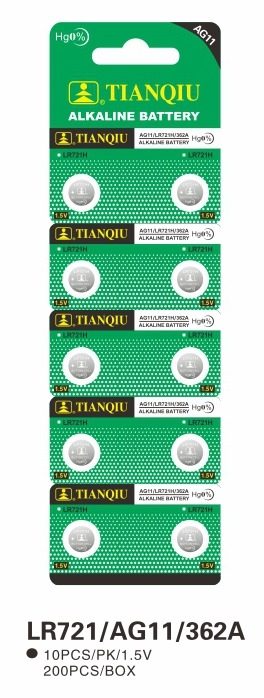
A cell that is too thin hides better, because nothing in the assembly looks wrong. It seats in the well, the spring or clip meets it intermittently, and the device reports itself dead — works when tapped, fails when set down. The hunt then moves to the device, when the answer was a caliper measurement away. The LR721 model page covers the 2.1 mm step in this family; the 6.8 mm cells — LR626 and LR621 — match the LR726’s 2.6 mm height and still fail, for the opposite reason: 1.1 mm too narrow to make contact.
Can a 3 V cell replace an LR726?
No. Voltage is the first test and the can the second, and our lithium range contains no cell in a 7.9 × 2.6 mm can — the smallest lithium coin cells we build are the 10 mm CR1025, with the 12.5 mm, 16 mm and 20 mm families above it.
That matters because dropping a 3.0 V cell into a holder cut for a 1.5 V button cell is over-voltage, not substitution, and the reverse mistake flattens a device designed around a 3 V coin. The CR2032, CR2025 and CR2016 comparison runs the same test on the lithium side, and the CR1025 guide shows how the lithium sizes map onto the diameters.
Which devices take an LR726?
Energizer’s cross-reference guide puts the two silver-oxide cells of this size under watches and sporting goods, and 7.9 mm is mid-ladder for button cells: roomy enough for a thermometer or a small instrument, compact enough for a slim case.
Two habits prevent most bad substitutions. Read the number off the cell in your hand, not off the manual — a manual outlives the cells it was written for, and the cell supplied can change mid-production-run without the book being updated. And if the device calls for a silver-oxide number, supply that chemistry: an alkaline LR726 will drop into the holder, but it cannot keep the calibration the movement was adjusted to. The button cell guide explains what the leading letters of a code say about the chemistry inside.
Is the LR726 covered by the EU battery regulation?
It is. Regulation (EU) 2023/1542 applies to the cell and to the pack it is sold in. Every LR726 consignment is issued with its own declaration of conformity for that regulation — TQ-EUDOC-LR726-20260701, citing test work to IEC 60086-1:2021, -2:2021, -3:2021 and -5:2021 — and an MSDS travels alongside.
UN38.3 governs how lithium cells are transported, so it has no bearing on an alkaline cell; the lithium items we make are the ones that travel with that report. Where a paperwork set has to be built — for customs, for a retailer’s compliance pack, for a tender submission — the certification matrix pairs each document with the question it settles, and the EU battery regulation page sets out the marking, warning and collection duties that follow a button cell and its packaging.
A flat button cell remains hazardous: a swallowed one can burn whether or not it still holds charge, so keep loose and spent cells beyond a child’s reach and return them to a collection point rather than the household bin. The disposal guide lists the routes that take button cells and explains why the terminals of a spent cell should be taped before it goes into the box.
What does an LR726 order have to state?
Four things decide an LR726 order: the cell, the pack, the destination market and the quantity. On a private-label programme, add the brand printed on the cell and the card — that artwork is part of the purchase, not an afterthought bolted on at the end.
The cell leaves our alkaline button lines at 0% mercury and is dressed however the programme requires — loose ten-piece strip, printed blister card or box. Because the printing and the cellmaking sit in one plant, artwork proofs and specification changes travel together instead of being chased across two suppliers. A first order begins at 50 cartons per product line, and a retail programme may combine several SKUs in one carton; the MOQ guide sets out what fixes that floor, and the wholesale page gives the button-range terms.
Name early any market that regulates button-cell packaging, because the duty attaches to the retail pack rather than to the cell: where child-resistant packaging and a warning are required, the card and box must be designed for it from the first proof. The packaging guide sets out that print cycle.
Where every figure here comes from
Every figure here is traceable to a named document, and where the cell belongs to one maker rather than to a standard, that maker’s own sheet is cited on the spot. Ask us for any of these files and we will send it.
- Capacity, discharge time, weight, storage, materials and the EU declaration — taken from our own published data for the LR726 / LR726H we build; the LR726 model page and the sheet that backs it carry the same figures, tested at 20 ± 2 °C.
- The 7.9 mm heights and the AG2, AG3, AG5 and AG11 strip codes — our own packing data, matching the figures shown on the button cell hub.
- 32 mAh, 1.55 V, 7.90 × 2.60 mm to IEC 60086-3, −10 °C to +60 °C, under 5% self-discharge a year, and the low-drain heading — printed in Renata’s technical data sheet for the 397 (SR726SW); the same maker’s 397 (OEM) page gives 0.48 g.
- The Renata 396 cross-reference names — that maker’s product page for its 396 (SR726W), which places the same cell at Maxell, Panasonic, Murata and Toshiba as SR726W, as Eveready 396, Varta V396, Rayovac 396, Duracell D 396/397, Timex V, Citizen 280-52 and Seiko SB-BL.
- The 396, 397, SR59 and the high-drain / low-drain split at 7.9 × 2.6 mm — the Maxell Micro Battery Cross Reference and Replacement Guide, where the SR726W and SR726SW occupy separate rows at the same size, each carrying SR59 in its IEC column while the chart’s model column reads SR726W and SR726SW.
- The single row headed 397/396 and the device note for this size — Energizer’s Battery Cross Reference Guide, which prints 396/397, SP397/SP396, V397/V396, type N / 26 and SR726SW alongside type V / 29 and SR726W in one row listed for watches and sporting goods.
- Swallow hazard, non-rechargeable warning and collection duty — the safety notes printed on this can’s maker sheet, plus the obligations set out on the EU battery regulation page.