 TIANQIU
A CR1025 is one of the least ambiguous cells in the catalogue, and one of the most heavily cross-referenced anyway — the same 10 mm can turns up in small watches, key fobs, memory backup circuits and sensor boards, and the number on the pack was set by whoever specified the device rather than by the cell inside it. This page sets out what the designation encodes, which codes are confirmed manufacturer designations and which are trade shorthand, and which neighbouring cells will and will not go into a CR1025 holder.
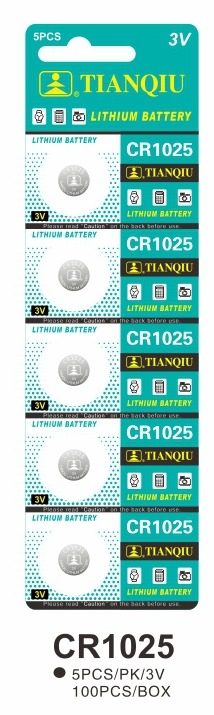
What does the CR1025 designation tell you?
CR1025 is a self-describing code. CR marks the lithium manganese dioxide system; 10 is the diameter in millimetres; 25 is the thickness in tenths of a millimetre. The cell therefore measures 10.0 mm across and 2.5 mm high, and it is a primary cell rated 3.0 V nominal, not rechargeable.
That is not how every family in this catalogue is named. In the alkaline and silver-oxide button range the numbers are catalogue conventions — AG13, LR44, 357 and A76 all describe one 11.6 mm cell — and a buyer has to cross-reference to know what is in front of them. The lithium coin range does not work that way, and section by section below that difference is what makes a CR1025 easier to replace and easier to order.
| Item | CR1025 | Where the figure comes from |
|---|---|---|
| IEC designation | CR1025 | The designation itself — Renata prints CR1025 in every maker column of its CR1025 cross-reference guide |
| ANSI / NEDA designation | 5033LC | Energizer CR1025 product data sheet, designation line |
| System and voltage | Li-MnO₂, 3.0 V nominal, primary | Our own data sheet for the model; Energizer and Renata both print 3.0 V |
| Size | 10.0 mm diameter × 2.5 mm high | Renata prints 10.0 mm × 2.5 mm; Energizer's dimension drawing gives 10.00 mm maximum diameter and 2.50 mm height |
| Declared capacity | 30 mAh (0.090 Wh) | Our data sheet — 62 kΩ continuous to a 2.0 V cut-off at 20 ± 2 °C |
| Approx. weight | 0.6 g (only for reference) | Our data sheet — Renata prints 0.60 g, Energizer 0.7 g for the same size |
| Declared storage | One year after delivery under normal storage, 98% of initial capacity maintained | Our storage statement for this model |
| EU declaration | TQ-EUDOC-CR1025-20260622 | Our declaration of conformity, tested to IEC 60086-1, -2 and -3 (2021) and IEC 60086-4 (2025) |
Weight moves between documents because the seal and the can lot move, so the figures above are quoted from the document named beside each one rather than merged into a single 'standard' value. Our own data sheet for this model does not declare an operating temperature range — ask for the current issue if your design needs one.
What is a CR1025 battery equivalent to?
A CR1025 is equivalent to any other 10.0 mm × 2.5 mm lithium manganese dioxide cell, and at this size the equivalent normally carries the same code, because the lithium coin designation is uniform across makers rather than a vendor convention.
Renata’s cross-reference guide for its own CR1025 is the clearest place to see that. The guide names the maker behind each column, and every column holds the same number — Maxell, Panasonic, Murata, Toshiba and Energizer Eveready all list CR1025, which is exactly what the IEC designation says the cell is.
| Code you may see | What it is | Source status |
|---|---|---|
| CR1025 | IEC designation — and the code printed by Maxell, Panasonic, Murata, Toshiba, Renata and Energizer Eveready | Confirmed — Renata CR1025 cross-reference guide; Energizer CR1025 product data sheet |
| 5033LC | ANSI / NEDA designation for this size | Confirmed — Energizer CR1025 product data sheet |
| DL1025 | Code following Duracell's DL prefix pattern for lithium coins | Trade listings only — not confirmed in a manufacturer document at 10 mm; treat as unconfirmed |
| ECR1025 | Code following the Eveready prefix pattern (ECR) seen in the Maxell chart | Trade listings only — treat as unconfirmed |
| KECR1025 | Code following the Rayovac prefix pattern (KECR) seen in the Maxell chart | Trade listings only — treat as unconfirmed |
| KL1025 / L1025 | Further trade-list codes with no maker pattern we could trace | Trade listings only — treat as unconfirmed |
| BR1025 | Not a CR code at all — BR is the carbon-monofluoride lithium system, CR is manganese dioxide | No BR1025 in the documents we checked: Renata's CR1025 guide lists no BR code, and the Maxell chart has no 10 mm row |
The prefixes are the clue to where the unconfirmed rows come from: in the Maxell chart every 12.5 mm, 16 mm and 20 mm lithium row carries ECR in the Eveready column and DL in the Duracell column. That chart has no 10 mm row, so the same pattern cannot be shown for this size from any document we hold — which is why the DL, ECR and KECR versions of a CR1025 circulate without a manufacturer source behind them. Where a code rests on a single source we mark it instead of repeating it as fact.
If you already hold one of the codes in that table, the cell cross-reference tool resolves it to the standard size the designation implies, and the model page carries the specification behind the number.
Does a CR1025 have an alkaline or silver-oxide equivalent?
Not in the button-cell range we publish. Our alkaline and silver-oxide strips are made in five diameters — 5.8 mm, 6.8 mm, 7.9 mm, 9.5 mm and 11.6 mm — and none of them is 10.0 mm. The chemistry differs as well: 1.5 V or 1.55 V against 3.0 V.
The diameter ladder below is our own packing data for the ten-piece strips, which is the same data the button cell hub publishes. It is worth reading as a set of steps rather than a list: a cell moves between holders only when the diameter is right, and at these sizes half a millimetre is the difference between contact and no contact. The button cell guide sets out how the catalogue names in the table map onto the IEC designations.
| Diameter | Cells we produce at that size (strip code) | Height steps we carry |
|---|---|---|
| 5.8 mm | AG0 strip | 2.1 mm |
| 6.8 mm | AG1 and AG4 strips | 2.1 mm and 2.6 mm |
| 7.9 mm | AG2, AG3, AG5 and AG11 strips | 2.1 mm, 2.6 mm, 3.6 mm and 5.4 mm |
| 9.5 mm | AG6, AG7 and AG9 strips | 2.1 mm, 2.6 mm and 3.6 mm |
| 11.6 mm | AG8, AG10, AG12 and AG13 strips | 2.1 mm, 3.1 mm, 4.2 mm and 5.4 mm |
| 10.0 mm | 23A — a 12 V cylindrical stack 28.3 mm long, not a button cell | 28.3 mm overall length |
Dimensions are from our own packing data for these strips. The A and G names are catalogue conventions rather than IEC or ANSI designations, which is why the same 9.5 mm strip is sold as AG9, LR45 or L936 depending on who printed the card.
What will a CR1025 not fit?
Diameter is the obstacle at this size. The 12.5 mm and 16 mm lithium cells are wider than the holder cut for a 10.0 mm can, and the 20 mm family that shares the CR2025’s 2.5 mm height is twice the width. Height still has to match as well.
| Cell | Size | Why it does not replace a CR1025 |
|---|---|---|
| CR1216 | 12.5 × 1.6 mm | 2.5 mm wider than the holder; the thinner can does not help once the diameter is wrong |
| CR1220 | 12.5 × 2.0 mm | 2.5 mm wider, and 0.5 mm shorter — two mismatches at once |
| CR1616 | 16.0 × 1.6 mm | 6 mm wider; a 16 mm can will not enter a 10 mm compartment |
| CR1620 | 16.0 × 2.0 mm | 6 mm wider, and shorter than the CR1025 it is offered against |
| CR1632 | 16.0 × 3.2 mm | 6 mm wider and 0.7 mm taller — the taller can may also stop a case closing |
| CR2016 | 20.0 × 1.6 mm | Twice the diameter and 0.9 mm shorter |
| CR2025 | 20.0 × 2.5 mm | Same height, twice the diameter — the trap that catches buyers comparing numbers alone |
| CR2032 | 20.0 × 3.2 mm | Twice the diameter and 0.7 mm taller |
| LR936, LR927, LR920 and the other 9.5 mm strips | 9.5 mm diameter | Half a millimetre narrow, and 1.5 V to 1.55 V rather than 3.0 V: a loose cell loses contact, and the chemistry is not a substitute for a 3.0 V device |
Every size in this table is taken from the manufacturers' cross-reference documents for those sizes and from our own packing data for the 9.5 mm strips; the 12.5 mm, 16 mm and 20 mm rows are the Maxell chart's own figures. None of them shares both dimensions with the CR1025, which is why the substitution question has a short answer at 10 mm.
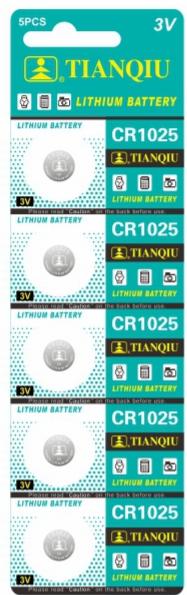
How do you read the CR1025 capacity and drain figures?
Capacity only means something next to the load and the cut-off it was measured at. Our CR1025 is declared 30 mAh (0.090 Wh) with a median discharge time of 680 hours at 62 kΩ continuous to 2.0 V at 20 ± 2 °C.
Three documents agree on roughly the same 30 mAh for this size while printing three different test conditions, which is the whole reason the condition belongs with the number.
| Document | Declared capacity | Test condition printed with it |
|---|---|---|
| Our CR1025 data sheet | 30 mAh / 0.090 Wh | 62 kΩ continuous to a 2.0 V cut-off at 20 ± 2 °C; median discharge time 680 hours |
| Energizer CR1025 product data sheet | 30 mAh to 2.0 V | 68 kΩ at 21 °C; 721 hours at 68,000 Ω; typical drain 0.043 mA at 2.9 V |
| Renata CR1025 technical data | 30 mAh | Nominal 3 V; Renata prints 30 mAh with 0.60 g for this can |
Identical capacity, three different loads — a 62 kΩ condition and a 68 kΩ condition are close enough to compare, but a capacity quoted with no condition at all is comparable with neither. A cell that reads on a meter and still fails in the device is a separate failure mode, covered in our own battery testing guide.
| Property | Our data for the CR1025 | Energizer data sheet |
|---|---|---|
| Operating temperature | Not declared for this model — request the current data sheet | −30 °C to +60 °C |
| Storage | One year after delivery under normal storage, 98% of initial capacity maintained | Self-discharge about 1% a year |
| Weight | 0.6 g (only for reference) | 0.7 g; Renata prints 0.60 g |
| Volume | Not declared | 0.2 cm³ |
We publish what our own technical file holds and mark the field we do not declare rather than filling it from another maker's document, because the two would then be quoted as if they described the same product.
Which devices take a CR1025?
Our own model page names memory backup, key fobs, remote controls and low-current sensors for this cell, which is the low-drain end of the market. A 10 mm coin cell is sized for a board or a small housing rather than for a device that draws current continuously.
Two habits keep replacements honest. Read the code off the cell you are removing rather than out of the manual, because a manual is reprinted across model years while the cell fitted can change without it; and where a device is fed by a 3.0 V lithium cell, fit a 3.0 V lithium cell — the alkaline buttons in the same drawer are 1.5 V and will read as a flat battery from the first switch-on. The PCB coin cell guide covers holder clearance and the capacity budget on the design side, and the CR2032, CR2025 and CR2016 comparison covers the 20 mm family if the holder turns out to be larger than 10 mm.
Is a CR1025 rechargeable?
No. The CR1025 is a primary lithium cell and must not be charged. Our own words for the model are non-rechargeable, and pushing current into a primary coin cell can make it leak or rupture inside a sealed compartment — which is why rechargeable lithium coin cells are a separate product category rather than a voltage setting.
Swallowing is the other risk that travels with every button cell, and it does not stop when the cell is spent: a used cell is still a chemical burn hazard inside a child, so keep loose and spent cells sealed until they reach a collection point. Keep loose cells away from children, keep them in the original packaging until they are fitted, and take used cells to a collection point rather than putting them in general waste — the disposal guide sets out what the collection routes accept.
Does UN38.3 apply to a CR1025?
Yes. UN38.3 is the transport test for lithium cells, and a CR1025 is lithium, so it is in scope — unlike the alkaline and silver-oxide button cells in our range, which are not. Our consignments for this model ship with the UN38.3 transport documentation, the EU declaration of conformity TQ-EUDOC-CR1025-20260622, an MSDS and CE marking.
The lithium system also brings the safety standard IEC 60086-4 into the model’s technical file, which our declaration for the CR1025 is tested against alongside Parts 1, 2 and 3. If you need to match a document to a question — a customs file, a tender or a retailer’s own compliance pack — the certification matrix shows which paper answers which, and the EU battery regulation page covers the 2023/1542 marking and waste duties that apply to the cell and the pack.
What does a CR1025 order have to state?
Four things decide what is printed and what paperwork ships: the cell specification, the pack format, the destination market and the quantity. An OEM order also has to state the brand the cell and the pack carry, because the label is part of the order rather than an add-on.
We build the CR1025 on our own lines as part of a lithium button range supplied with 0% mercury added, and ship it as a bare cell or in a retail format — blister card or printed box — with the cell and the printing produced in the same plant, so the artwork proof and the cell specification move together. First orders are quoted from 50 cartons per product line, and retail programmes can mix SKUs inside a carton, as the MOQ guide sets out; wholesale terms for the range are on the wholesale page.
Where the figures on this page come from
Every number on this page is quoted from a document you can check or ask for — our own published data for the CR1025, the manufacturer data sheets and cross-reference guides listed below, and our own packing data for the button-cell sizes we run on the strips.
- Capacity, discharge time, weight, materials, storage, the standards list and the EU declaration — our own documentation for the CR1025 we manufacture, published on the CR1025 model page and the technical data card behind it, tested at 20 ± 2 °C.
- ANSI / NEDA 5033LC, the 3.0 V rating, the dimension drawing, the 0.2 cm³ volume, the −30 °C to +60 °C range, the 721-hour discharge and the ~1% annual self-discharge — Energizer’s CR1025 product data sheet (Form 1025NA0618), published at data.energizer.com.
- 10.0 mm diameter, 2.5 mm height, 0.60 g, 30 mAh, and every maker code in the equivalent table — Renata’s CR1025 product page and its cross-reference guide, which names Maxell, Panasonic, Murata, Toshiba and Energizer Eveready as printing CR1025.
- The 12.5 mm, 16 mm and 20 mm sizes in the fit table — the Maxell Micro Battery Cross Reference and Replacement Guide (CrossReference_17e), which carries a row for each of those sizes and is also where the ECR and DL prefix patterns are visible. That chart has no 10 mm row, which is why no DL1025, ECR1025 or KECR1025 is listed here as a manufacturer code.
- The 5.8 mm to 11.6 mm diameter ladder and the 9.5 mm strips — our own packing data for the AG strip range, the same figures published on the button cell hub.
- The swallowing hazard and the battery-compartment guidance — the safety note printed on the same Energizer data sheet, which recommends a tool or two independent simultaneous movements to open a battery compartment on a child-resistant design.