 TIANQIU
If your product takes a coin cell, the chances are good that the holder was designed for one of three cells: CR2032, CR2025 or CR2016. They are all 20 mm across, they all deliver 3.0 V, and in a photo they look almost identical.
They are not interchangeable. The difference between them is thickness, and thickness decides three things at once: whether the cell physically fits, how much capacity it holds, and what your instruction manual is allowed to say.
Do CR2032, CR2025 and CR2016 share one diameter?
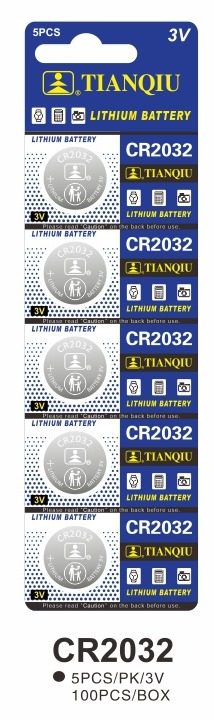
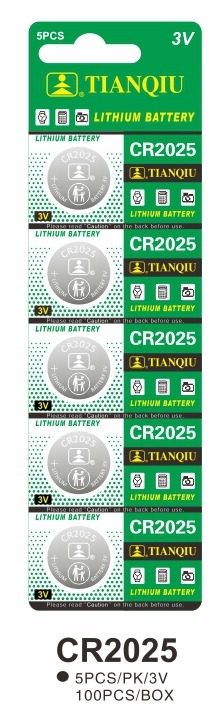
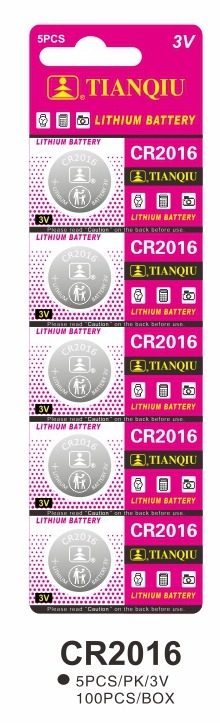
| Cell | Voltage | Diameter | Thickness | Capacity | Also marked as |
|---|---|---|---|---|---|
| CR2032 | 3.0 V | 20 mm | 3.2 mm | 190–255 mAh | 5004LC · ECR2032 · KCR2032 · DL2032 |
| CR2025 | 3.0 V | 20 mm | 2.5 mm | 130–185 mAh | ECR2025 · 5003LC · DL2025 |
| CR2016 | 3.0 V | 20 mm | 1.6 mm | 75–100 mAh | ECR2016 · 5000LC · DL2016 |
Read the last two columns together and the design decision becomes obvious: the thicker the cell, the more lithium inside it, and therefore the more energy it can store. Going from a CR2016 to a CR2032 roughly doubles or triples the runtime in the same 20 mm footprint.
Why does thickness matter more than capacity?
A holder is a spring. It is designed to press one specific cell against its contacts with a specific amount of travel.
- Too thick — a CR2032 forced into a holder made for a CR2025 puts pressure on the contacts and the PCB. In production this shows up as bent or flattened contacts, and after a few temperature cycles as intermittent contact.
- Too thin — a CR2016 dropped into a CR2032 holder sits loose. The product may work on the bench and fail in the field, because a loose cell loses contact when the device is dropped or vibrated.
Neither failure is a battery problem. Both are fit problems, and both are caught in the same place: by measuring the holder before you write the specification.
Which equivalent part numbers go on your drawing?
Your mechanical drawing may not say “CR2032”. Depending on which distributor or standard your engineers followed, the same cell can appear as DL2032 (Duracell’s numbering), ECR2032, KCR2032 or 5004LC. The same pattern applies to the other two sizes — CR2025 is also sold as DL2025 / ECR2025 / 5003LC, and CR2016 as DL2016 / ECR2016 / 5000LC.
This is why our cross-reference table exists: buyers send us the old cell, the drawing number or a photo of the holder, and we confirm the equivalent rather than guessing from the markings.
Which cell ends up in which product?
The three sizes cluster into recognisable applications:
- CR2032 — the workhorse. Car key fobs, motherboard CMOS/BIOS backup, digital scales, remote controls, smart locks and most small sensors.
- CR2025 — car key fobs, remote controls, thin motherboards: the same jobs where 0.7 mm of extra height is not available.
- CR2016 — key fobs and motherboards that have to stay very slim, where a shorter service life is accepted in exchange for the thinner stack.
If the device is yours to design, the rule of thumb is simple: choose the thickest cell the enclosure allows. Capacity is free runtime; you pay for it in millimetres.
What changes if you buy these cells for OEM or wholesale?
For a project, three details decide the price and the schedule:
- The exact cell — model, chemistry and any equivalent numbers on your existing packaging.
- The packaging format — bulk, single blister, 2-pack, 5-pack, or your own artwork. We print, blister-card and box in-house.
- The annual quantity — this sets the MOQ band and the lead time we can commit to.
Send those three things with a photo of the holder or the old cell if you are unsure, and we will come back with the equivalent model, the unit price and the lead time.