 TIANQIU
An LR927 is the 1.5 V alkaline button cell that measures 9.5 mm across: the middle height of the three alkaline cells that share that diameter, and the one the watch trade almost always meets through the silver-oxide cell built in the same can. Buyers arrive holding a 395, a 399, an AG7 or an LR57 and want to know whether the cell in front of them is a replacement — and the honest answer splits into two parts, because the can decides whether it fits and the chemistry decides what happens once it is in.
This page sets out every code the LR927 travels under, what actually separates a 395 from a 399, which same-diameter cells will not sit in the holder, and what an OEM order for the cell has to state. Every figure is quoted from a document you can check or ask us for.
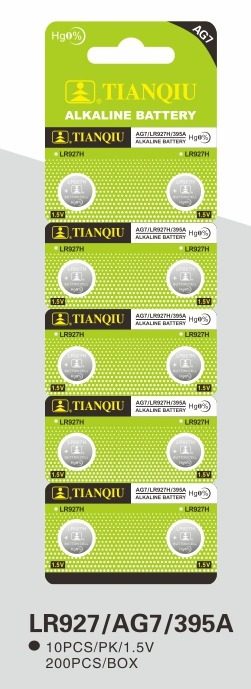
What is an LR927 battery?
The LR927 is a primary button cell: 1.5 V zinc-manganese dioxide, 9.5 mm across, replaced rather than recharged. In our own range the model is printed LR927/LR927H, the H suffix being a second designation for the identical cell, and it is one of three alkaline sizes we run at this diameter.
What the chemistry sets is the voltage and how the discharge curve falls; what the can decides is whether the cell goes into the holder at all. Take the zinc-and-manganese-dioxide pair that powers a torch or a wall clock, shrink it into a 9.5 mm can, and the result gives up its capacity on a gradually falling curve rather than holding a flat plateau. That is what makes it the economical choice in devices expected to run down and be replaced.
The figures we declare for this model sit on the model page and on the data sheet behind it:
| Property | Our LR927 / LR927H |
|---|---|
| IEC designation | LR927 |
| Chemistry | Alkaline zinc-manganese dioxide (Zn-MnO₂), non-rechargeable |
| Nominal voltage | 1.5 V |
| Size | 9.5 mm diameter; packed on our AG7 strip, carried at 2.6 mm high |
| Declared capacity | 28 mAh |
| Approx. weight | 0.58 g (only for reference) |
| Declared discharge time | 450.0 hours to a 1.2 V cut-off at 22 kΩ, 24 h/day, 20 ± 2 °C |
| Declared storage | One year under normal storage conditions |
| Critical materials | Manganese and graphite, 0% mercury added |
| Test basis | IEC 60086-1, -2, -3 and -5 (2021) |
| EU declaration | TQ-EUDOC-LR927-20260701 (alkaline button family) |
Every row is taken from our own documentation for the models we manufacture. Weight is approximate because it varies with the seal and the can lot, and capacity is declared for the test condition printed beside it rather than as a guaranteed figure for every load. Ask for the data sheet of the exact model before you quote a number onwards.
The materials list, storage statement and document references sit together on the LR927 model page. What that page leaves out is a cross-reference table, and that gap is what this page fills.
What is an LR927 battery equivalent to?
An LR927 is equivalent to any 9.5 mm button cell of the same chemistry at this height, and the codes it meets in the trade are LR927, LR927H, AG7 and LR57. The silver-oxide cell in the identical can is the SR927SW, sold as the 395, with the SR927W — sold as 399 — as the higher-drain listing in the same footprint.
The codes on this cell come from four separate naming systems, so a buyer who arrives holding one of them often needs the rest before an order can be placed with confidence. The table below sorts them by what each name actually is: a trade label, an IEC designation and a maker’s part number do not tell you the same thing.
| Code you may see | What it is | Source status |
|---|---|---|
| LR927 | IEC designation for the 1.5 V alkaline cell in this size | Confirmed — standards and data sheets; our own model designation |
| LR927H | Second designation for the same cell, used alongside LR927 | Confirmed — our product name (LR927/LR927H) and our packaging |
| AG7 | Trade name for the 9.5 mm cell at this height; the A and G prefixes are catalogue conventions | Our own ten-piece strip for this size is coded AG7SP10. Catalogues differ over whether AG7 means the 2.6 mm or the 2.7 mm can — measure the cell |
| LR57 / LR926 / G7 | Further trade designations used for this size and chemistry | Trade listings only — we did not find them in a manufacturer cross-reference chart; treat as unconfirmed |
| SR927SW | Designation for the 1.55 V silver-oxide cell in the same can, low drain | Confirmed — watch-cell data sheets; Maxell cross-reference chart |
| SR927W | Designation for the 1.55 V silver-oxide cell in the same can, high drain | Confirmed — watch-cell data sheets; Maxell cross-reference chart |
| 395 | The number the SR927SW is retailed under | Confirmed — printed in the Energizer, Duracell, Rayovac, Varta, Renata and Vinnic columns of the Maxell chart |
| 399 | The number the SR927W is retailed under | Confirmed — printed in the Energizer, Duracell, Rayovac, Varta and Renata columns of the Maxell chart |
| SR57 | Designation the cell also travels under, alongside the IEC code SR927SW | Confirmed — GP column of the Maxell chart; Energizer's 395/399 data sheet prints the cell as ANSI-1162SO/1165SO, IEC-SR57 |
| Bulova 610 / 613, Seiko SB-AP / SB-BP, Citizen 280-48 / 280-44, Timex W, Varta V395 / V399, Duracell D395 / D399 | Maker codes for the two silver-oxide products, all listed for one size | Maxell cross-reference chart, which names each maker against its own code |
Rows marked as trade listings only are included so you recognise the number if it is printed on a pack in front of you; we could not confirm them in a second independent manufacturer document, so treat them as unconfirmed and check the cell physically. Every A-and-G name is a catalogue convention rather than an IEC or ANSI designation, and it is not applied consistently between vendors.
If you have one of those codes and need the size it stands for, the cross-reference tool turns the name into the dimensions behind it, and the button cell hub lists every button size we produce.
Is a 395 the same as a 399?
No — they are two silver-oxide products in one can, separated by the drain they were designed for rather than by size. Renata heads its 395 data sheet low drain and its 399 data sheet high drain, and the two cells are rated differently for that reason.
This is the distinction most cross-reference lists lose. A chart that prints 395 and 399 on the same line is telling you the two numbers fit the same holder; it is not telling you the two cells behave the same way. Where a device names one number, fit that number.
| Document | Declared capacity | Condition and other figures printed with it |
|---|---|---|
| Renata 395 (SR927SW, low drain) | 55 mAh | 1.55 V; 9.50 mm diameter × 2.70 mm high according to IEC 60086-3 |
| Renata 399 (SR927W, high drain) | 53 mAh | 1.55 V; 0.73 g; 9.5 × 2.7 mm; discharged over 15 kΩ to 0.9 V at 20 °C |
| Energizer 395/399 data sheet | 51 mAh to 1.2 V | 1.55 V; 22 kΩ continuous drain at 21 °C, 752 hours to a 1.2 V cut-off; 0.8 g; 0.19 cm³; 10–25 Ω at 40 Hz |
Three manufacturer documents, three capacity figures for one can — 55, 53 and 51 mAh — because the load and the cut-off printed beside a number are part of the number. The Energizer sheet carries both retail numbers on one page and describes the cell line as designed for continuous low drain with high pulse on demand, which is the compromise a modern silver-oxide button cell makes.
The practical reading is short. If the device draws a steady trickle — a quartz movement, a thermometer, a standby clock — the low-drain 395 is the cell that was characterised for it. If it fires pulses — an alarm, a backlight, a camera meter — the high-drain 399 holds its voltage better under those bursts. Both are listed by Maxell at 9.5 × 2.73 mm, and both sit in the same holder.
Is an LR927 the same as an SR927SW or a 395?
They are the same footprint in two chemistries, and only one of them is the cell the device was characterised with. The SR927SW, printed as 395 on Renata’s data sheet, is silver oxide at 1.55 V; the LR927 is that same can wound with alkaline chemistry at 1.5 V.
What an owner notices is not the fit but how the discharge behaves. Silver oxide holds close to its nominal voltage for most of its life, so a movement that reads the battery’s state from its voltage keeps time on it; alkaline sags steadily downwards from 1.5 V, which is why the identical slot behaves differently depending on which of the two cells is sitting in it. The alkaline cell is the cheaper of the two, and it gives up voltage throughout its life rather than at the end.
| Property | LR927 / LR927H (alkaline) | 395 / SR927SW (silver oxide) |
|---|---|---|
| Nominal voltage | 1.5 V | 1.55 V |
| Chemistry | Zinc-manganese dioxide | Zinc / monovalent silver oxide, low drain |
| Body | 9.5 mm diameter; 2.6 mm on our AG7 strip | 9.50 × 2.70 mm per IEC 60086-3 (Renata); 9.5 × 2.73 mm in the Maxell chart |
| Declared capacity | 28 mAh (our data) | 55 mAh (Renata) and 51 mAh to 1.2 V (Energizer) |
| Approx. weight | 0.58 g (our data) | 0.8 g (Energizer 395/399 data sheet) |
| Operating temperature | Not declared for this model — request the data sheet | −10 °C to +60 °C (Renata data sheet) |
| Discharge curve | Falls gradually through life | Holds closer to nominal until the end |
| Typical use | Everyday low to medium drain devices | Watches, instruments, precision work |
Two cells can share a holder and still not be substitutes for one another, which is the part the word equivalent glosses over. Read the pair of columns as two separate products that happen to be the same size: one can is machined to take either, and the device was characterised with only one of them.
Which 9.5 mm cells will not replace an LR927?
The diameter gets a cell into the holder; the height decides whether it stays in contact. Three alkaline sizes occupy this 9.5 mm diameter and differ in nothing but height, and our own packing data lists three steps for them — 2.6 mm on the AG7 strip, 2.1 mm on the AG6 strip and 3.6 mm on the AG9 strip.
| Our strip code | Size | The cells at that height |
|---|---|---|
| AG9SP10 | 9.5 × 3.6 mm | LR936 (alkaline); 394 / 380 (SR936SW / SR936W) — the tallest 9.5 mm cell |
| AG7SP10 | 9.5 × 2.6 mm | The LR927 row; 395 / 399 (SR927SW / SR927W) in silver oxide |
| AG6SP10 | 9.5 × 2.1 mm | LR920 (alkaline); 371 / 370 (SR920SW / SR920W) |
The first two columns are the dimensions our own packing data carries for these strips; the third names the cells charted at each size. Because only the height moves across the family, a tray of mixed 9.5 mm cells looks uniform at arm's length — which is exactly how the wrong one ends up pressed into a device.
A cell that is too thin is the harder fault to diagnose, because nothing looks wrong. It settles into the well, the clip or the spring touches it intermittently, and the device reports itself flat — alive when you tap it, dead when you set it down. Most people then hunt for a fault in the device instead of reaching for a caliper. The 371 model page covers the 2.1 mm step in the same family, and the LR936 guide covers the 3.6 mm one.
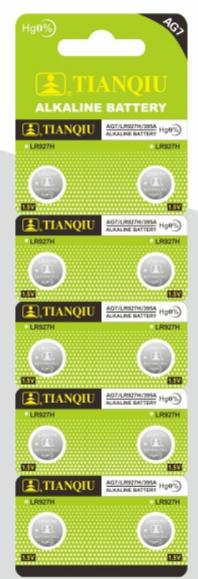
Can a 3 V CR927 replace an LR927?
No. The CR927 is a lithium manganese dioxide cell at 3.0 V in a similar 9.5 mm can, and the LR927 is a 1.5 V alkaline cell — so the two are not interchangeable even though the search results for one so often show the other.
That confusion matters because a 3.0 V cell pushed into a holder built for a 1.5 V button cell is over-voltage rather than a replacement, and the same mistake in reverse flattens a device that was built around a 3 V coin. Match the voltage first and the can second, in that order — the CR2032, CR2025 and CR2016 comparison walks through the same test on the lithium side.
Which devices take an LR927?
Our own LR927 page names toys, torches, meters and thermometers for the alkaline cell — the low-to-medium drain end of the button-cell market. The silver-oxide cell in the same can covers the precision end: Renata’s data sheet for the 395 is headed Watch Battery, and the 399 listing is the one the watch trade fits where a movement draws pulses.
Two habits stop most of the substitutions that go wrong. Take the number off the cell in your hand rather than out of the manual, because a manual outlives the cells it was printed for and the cell fitted can change across a production run without the book changing with it. And where a device names a silver-oxide number, fit silver oxide: the alkaline LR927 will drop into the holder, but it will not hold the accuracy the movement was adjusted to. The button cell guide sets out what the letters ahead of a code tell you about the chemistry inside.
Is the LR927 covered by the EU battery regulation?
Yes. Regulation (EU) 2023/1542 covers the cell and the pack it is sold in, and each LR927 consignment carries its own EU declaration of conformity — reference TQ-EUDOC-LR927-20260701, tested against IEC 60086-1:2021, -2:2021, -3:2021 and -5:2021 — together with an MSDS.
UN38.3 governs how lithium cells travel, so it has no application to this alkaline model; the lithium items in our range are the ones that carry that report. Where a buyer has to assemble paperwork — a customs file, a retailer’s compliance pack, a tender submission — the certification matrix sets out which document answers which question, and the EU battery regulation page covers the marking, warnings and waste duties that attach to a button cell and its packaging.
A spent button cell is still a hazard: swallowing one can burn, whether or not it holds charge, so store loose and used cells out of a child’s reach and take them to a collection point instead of the household bin. The disposal guide lists the routes that accept button cells, and explains taping the terminals of a spent cell before it goes in the box.
What does an LR927 order have to state?
Four things settle an LR927 order: the cell, the pack, the market and the volume. On an OEM programme the brand printed on the cell and on the card belongs on that list too — the label is part of what is being bought, not an extra fitted at the end.
The cell comes off our own alkaline button lines at 0% mercury added and leaves the plant in whatever dress the programme needs — a bare ten-piece strip, a printed blister card or a box. Printing happens on the same site that makes the cell, so artwork proofs and specification changes move together. First orders run from 50 cartons per product line and mixed-SKU cartons are possible for retail programmes; the MOQ guide explains what sets that floor, and the wholesale page carries the terms for the button range.
Markets that regulate the packaging of button cells are worth naming early in the conversation, because the requirement attaches to the retail pack and not to the cell: where a market asks for child-resistant packaging and a warning, the card and the box have to be built for it from the first proof. The packaging guide covers how that print cycle is run.
Where the figures on this page come from
Each figure below comes from a document rather than an estimate, and the document is named where the figure is used so you can check it or ask us for the file. Where a figure belongs to one maker’s cell rather than to a standard, the sheet it came from is named at that point.
- Capacity, discharge time, weight, storage, materials and the EU declaration — our own published data for the LR927 / LR927H we manufacture, on the LR927 model page and the data sheet behind it, tested at 20 ± 2 °C.
- The 9.5 mm family heights and the AG6, AG7 and AG9 strip codes — our own packing data, the same figures the button cell hub publishes.
- 55 mAh, 1.55 V, 9.50 × 2.70 mm and the low-drain heading — Renata’s technical data sheet and product page for its 395 (SR927SW), which prints the dimensions according to IEC 60086-3.
- 53 mAh, 15 kΩ to 0.9 V, 0.73 g and the high-drain heading — Renata’s technical data sheet for its 399 (SR927W).
- 51 mAh to 1.2 V, 752 hours, 0.8 g, 0.19 cm³, 10–25 Ω, ANSI-1162SO/1165SO and IEC-SR57 — Energizer’s 395/399 product data sheet, Form EBC-4362B-ZbEU, published at data.energizer.com/pdfs/395-399_eu.pdf. The US revision of the same sheet, Form 395/399GL0719, prints 743 hours for the same 22 kΩ load to a 1.2 V cut-off, so the two revisions differ by a few hours.
- The 395, 399 and maker codes, and the 9.5 × 2.73 mm charted height — the Maxell Micro Battery Cross Reference and Replacement Guide, which names each maker against its own code and prints the SR927SW and SR927W rows separately.
- The burn hazard, the non-rechargeable warning and the collection duty — the safety notes printed on the maker’s data sheet for this can, and the duties summarised on the EU battery regulation page.