 TIANQIU
An LR936 is not a difficult cell to identify — it is the tallest of the button cells that measure 9.5 mm across, and almost all of the confusion around it comes from the name printed on the pack rather than from the battery inside. Buyers meet it as an AG9, an LR45, an L936, or as a silver-oxide 394 or 380 in the same slot, and the difference between those two groups is the difference between 1.5 V alkaline and 1.55 V silver oxide.
This page sets out what the LR936 is, every code the same size travels under, which substitutions hold and which do not, and what an OEM order for the cell has to state.
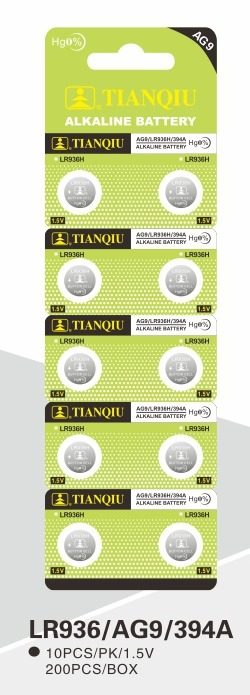
What is an LR936 battery?
An LR936 is a 1.5 V alkaline zinc-manganese dioxide button cell, 9.5 mm in diameter and 3.6 mm high. IEC designates the alkaline cell LR936 and the silver-oxide cell in the same can SR936SW. In our own range the model is printed LR936/LR936H, the H suffix being a second designation for the identical cell.
The chemistry fixes the voltage and the shape of the discharge curve; the can fixes whether the cell goes in. Because it is alkaline, the LR936 holds 1.5 V nominal and delivers its capacity on a gradually falling curve, which is why it is the economical choice in devices that are expected to run down and be replaced rather than measured against a precision reference.
Our declared figures for the cell are on the model page and on the data sheet behind it:
| Property | Our LR936 / LR936H |
|---|---|
| IEC designation | LR936 |
| Chemistry | Alkaline zinc-manganese dioxide (Zn-MnO₂), non-rechargeable |
| Nominal voltage | 1.5 V |
| Size | 9.5 mm diameter × 3.6 mm high |
| Declared capacity | 49 mAh |
| Approx. weight | 0.86 g (only for reference) |
| Declared discharge time | 800.0 hours to a 1.2 V cut-off at 22 kΩ, 24 h/day, 20 ± 2 °C |
| Declared storage | One year under normal storage conditions |
| Test basis | IEC 60086-1, -2, -3 and -5 (2021) |
| EU declaration | TQ-EUDOC-LR936-20260701 (alkaline button family) |
Every row is taken from our own documentation for the models we manufacture. Weight is approximate because it varies with the seal and the can lot, and capacity is declared for the test condition printed beside it rather than as a guaranteed figure for every load. Ask for the data sheet of the exact model before you quote a number onwards.
What is an LR936 battery equivalent to?
An LR936 is equivalent to any 9.5 × 3.6 mm button cell of the same chemistry — the cell that trade listings sell as AG9, LR45 or L936. The silver-oxide cell in the same footprint is the SR936SW, sold in the watch trade as 394, with a second silver-oxide listing at 380 (SR936W).
Four naming systems meet on this one cell, and a buyer holding any single one of them usually needs the others to place an order confidently. The table below separates the codes by what they actually are, because a trade name, an IEC designation and a maker’s own part number do not carry the same information.
| Code | What it is | Where it appears |
|---|---|---|
| LR936 | IEC designation for the 1.5 V alkaline cell in this size | Standards and data sheets; our own model designation |
| LR936H | Second designation for the same cell, used alongside LR936 | Our product name (LR936/LR936H) and our packaging |
| AG9 | Trade name for this size; the A and G prefixes are catalogue conventions | Retail packs and our own strip code AG9SP10 |
| LR45 / L936 | Further trade designations for the same alkaline size | Trade catalogues and cross-reference lists — confirmed in trade listings only, treat as unconfirmed |
| 394 | Watch-trade number for the silver-oxide cell in this can (SR936SW) | Watch-cell charts; Renata 394 data sheet and cross-reference guide |
| 380 | Watch-trade number for the second silver-oxide product in this can (SR936W) | Maxell cross-reference chart, SR936W row at 9.5 × 3.6 mm |
| SR936SW / SR936W | Designations for the 1.55 V silver-oxide cells in the same can | Watch and instrument data sheets, IEC 60086-3 |
| SR936 (SR936SW) | The short form Renata prints alongside 394 | Renata 394 technical data sheet |
| SR45 | GP's own code for this size in silver oxide | Maxell cross-reference chart, GP column |
| Maxell / Panasonic / Murata / Toshiba SR936SW, Energizer Eveready 394, Varta V394, Rayovac 394, Duracell D 394, Citizen 280-17, Seiko SB-A4 | Maker codes for the silver-oxide cell, all listed for one size | Renata 394 cross-reference guide, corroborated by the Maxell cross-reference chart |
Rows marked as trade listings only are included so you recognise the number if it is printed on a pack in front of you; we could not confirm them in a second independent manufacturer document, so treat them as unconfirmed and check the cell physically. The AG9 name also appears in our own packaging data for this size.
The lesson worth keeping from that table is that a code identifies a size and a system, and only sometimes a chemistry. Two cells can both be 9.5 × 3.6 mm and still differ in what they deliver, which is why the next two sections matter more than the list itself.
Is an LR936 the same as a 394 or an SR936SW?
Both cells drop into the same holder, but only one of them is the cell the device was characterised with. The 394, printed as 394 / SR936SW (SR936) on Renata’s technical data sheet, is silver oxide at 1.55 V, and the LR936 is the identical can built in alkaline chemistry at 1.5 V.
What changes in use is how flat the voltage stays, not how the cell fits. A silver-oxide cell holds its voltage closer to nominal across the discharge, so a watch or an instrument that judges the state of the battery from its voltage stays accurate for longer on silver oxide than on alkaline. An alkaline LR936 in the same slot is the cheaper cell, and it runs down on a more gradual curve.
| Property | LR936 / LR936H (alkaline) | 394 / SR936SW (silver oxide) |
|---|---|---|
| Nominal voltage | 1.5 V | 1.55 V |
| Chemistry | Zinc-manganese dioxide | Zinc / monovalent silver oxide, low drain |
| Body | 9.5 × 3.6 mm | 9.50 × 3.60 mm (IEC 60086-3) |
| Declared capacity | 49 mAh (our data) | 80 mAh at 10.0 kΩ to 0.9 V at 20 °C (Renata data sheet) |
| Approx. weight | 0.86 g (our data) | 0.95 g (Renata data sheet) |
| Operating temperature | Not declared for this model — request the data sheet | −10 °C to +60 °C (Renata data sheet) |
| Discharge curve | Falls gradually through life | Holds closer to nominal until the end |
| Typical use | Economical everyday button-cell devices | Watches, instruments, precision work |
Fitting one holder is not the same as being electrically equivalent. That is the distinction the word equivalent hides, and it is worth stating whenever a part number is cross-referenced: the can decides whether the cell goes in, and the chemistry decides how the behaviour differs once it is in.
What is a 380 battery, and is it the same as a 394?
It is the other silver-oxide product in this can, not another name for the 394. The Maxell cross-reference chart lists 380 in the SR936W row and 394 in the SR936SW row, both at 9.5 × 3.6 mm, which tells you the watch trade carries two separate products for this size rather than one product with two labels.
That matters when a device names one of them. If the label says 394, fit 394; if it says 380, fit 380. Both will sit in the holder and both are silver oxide, but a substitution across two products with different intended drain gives you a cell that behaves differently from the one the device was characterised with.
Can I use a shorter 9.5 mm cell instead?
No — height decides the fit. Several button cells share this 9.5 mm diameter and differ only in how tall they are, and our own packing data carries the size at three heights: 3.6 mm for the AG9 strip, 2.6 mm for the AG7 strip and 2.1 mm for the AG6 strip, each supplied in ten-piece strips.
| Our strip code | Height | Silver-oxide cells at the same diameter |
|---|---|---|
| AG9SP10 | 9.5 × 3.6 mm | 380 / 394 (SR936W / SR936SW) — 9.50 × 3.60 mm per Renata's 394 data sheet |
| AG7SP10 | 9.5 × 2.6 mm | 399 / 395 (SR927W / SR927SW) — 9.50 × 2.73 mm in the Maxell chart |
| AG6SP10 | 9.5 × 2.1 mm | 370 / 371 (SR920W / SR920SW) — 9.50 × 2.05 mm in the Maxell chart |
The two left-hand columns are the dimensions our own packing data carries for these strips; the right-hand column comes from the manufacturers' cross-reference documents, each of which gives the height to its own precision. Only the height changes across the family, so a mixed tray of 9.5 mm cells looks uniform at a glance — which is how the wrong one ends up in a device.
A short cell is the harder fault to spot. It sits down in the holder, the spring or the clip reaches it only now and then, and the device reads as flat — it runs when you nudge it and stops when you put it down. That behaviour sends people looking for a fault in the device rather than in the cell, which is why the height matters as much as the diameter.
How long does an LR936 last, and how is it stored?
Our LR936 is declared at 49 mAh, with a median discharge time of 800.0 hours on the test condition our data sheet prints beside it — a 22 kΩ continuous load to a 1.2 V cut-off at 20 ± 2 °C, 24 hours a day. Storage is declared at one year under normal conditions.
Storage in a warehouse or a shop comes down to three habits. Leave the cells in the pack they arrived in, because the packaging is what keeps a loose cell from shorting against the next one; keep the cartons away from damp and direct heat; and rotate by the production date printed on the cell rather than by the delivery note. Because the date code is printed in the format you specify for the order, a retail programme can put a replace-before line on the pack that matches the cell inside — the packaging guide covers how that print cycle works.
Can an LR936 battery be recharged?
No. The LR936 is a primary zinc-manganese dioxide cell and is marked non-rechargeable. Current pushed back into a primary button cell does not restore capacity: the cell can leak or rupture, and a leaking button cell means caustic electrolyte inside a small sealed compartment.
A button cell is also a swallowing hazard, and a spent cell is as dangerous as a new one. Keep loose cells away from children, keep them in the original child-resistant packaging until they are fitted, and take used cells to a collection point rather than putting them in general waste — the disposal guide covers what the collection routes accept.
Which devices take an LR936?
Our own LR936 page names toys, torches, meters and thermometers for the alkaline cell, and the silver-oxide cell in the same footprint covers the precision end of the market — Renata’s data sheet for the 394 is headed Watch Battery. The button cell guide explains how the letters in front of a code map to the chemistry behind it.
Two habits prevent most of the substitutions that go wrong. Read the code off the cell you are removing rather than out of the manual, because a manual is reprinted across model years while the cell inside can change without it. And when a device names a silver-oxide number, supply a silver-oxide cell: the alkaline LR936 will sit in the holder, but it will not hold the accuracy the device was set up around. The cell cross-reference tool resolves a code you already have to the standard size.
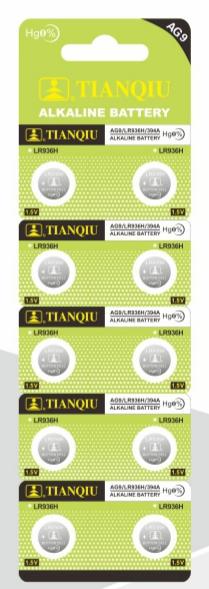
What does an LR936 order have to state?
For an OEM or wholesale order the cell specification, the packing format and the market are the three things that have to be pinned down before production, and the answers decide what is printed and what documentation ships with the goods.
We produce the LR936 / LR936H on our own lines as part of an alkaline button-cell range supplied with 0% mercury added, and ship it as a bare cell or in a retail format — blister card, strip or printed box — with the cell, the card and the box printed in the same plant, so the artwork proof and the cell specification move together. Opening orders are quoted from 50 cartons per product line, and retail programmes can mix SKUs inside a carton, as the MOQ guide sets out.
Documentation follows the chemistry. The LR936 is an alkaline cell, so it ships with the EU Regulation (EU) 2023/1542 paperwork for the models in the order — our declaration for this model is TQ-EUDOC-LR936-20260701, tested against IEC 60086-1, -2, -3 and -5 (2021) — together with an MSDS. UN38.3, the lithium transport test, does not apply to it. Name the market you are selling into and we send the current documents for the models in the order; the certification matrix shows which document answers which question.
Where the figures on this page come from
Nothing here is estimated: each figure is quoted from a document you can check, and where a value comes from one maker’s own data sheet rather than from a standard, that document is named so you can verify it or request the file.
- Capacity, discharge time, weight, storage and the EU declaration — our own published data for the LR936 / LR936H we manufacture, on the LR936 model page and the data sheet behind it, tested at 20 ± 2 °C.
- Dimensions of the 9.5 mm family — the pack data and the strip codes our own button-cell hub publishes for the AG6, AG7 and AG9 sizes.
- The silver-oxide cell in the same can — Renata’s technical data sheet for its 394 (Rev. 394MF.06), which prints 394 / SR936SW (SR936), 1.55 V, 80 mAh over 10.0 kΩ to 0.9 V at 20 °C, ~0.95 g, 9.50 × 3.60 mm per IEC 60086-3.
- Cross-reference codes — Renata’s 394 cross-reference guide (Maxell, Panasonic, Murata, Toshiba, Energizer Eveready, Varta, Rayovac, Duracell, Citizen, Seiko) and the Maxell Micro Battery Cross Reference and Replacement Guide, which prints the 9.5 × 3.6 mm rows separately for 380 (SR936W) and 394 (SR936SW).
- Trade names (AG9, LR45, L936) — trade listings only. We could not confirm them in a manufacturer document, so they are marked unconfirmed in the table above; our own strip code for this size is AG9SP10.