 TIANQIU
A button cell is not one product. The three letters on the front tell you which chemistry is inside, and the chemistry decides voltage, how flat the discharge curve is, and what the cell costs.
What are the three button cell families?
| Family | Chemistry | Voltage | Discharge | Best for |
|---|---|---|---|---|
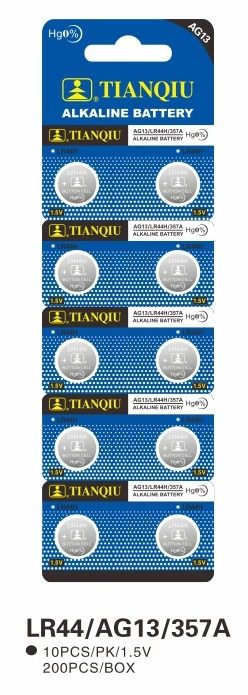
| LR | Alkaline | 1.5 V | Gradual fall | Economical everyday cells: watches, toys, calculators, laser pointers |
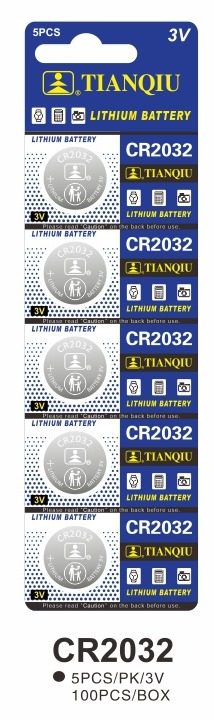
| CR | Lithium | 3.0 V | Very flat | Long life and stable voltage: motherboards, key fobs, sensors, medical devices |
| SR | Silver-oxide | 1.55 V | Flatter than LR | Precision instruments: watches with functions, meters, hearing aids |
LR and SR are both 1.5 V, so they can often replace each other physically — but not always usefully. CR runs at 3.0 V and is never a substitute for a 1.5 V cell.
What are the live specs from our own data?
The numbers below come straight from the product data behind our model pages — the same figures you would get in a spec sheet request.
| Model | Voltage | Size (Ø × H) | Capacity | Also marked as |
|---|---|---|---|---|
| CR2032 | 3.0V | 20 × 3.2 mm | 190mAh ~ 255mAh | 5004LC · ECR2032 · KCR2032 · DL2032 |
| CR2450 | 3.0V | 24.5 × 5.0 mm | 550mAh ~ 620mAh | ECR2450 · DL2450 |
| CR1632 | 3V | 16 × 3.2 mm | 140mAh | ECR1632 · DL1632 |
| LR44 | 1.5V | 11.6 × 5.4 mm | 118mAh | AG13 · A76 · G13A · L1154 |
| SR626 | 1.55V | 6.8 × 2.6 mm | 27mAh | SR626SW · 377 · 376 |
| SR44 | 1.55V | 11.6 × 5.4 mm | 175mAh | SR44W · 357 · 303 |
Capacities are typical values at low drain; the exact figure depends on the load and the cut-off voltage.
Why do AG13, 357 and 377 cause confusion?
A device rarely names the chemistry. It names a code, and the same cell travels under several of them:
- AG13 = LR44 (alkaline) — and the silver-oxide equivalent is 357 = SR44
- 377 = SR626SW — the common watch cell
- LR41 / AG3 — the small cell used in thermometers and tiny toys
- CR2032 = DL2032 = ECR2032 = 5004LC — the coin cell on most motherboards
If the housing is built for a 1.5 V silver-oxide cell, fitting the alkaline equivalent usually works but shortens the service life and can affect timing accuracy. That is why our cross-reference table is built from real compatibility data rather than from memory.
How do you choose a button cell in practice?
- Read the old cell. The code printed on it beats any guess from the device model.
- Match size and voltage first. Diameter and thickness decide whether it fits; voltage decides whether it works. The CR2450 and the CR2477 are the same 3 V lithium family and the same 24.5 mm diameter, but they differ in thickness — the code records it.
- Then choose the chemistry. Same size and voltage usually lets you trade cost (LR) against life and stability (SR), or step up to CR for long-life backup.
- Check the drain. A camera flash or a medical meter behaves very differently from a wall clock, and a toy left switched on will flatten an LR cell far sooner than a thermometer read once a day.
Are these cells produced in-house and documented for export?
CR, LR and SR button cells are produced on our own lines and shipped with UL documentation for the covered lines, CE documentation and EU 2023/1542 battery regulation files; UN38.3 transport documentation applies to the CR lithium cells, while LR and SR cells are non-dangerous goods. Custom printing, blister cards and boxes are all done in the same plant.
Every cell named above has its own model page — the full model list carries the declared voltage, capacity and equivalent codes, and any number printed on a cell can be resolved in the cross-reference tool. The questions buyers ask most are collected in the battery FAQ.