 TIANQIU
A quick check on the label settles the voltage, not the current. The short answer: a AA battery has no fixed amperage — the device decides. The cell is rated 1.5 V nominal (IEC LR6), and the current it delivers follows the load: 1.5 V across a 15 Ω load works out at about 100 mA. What the cell does have a ceiling on is maximum continuous current, and that figure lives on the data sheet.
How many amps is a AA battery?
A AA battery holds a voltage and lets the load pull current, so there is no single number to quote. At 1.5 V nominal, a 150 Ω load draws about 10 mA and a 15 Ω load about 100 mA. The cell’s maximum continuous discharge current is a line on its data sheet.
Four things move the answer:
- The load. Current is voltage divided by resistance. Change what the device presents and the drain changes with it.
- The cell’s internal resistance. Under a heavy drain the terminal voltage sags, so the measured current falls below the ideal arithmetic.
- Temperature. A cold cell delivers less current and sags sooner than a warm one.
- How long the drain lasts. A short pulse and a steady drain of the same average current are not the same job for the cell.
| Load at 1.5 V | Current it draws | What that load looks like |
|---|---|---|
| 150 Ω | About 10 mA | A low-drain device — clock, remote, sensor |
| 15 Ω | About 100 mA | A steady heavier drain — motorised toy, torch |
Arithmetic for an ideal 1.5 V source, current equals voltage divided by resistance. A real cell's internal resistance pulls the terminal voltage down under load, so the current you measure at 15 Ω is lower than 100 mA — the discharge curve on the data sheet shows by how much.
The label on a cell carries the voltage and the IEC code, not the current. Two figures do the work in a spec sheet: nominal voltage (1.5 V for an alkaline AA, LR6) and maximum continuous discharge current. If you need the second one for the line you plan to use, ask us for the data sheet of that model.
One thing not to do: press a cell across a metal object, a coin or a piece of wire to see what it can deliver. That is a short circuit rather than a current rating, and it can heat the cell, vent it or damage it. Current is measured into a defined load, never into a dead short.
What is the difference between amps, amp-hours and mAh?
Amps measure how fast charge flows — a rate. Amp-hours measure how much charge the cell holds — a quantity, rate multiplied by time. mAh is amp-hours divided by a thousand, so a 2,500 mAh cell holds 2.5 Ah, and a device drawing 25 mA takes about 100 hours to use it.
| Quantity | Unit | What it tells you | On a AA alkaline cell |
|---|---|---|---|
| Voltage | V | The electrical pressure the cell maintains | 1.5 V nominal (LR6) |
| Current | A or mA | How fast charge is flowing right now | Set by the device, not the cell |
| Capacity | Ah or mAh | How much charge the cell holds in total | 2150–2600 mAh declared |
| Energy | Wh | Voltage multiplied by charge | Roughly 3.2–3.9 Wh (see note) |
Capacities are the figures we declare for our own cells. Energy is arithmetic — nominal voltage multiplied by declared capacity — and is an estimate rather than a rating, because terminal voltage falls through the discharge.
The same split runs through the whole size range, which is why a bigger cell is not a stronger one in volts:
| IEC code | Common name | Nominal voltage | Capacity we declare |
|---|---|---|---|
| LR6 | AA | 1.5 V | 2150 mAh to 2600 mAh |
| LR03 | AAA | 1.5 V | 1020 mAh to 1260 mAh |
| LR20 | D | 1.5 V | 18000 mAh |
| 6LR61 | 9 V block | 9.0 V | 620 mAh to 640 mAh |
AA, AAA and D are all 1.5 V — the larger can holds more charge, not more volts. Capacity for the C size (LR14) is set per project, so ask for the data sheet rather than assuming a number.
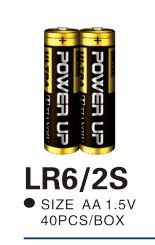
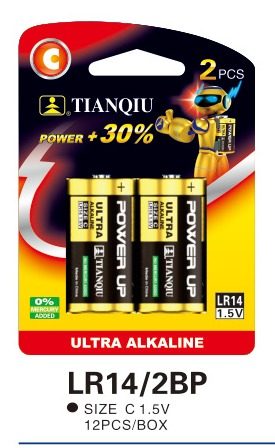
Model pages: AA battery (LR6) · AAA battery (LR03) · AA product line · AAA product line · D battery (LR20)
How do you work out what a device actually draws?
Three routes, in order of reliability: read the rating plate or manual, measure the current with a meter wired in series, or calculate from the load resistance. The device’s own figure beats any table of averages, and motors and radios are the cases where an average misleads.
- The rating plate. Many devices print their current or their power rating. Power divided by voltage gives the current — a 0.3 W load on a 1.5 V cell is 200 mA.
- In-series measurement. A meter reads current only when it is in the circuit: break the connection and put the meter in series, on the correct range. Reading current with the probes across the cell measures a short, not a load.
- Calculate it. If you know the load resistance, current is voltage divided by resistance. Treat the result as ideal and confirm it with a measurement.
- Watch the start-up surge. Motors and transmitters pull their highest current in the first moments, which is why a device that averages a low drain can still flatten a set quickly.
Voltage and current are measured differently — our guide to testing a battery with a multimeter covers the voltage side, and how long batteries last covers the difference between shelf life and service life.
How many amps can a AA battery supply at once?
The ceiling is the cell’s maximum continuous discharge current. For the lines we make, that is a data-sheet figure rather than a number printed on the label, so ask for the discharge curve of the model you intend to use. Short bursts can exceed the continuous rating; a steady drain cannot.
What is happening at that ceiling:
- Internal resistance. Every cell has some, and it turns part of the delivered energy into heat. Heavier drains sag the terminal voltage further.
- Chemistry and construction. Alkaline, zinc-carbon and NiMH cells are built for different drain profiles, so the same size does not mean the same current capability.
- The cost of exceeding it. Push a cell past its rating and the voltage collapses, the runtime drops well below the arithmetic and the cell can overheat or leak.
Three rules keep a device out of that territory. Never short a cell. Never mix chemistries or mix a new cell with a used one in the same holder — the stronger cell drives current backwards through the weaker one. And never put a single-use cell into a charger: our EU battery information warns that attempting to recharge a non-rechargeable cell can cause leakage or rupture.
Do two AA batteries give twice the amps?
No — series and parallel do different jobs. Two AA cells in series give 3.0 V with the same current capability as one cell, which is how nearly every battery holder is wired. Two cells in parallel stay at 1.5 V and can supply more current in total, because the capacity adds instead of the voltage.
| Wiring | Voltage | Capacity | Current capability | Where you meet it |
|---|---|---|---|---|
| Two cells in series | 3.0 V | Same as one cell | Same as one cell | Almost every AA holder |
| Two cells in parallel | 1.5 V | Adds: 2 × 2,150–2,600 mAh | Roughly doubles | Packs built for runtime at low voltage |
Arithmetic from the capacities we declare for our own AA cells. Cells wired in parallel have to be matched in type, age and state of charge, and both must be fitted the same way round — a reversed cell in a series string is pushed backwards by the others.
The practical consequence for buyers: if a device needs to run longer before a change, the lever is capacity, not voltage. A D cell (LR20) does not supply more volts than an AA; it stores more charge, which is why heavy drains and long service intervals are its job.
How long will a AA battery last at a given current?
Divide capacity by current: a 2,500 mAh cell at 25 mA works out at about 100 hours, and the same cell at 250 mA at about 10 hours. Those are ideal figures. At the higher rates the usable capacity is lower, so the real runtime is shorter.
| Load current | Ideal runtime from a 2,500 mAh cell |
|---|---|
| 25 mA | About 100 hours |
| 100 mA | About 25 hours |
| 250 mA | About 10 hours |
| 500 mA | About 5 hours |
Ideal arithmetic: capacity divided by current. Real runtime falls below these figures as the drain rises, because usable capacity drops at high current, and it also depends on the voltage at which the device stops working.
Three factors decide how far the real figure moves from the arithmetic: the cut-off voltage at which the device gives up, the duty cycle (intermittent use recovers some voltage between bursts), and the temperature the device runs in. A cell that measures fine with no load can still be finished under a real load — the difference between open-circuit voltage and loaded voltage is the whole subject of how to test a battery.
How many amps do coin cells and button cells supply?
Coin cells are built for a small, steady drain rather than a high one. Our CR2032 is a 3.0 V lithium cell with a declared capacity of 190 mAh to 255 mAh — sized for a CMOS clock, a key fob or a sensor. It is a primary cell and must never be charged.
- Current is still a data-sheet figure. A coin cell’s continuous drain is a fraction of a AA’s, and a pulse rating (for a radio transmission, say) is a separate line on the sheet.
- Design for the job. If you are choosing a cell for a board, match the average and peak drain of the circuit to the cell’s rating — the checklist is in our guide to choosing a coin cell for a PCB.
- Sizes are not interchangeable. A 3.0 V CR2032 must not replace a 1.5 V LR44 or a 1.55 V SR626, and the same diameter does not mean the same cell. Our cross-reference tool checks a code against its equivalents.
- Coin cells are a swallowing hazard — keep loose cells, and devices whose cell compartment a child can open, out of reach.
- If a coin cell is swallowed, seek medical help immediately — do not wait for symptoms to appear.
What changes when you specify cells for a product?
For a product you are developing, the number to send us is the load profile rather than the amps of a cell: average current, peak current and how long each peak lasts, duty cycle, the cut-off voltage of the circuit and the temperature range. We then match the line and confirm against its data sheet.
What that looks like in a project:
- Load profile first. Send that load profile and we can say which line and which capacity suits the job, instead of quoting the largest cell by default.
- Documentation by market. The file set a product needs depends on where it is sold — tell us the market and we confirm it by model, starting from battery certifications.
- Samples and artwork. A sample carrying your own label is part of the process, and the capacity you choose has to be fixed before the artwork is signed off.
- Minimum order. First orders run from 50 cartons per product line, and mixed-SKU cartons are possible for retail programmes — see wholesale batteries.
We build the cylindrical lines and the coin cells on our own lines, so a range that mixes AA, AAA, D and button cells can be quoted as one programme. The process is set out under OEM battery manufacturing.