 TIANQIU
“How long does a battery last” has two different answers, and mixing them up is the reason buyers end up disappointed. Shelf life is how long a cell keeps its charge in a drawer. Service life is how long it runs a specific device.
What is shelf life and how long do cells keep?
| Chemistry | Typical shelf life | Stored well means |
|---|---|---|
| Zinc-carbon | 2–3 years | Cool, dry, away from metal objects |
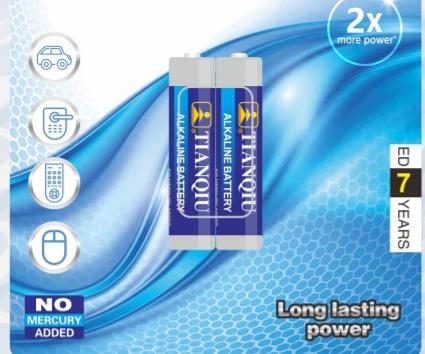
| Alkaline | 5–10 years | Cool, dry, in the original packaging |
| Lithium coin (CR) | ~10 years | Any dry room temperature storage |
| NiMH (rechargeable) | Charge drops in months | Recharge before use; store charged in a cool place |
Storage life is the figure brands print on the pack. Heat is the main enemy — a cell kept in a hot garage ages several times faster than one in a cupboard.
What decides service life?
Capacity only tells you part of the story, because the same cell behaves completely differently depending on the load:
| Device | Typical drain | What it means for life |
|---|---|---|
| Wall clock, remote control | Very low, pulsed | Months to years on any alkaline cell |
| Smoke detector | Very low, continuous | Usually a year by design, on a specified cell |
| Digital scale, thermometer | Very low | Years, or until the display dims |
| Torch, radio | Medium | Hours of continuous use per set; weeks of occasional use |
| Motorised toy, camera flash | High, in bursts | Hours only — this is where AA beats AAA clearly |
The same AA cell that runs a clock for years will run a motorised toy for a couple of hours. That is not a defect; it is the load.
Why do D cells last longer in heavy devices?
Larger cells hold more active material. Our own data, for the same alkaline chemistry:
| Cell | Nominal voltage | Typical capacity |
|---|---|---|
| LR20 (D) | 1.5 V | 18,000 mAh |
| AA (LR6) | 1.5 V | 2,000–3,000 mAh |
| AAA (LR03) | 1.5 V | 1,000–1,200 mAh |
Capacity figures are typical at low drain. LR20 is a measured figure from our product data; AA and AAA are the standard range for alkaline cells.
A D cell holds roughly six to nine times the energy of an AA, which is why heavy-drain devices — big torches, portable radios, pumps — are designed around it.
What are the signs a cell is finished?
- The device slows down or the display dims under use (voltage collapses under load, even if it reads fine with no load).
- The device resets or loses settings — the classic sign in clocks and remotes.
- A cell that has visibly leaked, or feels warm, should be removed and the compartment cleaned before a new cell is fitted.
What changes when you buy for a product or a retail range?
If you are specifying cells for a device, the useful information is the device drain, the required service interval and the storage conditions. Send those and we will confirm the cell and the capacity it needs, then quote the packaging with it.
Service life is set by the drain the device applies, so the same cell can last years in a watch and weeks in a camera. The declared capacity for each cell we make is on the model pages, and the shelf-life and storage questions are answered in the battery FAQ.