 TIANQIU
A battery order generates a lot of paper, and buyers regularly ask for the wrong half of it. The document a customs broker needs is not the document your compliance team needs, and neither of them is the document the certifying body issued to the factory.
This is what each one actually does.
Which certificates describe the factory?
These are issued to the manufacturing site, not to a product. They travel with the supplier, not with the shipment.
- ISO 9001:2015 — the quality management system. It tells you the factory has a documented process for incoming material, production and inspection.
- ISO 45001:2018 — occupational health and safety management. Increasingly requested by European retailers.
- Social compliance audits such as BSCI — a labour-standards audit of the site rather than the product.
Which certificates and reports describe the product?
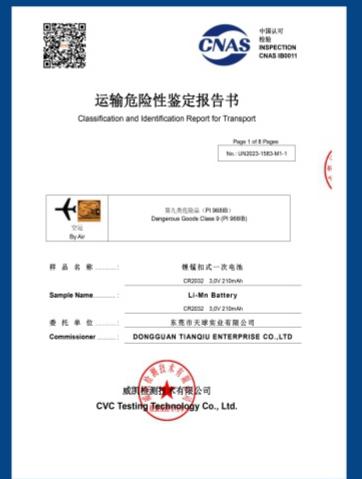
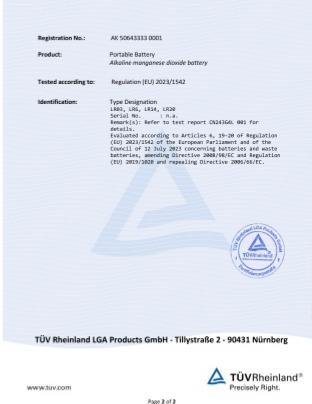
These are issued per chemistry, per design and sometimes per model.
- UL — safety certification of the cell construction.
- CE declaration and RoHS — the manufacturer’s declaration that the product meets the applicable European requirements, including restricted substances.
- UN38.3 test report — the transport test every lithium cell has to pass before it can be flown or shipped. This is the one your freight forwarder will ask for by name.
Which documents travel with the shipment?
These are generated for your order, and no two shipments have the same ones.
| Document | Who asks for it | What it covers |
|---|---|---|
| Commercial invoice and packing list | Customs broker, your finance team | What was sold, at what value, in how many cartons |
| EU declaration of conformity | Your compliance file, the importer | EU Regulation 2023/1542 and the IEC 60086 series, with a declaration number per model |
| MSDS / SDS | Forwarder, insurer, some retailers | The material safety data sheet for the chemistry actually shipped |
| UN38.3 transport documentation | Airline, forwarder, sea carrier | Evidence the cell passed the transport test for lithium batteries |
| Bill of lading or air waybill | Customs, you | Issued by the forwarder with the container or flight details |
| Maritime and air transport certificates | Carriers, and buyers shipping by both modes | Mode-specific approvals for moving the cells |
The document set for one shipment. Ask for samples of each before you order, so you know what your compliance file will look like.
What is in the EU battery regulation file?
If you sell into the European Union, EU Regulation 2023/1542 sets limits on hazardous substances (mercury, cadmium and lead), the marking and labelling the cell and pack must carry, the separate-collection symbol, and the waste-battery duties that sit with the producer. It also expects an EU representative for producers outside the Union.
Practically, what you want from your supplier is a declaration of conformity with a declaration number you can quote — one per model, not one per year, and not a generic letter. Our own declarations are numbered per model, tested against the IEC 60086 series, and the marking, warnings and waste-battery notes are set out in full on the EU compliance page.
How do you tell a real certificate from a logo?
This is the single most useful habit in battery sourcing:
- A logo is not a certificate. A CE mark, a UL mark or a recycling glyph pasted into a PDF tells you nothing. A certificate has an issuing body, a certificate number and validity dates.
- Read the dates. Certificates expire. An expired certificate that is still on a supplier’s website is a genuine due-diligence finding, and it is the first thing a careful buyer checks.
- Read the addressee. A certificate or an authorisation letter is issued to a named legal entity. If the name on the document is not the name on your contract and your invoice, ask why.
- Check the scope. ISO 9001 issued for a sales office does not cover a production line.
- Verify, don’t trust. Certificate numbers can be checked with the issuing body. It takes minutes and it is the highest-value minutes in the whole process.
What arrives, and when?
Standard practice on a battery order, and worth agreeing up front:
- Before the order — the certificate set, so your compliance file can be reviewed, and a sample declaration for the model you are considering.
- With the sample — the specification sheet and the model’s declaration number.
- With the shipment — the order-specific documents above, plus the commercial paperwork.
- On request, later — updated certificates when they are renewed, so your file does not go stale.
Our certificate library, including the factory certificates and the national trademark registrations, is collected on the certifications page, and the datasheets are in the downloads centre. If you need the file set for a specific model before you commit, ask for it — we send it the same working day. What travels with the consignment rather than the order is covered in the shipping policy, and the compliance questions buyers ask most are in the battery FAQ.