 TIANQIU
Two documents arrive in almost every battery compliance file, and buyers reach for the names as if they were interchangeable. They are not close. One is a laboratory result measured against a fixed list of ten substances. The other is a statement a supplier signs about what its article contains. Swapping them wastes a week of correspondence, and occasionally puts a number on a declaration of conformity that nobody can stand behind.
This page separates the two, gives the ceilings and dates behind each, and sets out what an OEM factory can sign honestly and what has to come out of a testing house.
What does a RoHS document actually cover?
RoHS restricts ten substances in electrical and electronic equipment and fixes a ceiling for each, expressed as a share of weight in every homogeneous material. The list and the ceilings sit in Annex II to Directive 2011/65/EU; the four phthalates were added later by Delegated Directive (EU) 2015/863.
The word doing the work there is homogeneous. The directive defines a homogeneous material as one of uniform composition throughout, or a combination that cannot be pulled apart by mechanical actions such as unscrewing, cutting, crushing or grinding. A coin cell is therefore not one material: the can, the cap, the gasket, the separator, the cathode mix and the electrolyte are each judged separately, and so is the nickel plating on the steel.
| Restricted group | Ceiling by weight | Why it is on the list |
|---|---|---|
| Lead, mercury, hexavalent chromium | 0.1 % | Metals the waste-recycling debate was written around |
| Cadmium | 0.01 % | The only entry with a tenfold tighter ceiling |
| PBB and PBDE | 0.1 % | Brominated flame retardants, legacy use in plastics |
| DEHP, BBP, DBP, DIBP | 0.1 % | Phthalate plasticisers, added by Delegated Directive (EU) 2015/863 |
Annex II to Directive 2011/65/EU, maximum concentration tolerated by weight in homogeneous materials. Nine entries share one ceiling and cadmium takes the tighter one; the practical reading is that a report has to say which material was tested, not only which model.
That last point decides what a usable report looks like. A RoHS report is a table of materials and results, each cell a measured share against a ceiling, produced by a laboratory that names the samples it received. A one-line letter saying the product is RoHS compliant is a different artefact with a different author, and the difference matters when the file is audited.
Does RoHS apply to a cell, or only to the device around it?
The directive is written for equipment: anything that depends on electric current to work, plus anything built to generate, transfer or measure such current, within 1,000 V AC or 1,500 V DC. Open scope arrived on 22 July 2019, so what matters now is whether the thing is equipment at all, not which category it falls in.
The exclusion list is short and specific: military material, equipment sent into space, a subassembly that only works inside an excluded product, large-scale stationary industrial tools, large-scale fixed installations, means of transport, non-road mobile machinery, active implantable medical devices, photovoltaic panels, equipment made solely for research and development, and pipe organs. Batteries are not on that list, and they are not carved out anywhere else in the text. What the directive does say, in Article 2(3), is that it applies without prejudice to Union law on chemicals, in particular REACH, and to specific waste management legislation — while the ceilings a cell must meet on its own come from a different file.
In practice that produces two files rather than one argument. Your equipment file wants RoHS evidence covering the materials inside the product, the cell included. The cell’s own substance ceilings come from Annex I of Regulation (EU) 2023/1542: mercury at 0.0005 %, cadmium at 0.002 % and, since 18 August 2024, lead at 0.01 % for portable batteries, with portable zinc-air button cells given until 18 August 2028. Those dates and the marking duties that travel with them are set out in our guide to the EU Battery Regulation; what matters here is that the two documents answer two different questions and one does not replace the other.
What does a REACH declaration have to state?
REACH works from the opposite direction. It sets no ceiling; it creates a duty to communicate. Where an article carries a Candidate List substance above 0.1 % by weight, the supplier must give the recipient enough information to allow safe use, free of charge and within 45 days of a request, under Article 33 of Regulation (EC) 1907/2006.
Two consequences follow for paperwork. First, the declaration is about a comparison between an article and a published list, so a usable one names the list version it was checked against and carries a revision date. Second, the duty is supported by a database: since 5 January 2021 companies placing such articles on the EU market submit the same information to ECHA’s SCIP database, which is what a waste operator or a recycler reads years later. A supplier that has never heard of SCIP has probably not maintained the declaration either.
Neither document is a certificate. REACH does not approve articles and does not issue marks, so a badge reading REACH certified describes an assessment no European body performs. What can be checked is the substance name, the threshold, the list date and the model it applies to.
How do you tell a test report from a declaration?
A test report is signed by the laboratory that received the samples; a declaration is signed by the party putting the article on the market. The report records what was measured, on which date and against which method. The declaration makes a claim about a model the signer is responsible for. Tenders ask for the second, auditors for the first.
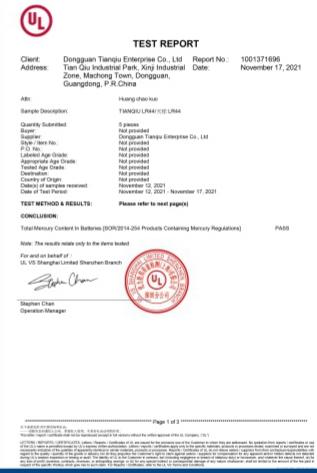
Three limits are worth knowing before a report is filed as if it covered more than it does. A single-substance report answers a single question, and mercury content is one line of the RoHS list and a different requirement from the Canadian regulation it was written against. A report written for selected tests says so — the cover pages in circulation often carry the phrase requesting client’s scope, which means the laboratory tested what was asked and nothing more. And screening is not analysis: X-ray fluorescence is a fast way to sort materials, but where a screening reading sits near a ceiling, only wet chemistry settles it.
Which market asks for which document?
Four markets cover most battery orders, and each asks a slightly different question. The mistake worth avoiding is treating one file as sufficient everywhere, which is what happens when a document set is copied from a European order onto a North American one.
| Market | Substance paperwork | What else the file needs |
|---|---|---|
| European Union | RoHS report or declaration, plus a Candidate List statement | Numbered EU declaration of conformity; SCIP where a Candidate List substance exceeds 0.1 % |
| United Kingdom | UK RoHS and UK REACH, run in parallel with the EU regimes | The marking your importer uses; ask which one before the artwork is printed |
| United States | No federal RoHS equivalent; state-level warnings such as California's Proposition 65 | UN38.3 summary for lithium lines; child-resistant packaging rules for coin cells |
| Canada | Products Containing Mercury Regulations, which is the basis of the report above | The same transport paperwork the mode of carriage requires |
Four destinations, four different questions. The EU and UK columns are substance regimes, the US column is largely transport and warning law, and Canada's mercury limit is a product rule rather than a materials list.
Two habits make that split work in practice. The first is not asking for a RoHS certificate: no European body certifies RoHS, so what arrives is either a laboratory report or a declaration on the supplier’s letterhead. The second is keeping the two files apart when the same cell ships inside a device — the equipment file is the brand owner’s obligation, the Annex I ceilings belong to the cell, and the two are checked at different moments by different people.
What can we sign, and what has to come from a laboratory?
We sign what we can evidence. Our certifications page lists RoHS among the documents held for the range, alongside UL for selected lines and reports from SGS and PONY. A numbered EU declaration is issued per model in the TQ-EUDOC form, with the model code and issue date inside the number.
What no manufacturer can do is sign a test it did not run. A laboratory report is only evidence of what that laboratory measured on the samples it received, on the date printed on its cover, so a report is reissued rather than re-signed when it ages out. Where a model in your list has no report on file, we say so and send the data sheet instead; a data sheet states declared performance, and declared performance is not the same claim as a measured substance result.
A report that names a model you are not buying is still worth reading as evidence that a factory tests at all, and it is not evidence about the cell in your carton — the honest request is the same test on your model, or a family report where the materials are identical. And a pass on substances is not a safety verdict: RoHS says nothing about how a cell behaves under abuse, which is what the product standards and, for lithium, the UN38.3 summary are for. That division is set out in the certificates and documents guide.
What belongs in the purchase order?
One line in the order prevents most of the correspondence that follows delivery. Name the document you expect, the model list it must cover, and the market it is going into, because the three together decide which file is opened.
- The model list with both designations, for example LR44/LR44H, not just one of them
- The destination market, since the EU, UK, US and Canadian files differ
- The document you want: laboratory report, supplier declaration, or both
- The revision or issue date you will accept, and whether it must postdate the current design
- The substance list the document has to cover, so that a single-substance report is not filed as a full one
- Who signs: the factory or the brand owner placing the article on the market, which is a question your own compliance team has to answer
The revision dates are the part that gets lost. Annex II is amended by delegated act, the Candidate List is republished as substances are added, and designs are revised between orders, so a file built for a first shipment quietly stops describing the fourth. Re-checking two dates a year costs an hour and removes the most common reason a compliance pack is rejected at the far end.
Where the claims on this page come from
Ceilings, dates and article numbers were read in the primary texts rather than in trade summaries, because the gap between an obligation and a habit is where compliance files go wrong. Where a statement describes our own paperwork, it restates a split already published on this site.
- Directive 2011/65/EU, Article 2 on scope and exclusions, Article 3(1) on the definition of equipment, Article 4(1) with Annex II on the ten substances and their maximum concentrations, Article 4(3) with Annex I category 11 for the open scope that took effect on 22 July 2019, and the definition of homogeneous material in Article 3
- Delegated Directive (EU) 2015/863, which added the four phthalates to Annex II
- Regulation (EU) 2023/1542, Annex I, for the mercury, cadmium and lead ceilings and their application dates
- Regulation (EC) 1907/2006, Article 33 on the duty to communicate information on substances in articles, including the 45-day response period
- ECHA’s SCIP database, open to submissions from 5 January 2021 under the Waste Framework Directive
- Our own certifications page, for which documents are held and for which ranges