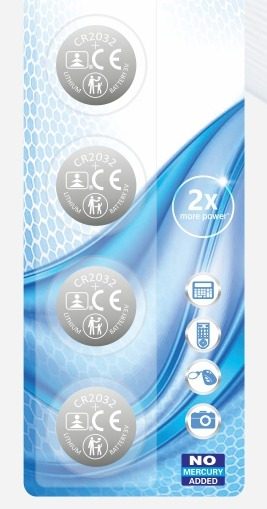
TIANQIU
The AirTag is one of the few trackers whose cell you can change yourself in under a minute, and it is the device that made the CR2032 a household part number. It is also the device that turned a battery-engineering detail — the bitterant coating added to coin cells to stop children swallowing them — into a support question asked thousands of times a year.
That matters to us for two reasons. We make the CR2032, and we make the packs it is sold in. This guide sets out the cell Apple specifies, the replacement procedure in Apple’s own order, why a brand-new cell sometimes fails to connect, the safety warning that has to travel with the cell, and what a retail or OEM programme has to document when it sells replacement cells for trackers.
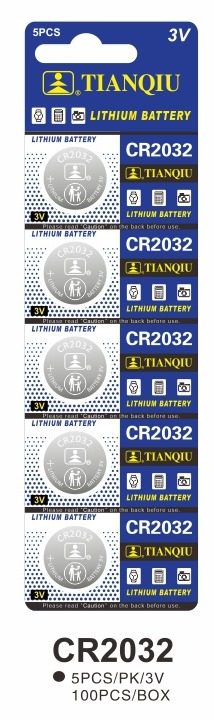
What battery does an Apple AirTag take?
An AirTag takes one CR2032 lithium 3V coin cell, fitted with the positive side facing up. That is the wording on Apple’s own battery replacement page, and the technical specifications for both the 2021 AirTag and the second-generation model introduced in January 2026 list a user-replaceable CR2032.
In practice, the cell is one you already know from watches, key fobs and motherboards. What is worth reading carefully is everything printed around that code, because the same 20 mm case carries several designations and two different chemistries.
| Specification | Apple AirTag — what the device names | Our CR2032 — declared figures |
|---|---|---|
| Cell | CR2032 lithium 3V coin cell | CR2032 (IEC) — ANSI/NEDA 5004LC |
| Chemistry | Lithium, non-rechargeable | Lithium manganese dioxide (Li-MnO₂), non-rechargeable |
| Nominal voltage | 3 V | 3.0 V |
| Dimensions | Not stated in the specification text | 20.0 mm diameter × 3.2 mm thickness |
| Capacity | Not stated | 190 mAh to 255 mAh declared, per model data sheet |
| Weight | Not stated | 2.9 g to 3.1 g (reference) |
| Installation | Positive side facing up | Polarity marked on the cell; flat face up in the AirTag tray |
| Standards we list against the model | — | IEC 60086-1, -2, -3, -4 |
| EU declaration of conformity | — | TQ-EUDOC-CR2032-20260418 (Regulation (EU) 2023/1542) |
The device column is quoted from Apple's AirTag battery replacement page and tech specs; the right-hand column is our own published CR2032 data. Where Apple does not state a figure (capacity, dimensions, weight) we do not invent one for the device — our figures describe the cell we supply.
One property of the cell is not in that table and is easy to overlook: a CR2032 is a primary cell. It is not rechargeable and must never be put in a charger. Every AirTag is designed around a single-use cell for that reason.
How do you replace the battery in an AirTag?
Press down on the polished stainless steel battery cover and rotate it counterclockwise until it stops, lift the cover off, swap the cell positive-side up, then seat the cover with its three tabs in the three slots and rotate it clockwise until it stops. Apple publishes exactly that sequence, and no tool, pairing step or app setting is involved.
| Step | What you do | What tells you it worked |
|---|---|---|
| 1 | Press down on the polished stainless steel battery cover and rotate counterclockwise until it stops | The cover reaches a hard stop, about a quarter turn |
| 2 | Remove the cover and the old cell | The CR2032 sits in a shallow tray and lifts out |
| 3 | Insert a new CR2032 lithium 3V coin battery with the positive side facing up | The AirTag plays a sound when the cell connects |
| 4 | Replace the cover with the three tabs on the cover aligned to the three slots on the AirTag | The cover sits flush — no gap at the seam |
| 5 | Rotate the cover clockwise until it stops | The tracker reappears in Find My without re-pairing |
Steps and the connection tone are taken from Apple's support article on replacing an AirTag battery. The AirTag reconnects to the same Apple Account automatically; nothing is re-registered.
Two failures account for most of the complaints after a swap, and both are visible without a meter:
- The cell is the wrong way up. A CR2032 looks almost symmetrical, so the printed face is a useful tell: the positive side carries the marking and faces up. No tone, no tracking.
- The cover is not locked. A cover that has not rotated to its stop can leave the circuit open, and on a tracker carried in a pocket or bag it can also work loose. It must click fully home.
If the orientation and the cover are both right and the AirTag still does not chime, the coating described in the next section is the next thing to check.
Why does a new CR2032 not work in an AirTag?
Because some CR2032 cells carry a bitterant coating, and that coating is an electrical insulator. Apple’s wording is that CR2032 batteries with bitterant coatings might not work with AirTag or other battery-powered products, depending on the alignment of the coating in relation to the battery contacts — which is another way of saying the coating’s position on the can is not controlled well enough for the holder.
The coating exists for a different purpose. It is applied to coin cells to discourage a child from swallowing one, and Apple’s own replacement page tells users to use a bitterant-coated CR2032 to reduce the risk of accidental ingestion, and to look for packaging that states “Compatible with Apple AirTag”. So the same feature that reduces an ingestion risk can interrupt a contact patch — the guidance is to use a coated cell that has been checked against the device, not to avoid coating altogether.
What that means commercially is that the coating is a model-level fact, not a brand-level one. Two CR2032 packs from the same shelf can differ. We state what applies to the model you are ordering on its technical data sheet, so ask rather than assume — a question worth asking before a retail run, not after.
| Symptom after fitting a new cell | Check first | Then |
|---|---|---|
| No sound, tracker does not appear | Orientation — the marked positive face must point up | Re-seat the cover until it clicks home |
| Cell reads 3 V on a meter but the tracker stays dead | Contact patch under the cell | Suspect a bitterant coating; try an uncoated cell or a cell labelled for AirTag |
| Tracker works, then drops out | Cover fully rotated to its stop | Confirmed in Find My before you carry it — a loose cover is also the child-access case |
| Cell is a CR2025 or CR2016 | Thickness — 2.5 mm or 1.6 mm against 3.2 mm | Fit a CR2032; the thinner cell will not hold contact reliably |
Orientation, the connection sound and the coating wording come from Apple's support article; the contact-loop reasoning follows from the cell construction. Nothing here requires a tool.
Are all CR2032 coin cells the same?
Physically, yes: every CR2032 is a 20.0 mm × 3.2 mm lithium cell at 3.0 V nominal. Commercially, no — the designations differ by maker, a second chemistry shares the can, and two thinner cells share the diameter. A holder that accepts any of them is not proof that they are the same battery.
| Code you may see | What it is | Where we verified it |
|---|---|---|
| CR2032 | The IEC size designation — the code we manufacture to | IEC 60086; printed on every cell we make |
| 5004LC | The ANSI / NEDA designation for this size | Energizer CR2032 product datasheet: "Designation: ANSI / NEDA-5004LC, IEC-CR2032" |
| DL2032 · ECR2032 | Duracell and Energizer codes for the same cell | Maxell cross-reference chart (Duracell and Eveready columns) · Energizer CR2032 product page replacement list |
| KECR2032 · KCR2032 | Rayovac and Kodak codes seen in trade listings | Single source in the charts we hold — treat as unconfirmed until the maker confirms it |
| SB-T15 / ST-T15 | Seiko number for this size | Renata CR2032 cross-reference guide; Maxell prints SB-T51 instead — the charts disagree, so read the marking on the cell |
| BR2032 | Same 20.0 × 3.2 mm can, different chemistry (Li-CFx) | Energizer CR2032 product page replacement list · Renata and Maxell both print this size as "CR/BR2032" — lower capacity and a different discharge curve |
| CR2025 · CR2016 | Same 20 mm diameter, thinner cells — 2.5 mm and 1.6 mm | IEC 60086 size designations; makers publish roughly 170 mAh and 100 mAh typical against our CR2032 190–255 mAh |
Only maker-verified numbers are listed as confirmed. Where a code appears only in retail listings or the charts contradict each other, we say so instead of merging it into the confirmed list — the full sourced chain is published on the CR2032 model page.
For a device that specifies CR2032, the practical rule is short: match the designation, check the thickness, and treat chemistry as part of the designation rather than as a detail. A BR2032 in an AirTag is an unnecessary experiment; a CR2025 is a contact problem waiting to happen.
How long does an AirTag battery last?
There is no published replacement interval to plan against — the tracker tells you. Apple’s technical specifications give the test basis behind its life figure: everyday use of four play-sound events and one Precision Finding event per day, with the explicit note that battery life varies with usage, environmental conditions, the replacement battery manufacturer and other factors.
That last clause is our business. Two CR2032 cells can be the same size, the same 3.0 V and the same nominal designation, and still behave differently in a tracker: how much capacity is really in the can, how flat the discharge curve is, and how much the cell self-discharges while it waits decides whether the Low Battery notice arrives at month ten or month four.
Three habits make the difference for a fleet of trackers or a retail range:
- Buy the cell that matches the job, not the cheapest one on the pallet. The declared capacity range is on our data sheet per model — 190–255 mAh for the CR2032 — and it is the number that decides runtime at the tracker’s duty cycle.
- Plan for the shelf, not just the swap. Our declared shelf statement for the model is one year after delivery under normal storage at 98% of initial capacity; a cell can sit in a warehouse or a blister pack before it is ever fitted, so stock rotation matters as much as cell choice. The storage and dating rules are set out in the shelf life guide.
- Respect the temperature window. Apple’s second-generation specification gives an operating ambient range of −20 °C to +60 °C for the tracker itself; the cell inside is a lithium cell with its own published temperature line, which is covered in the cold-weather guide.
Is the AirTag coin cell a swallowing hazard?
Yes — and the warning belongs to the cell, not only to the tracker. Apple prints the full ingestion warning with the product, and its text is unambiguous: a swallowed button cell or coin battery can cause internal chemical burns in as little as two hours, ingestion can cause death or serious injury, new and used batteries must be kept out of reach of children, and a suspected swallow needs immediate medical attention.
| What the warning says | What it means in practice |
|---|---|
| Ingestion hazard — this product contains a button cell or coin battery | The risk travels with the cell itself, in a tracker, a fob, a watch or a spare pack |
| Internal chemical burns in as little as 2 hours | A suspected swallow is an emergency, not a wait-and-see — seek medical attention at once |
| Keep new and used batteries out of reach of children | A spent cell still holds charge; it is not safe to leave loose in a drawer |
| Replace only with the same type (CR2032) | A thinner cell that rattles in the tray is easier to dislodge and can break contact |
Quoted from the ingestion warning on Apple's AirTag battery replacement page. Apple's device-side warning that the AirTag, the cover and the cell present a choking hazard to small children is part of the same notice.
For a manufacturer or importer, two consequences follow. First, the warning has to be on the pack as well as in the manual — the US rule for separately sold button cells (child-resistant packaging plus warning label, with the hazard symbol and panel sizes specified) is set out on our US button battery packaging law page. Second, a used-cell routine is part of the product: cells should be taped and handed to a collection point rather than binned, which the disposal guide covers step by step.
How do you buy CR2032 cells for a tracker or a retail programme?
The CR2032 is in our own range as a 3.0 V lithium manganese dioxide cell, and it is supplied the way tracker and accessory programmes need it: the declared figures on a per-model technical data sheet, the compliance file for the market, and the pack format your shelf needs. What the programme has to pin down is the coating question, the cell count and the document set.
What we supply and what we ask for:
- The cell, per model. CR2032 at a declared 190–255 mAh, 20.0 × 3.2 mm, listed against IEC 60086-1, -2, -3 and -4 — with the individual data sheet rather than a family average.
- The EU file. Each model carries its own numbered declaration of conformity under Regulation (EU) 2023/1542 — the CR2032 is TQ-EUDOC-CR2032-20260418 — alongside CE and RoHS documentation, as set out on battery certifications and EU battery compliance.
- The transport file. A CR2032 is a lithium cell, so the paper a forwarder asks for is the UN38.3 test summary. That is specific to lithium: our alkaline and silver-oxide lines are non-dangerous goods and carry no UN38.3 report.
- The pack and the print. Bulk, carded or blister, made and printed in our plant under your label, with your warning panel, your languages and a production date code we can trace to the batch — the same artwork cycle as any private-label packaging run.
- The coating answer, in writing. If your channel requires a bitterant-coated cell, say so at the enquiry stage and we confirm per model what we can supply rather than leaving it to the retail listing.
- The minimum. First orders run from 50 cartons per product line, and mixed-SKU cartons are possible for a retail range; wholesale batteries explains how that is quoted. Trackers, tags and sensor programmes are the case our IoT and sensors page covers in detail.