 TIANQIU
Three chemistries cover most of the batteries sold in a supermarket or a hardware store: zinc-carbon (often printed as “heavy duty”), alkaline, and lithium. They are not competing versions of the same product — they are built for different jobs.
How do the three chemistries compare?
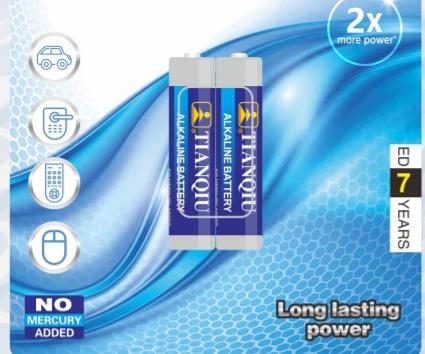
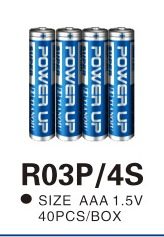
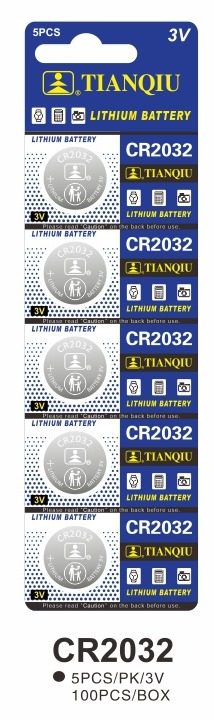
| Zinc-carbon | Alkaline | Lithium (coin / cylindrical) | |
|---|---|---|---|
| Typical voltage | 1.5 V | 1.5 V | 3.0 V (coin) / 1.5 V (cylindrical) |
| Capacity | Lowest | High | Highest per size |
| Discharge curve | Sags early | Sags steadily | Flat until nearly empty |
| Shelf life | ~2–3 years | ~5–10 years | ~10 years |
| Cold performance | Weak | Moderate | Good |
| Cost per cell | Lowest | Moderate | Highest |
| Best for | Clocks, remotes, low-drain devices | The everyday mix: toys, torches, radios | Backup, sensors, key fobs, medical devices |
Shelf life is storage life, not service life — a cell in a running device drains far faster than the same cell in a drawer.
Should you choose by drain instead of price?
The rule that decides it is how much current the device draws:
- Low drain — wall clocks, TV remotes, smoke detectors on alkaline: zinc-carbon can be the economical choice, and it is what many value lines are built with.
- Medium to high drain — toys, torches, portable radios, game controllers: alkaline is the default because its capacity advantage outweighs the price difference.
- Very low current over years — CMOS backup, sensors, medical devices: lithium coin cells win, because they hold their voltage flat for a decade and do not leak in storage.
Buying zinc-carbon for a device that draws heavily is a false economy: it will be replaced several times before one alkaline cell would have finished.
How much capacity does each chemistry actually hold?
The declared figures from our own product data, for the two sizes buyers order most:
| Chemistry | AA | AAA |
|---|---|---|
| Alkaline (LR6 / LR03) | 2150 – 2600mAh | 1020 – 1260mAh |
| Zinc-carbon (R6P / R03) | 900mAh | 400mAh |
Declared capacity at a low-drain discharge. The gap widens in the device, not on the label — a heavy load costs a zinc-carbon cell far more than it costs an alkaline one.
Read the two rows against each other. In the same AA can the alkaline cell declares 2150 – 2600mAh where the zinc-carbon R6P declares 900mAh; in the same AAA can, 1020 – 1260mAh against 400mAh for the R03. Both sizes run at 1.5 V, so the difference is energy stored, not volts delivered — and it is the whole reason alkaline costs more.
How long does each chemistry keep in storage?
Shelf life is storage life: how long a cell keeps its charge in a drawer, not how long it runs a device. The three chemistries do not age at the same rate:
- Zinc-carbon keeps for roughly 2–3 years, stored cool and dry away from metal objects. It is the shortest of the three, so it suits a range that sells through rather than one that sits.
- Alkaline keeps for roughly 5–10 years, cool and dry in the original packaging — enough for a retailer to hold a season of stock.
- Lithium keeps for roughly 10 years, holding its voltage flat until almost empty, which is why it is specified for devices that wait years before first use.
Heat is the main enemy in every case: a cell kept in a hot garage ages several times faster than one in a cupboard. The chemistry-by-chemistry figures are set out in how long batteries last.
When is lithium the right chemistry?
Lithium is not a bigger alkaline cell — it is a different system, and mostly a different shape. The lithium cells we build are lithium manganese dioxide (Li-MnO₂) coin and cylindrical cells, at 3.0 V nominal rather than 1.5 V. Three properties decide where they belong:
- Very low current over years — CMOS backup, sensors, key fobs, medical devices: lithium coin cells hold their voltage flat for about a decade and do not leak in storage.
- A flat discharge curve — the voltage stays close to nominal until almost empty, so a device that reads its own state from voltage does not drift as the cell ages.
- A different cell shape — a CR2032 coin cell is a 3 V part in a holder designed for it; it is not a swap for a 1.5 V AA or AAA.
For a buyer, the split is simple: alkaline and zinc-carbon cover the cylindrical AA/AAA range, and lithium covers the coin cells.
What does this mean for private label?
Most private-label programmes run two lines in parallel: a value line on zinc-carbon for low-drain hardware, and an alkaline line for the main range. Both are produced on our own lines, and both can carry your artwork on the cell, the blister card and the box.
The three chemistries are declared model by model on the battery models list — the 6F22 zinc-carbon 9 V and its alkaline twin the 6LR61 9 V block are the clearest example of one size in two chemistries. Lithium runs through our lithium battery programme.