TIANQIU
A hearing aid takes one of four zinc-air cells, and the number on the pack — 10, 312, 13 or 675 — is a size, not a brand. Each size carries a fixed tab colour and an IEC code, and the four are not interchangeable: two of them share a diameter, which is what makes the wrong pack so easy to buy. Here is how to identify the cell your aid needs, what the codes mean, and what changes when you buy the same cell in volume.
What sizes do hearing aid batteries come in?
Four sizes cover nearly every hearing aid: 10, 312, 13 and 675. All four are zinc-air cells at 1.4 V nominal in the makers’ published data. Each size has one fixed tab colour, one IEC code and one set of dimensions, so any of the three identifies the cell.
| Size | IEC code | Tab colour | Diameter × height | Where it is typically used |
|---|---|---|---|---|
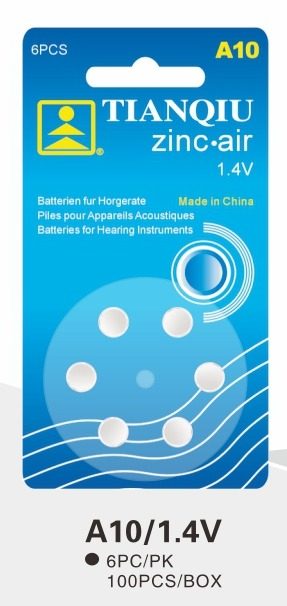
| 10 | PR70 | Yellow | 5.8 × 3.6 mm | The smallest in-the-canal and completely-in-canal aids |
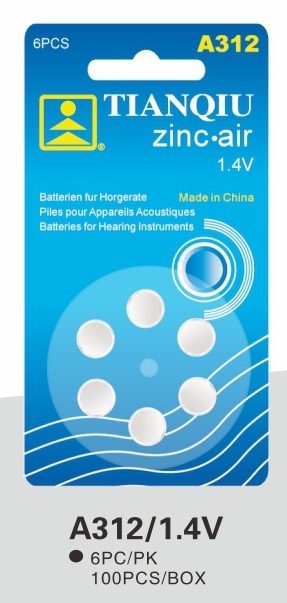
| 312 | PR41 | Brown | 7.9 × 3.6 mm | Receiver-in-canal and smaller behind-the-ear aids |
| 13 | PR48 | Orange | 7.9 × 5.4 mm | Larger in-the-ear and behind-the-ear aids |
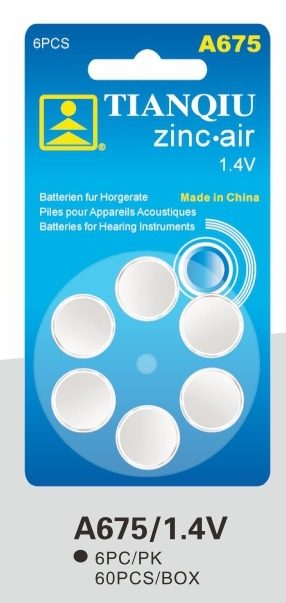
| 675 | PR44 | Blue | 11.6 × 5.4 mm | Power behind-the-ear aids and implant processors |
| 5 · 675 HP (niche) | PR63 · P675HP | Red · grey or green | 5.8 × 2.15 mm · 11.6 × 5.4 mm | Older aids and cochlear implant processors — for reference only |
Dimensions, IEC codes and the colour-code convention are taken from the hearing-aid battery data published by the cell makers and the standard cross-reference charts the industry uses. Voltage and capacity differ from brand to brand: the makers' own data sheets are the figures to quote in a specification.
Two things in that table decide whether you buy the right pack. The first is the diameter — 5.8 mm, 7.9 mm and 11.6 mm are the only three on the market, so a diameter on its own narrows the choice to two sizes at most. The second is the height, which is what separates them.
What do the size number, the IEC code and the brand code each mean?
They are three names for the same cell. The size number (10, 312, 13, 675) is what the hearing industry and the retail pack use, the IEC code (PR70, PR41, PR48, PR44) is the international designation, and each manufacturer also prints its own article number.
- Size number — the number on the blister pack and inside the aid’s manual. It is the one to quote when ordering.
- IEC designation — PR followed by the standard number for that can. PR41 is the zinc-air cell we list as size 312, PR44 is size 675.
- Manufacturer article numbers — every brand prefixes the size with its own letters, which is why one size 312 can also appear as a maker code on the pack. When you compare offers, compare the size number and the IEC code rather than the article number.
The same three-layer numbering runs through the button cells we make, and it is the reason we publish a cross-reference tool for the CR, LR, SR and AG codes. It is a useful habit with hearing-aid cells too: quote the size number and the IEC code in the purchase order, and the brand prefix stops mattering.
How do you tell a 312 from a 13?
By height, not by diameter. Size 312 and size 13 both measure 7.9 mm across and are almost impossible to separate by eye; size 312 is 3.6 mm tall and size 13 is 5.4 mm tall. The tab colour is the fast check — brown for 312, orange for 13.
If the tab is already off and the print has worn, measure the old cell rather than guessing. A caliper on the diameter and the height settles it in seconds, and it is worth doing before you order a pack rather than after.
| You have | Diameter | Height | What it is |
|---|---|---|---|
| A yellow tab | 5.8 mm | 3.6 mm | Size 10 / PR70 |
| A brown tab | 7.9 mm | 3.6 mm | Size 312 / PR41 |
| An orange tab | 7.9 mm | 5.4 mm | Size 13 / PR48 |
| A blue tab | 11.6 mm | 5.4 mm | Size 675 / PR44 |
Never force a cell into the battery door. A size 13 pressed into a 312 compartment, or the reverse, is how contacts get bent and hinges crack: a 312 in a 13 door sits loose and loses contact, and a 13 in a 312 door will not close cleanly.
Can you use an ordinary button cell in a hearing aid?
No — and this is the mistake the shared sizes invite. A hearing aid is designed around a zinc-air cell: 1.4 V nominal, air access through the holes under the tab, and a flat discharge curve that keeps the aid’s gain steady as the cell runs down.
Three of the four hearing-aid sizes share a can with an alkaline cell we manufacture, which is why the mix-up happens:
| Hearing-aid size | Same can as | Zinc-air cell | Alkaline cell of the same size |
|---|---|---|---|
| 312 / PR41 | Our LR41 button cell | 7.9 × 3.6 mm — makers publish roughly 160 mAh for this size | LR41, 7.9 × 3.6 mm — our data sheet declares 34 mAh |
| 13 / PR48 | Our LR754 button cell | 7.9 × 5.4 mm | LR754, 7.9 × 5.4 mm — our data sheet declares 48 mAh |
| 675 / PR44 | Our LR44 / SR44 button cells | 11.6 × 5.4 mm — makers publish the largest capacity of the four | LR44, 11.6 × 5.4 mm — our data sheet declares 118 mAh |
Same can, different chemistry. The alkaline cell drops into the compartment, but it holds a fraction of the charge and its voltage falls as it discharges, which is not what a hearing aid's amplifier was designed around. Fit the zinc-air cell your aid specifies.
The capacity gap is the practical part. Our LR41 alkaline button cell is documented at 34 mAh in our own EU battery data, while the zinc-air cell in the same 7.9 × 3.6 mm can is published by the cell makers at roughly 160 mAh — close to five times the charge, in the same hole. The comparison of the three button-cell chemistries we manufacture, including why silver-oxide is specified for watches, is in our button cell guide.
- Zinc-air and other button cells are a swallowing hazard — a cell lodged in the throat or stomach is a medical emergency. Seek help immediately, whether or not the cell has leaked.
- Keep loose cells, and any device whose compartment a child can open, out of reach — and never leave a peeled cell on a table while you fetch the aid.
- Never dispose of batteries in fire; do not charge a zinc-air cell, and do not carry loose cells where they can short against keys or coins.
Why does the tab matter — and why do these cells need air?
The tab is a seal over the air holes, not just a handle. A zinc-air cell makes its current from oxygen in the air: while the tab is on, the cell is dormant and holds its charge; peel it and the reaction starts and the cell runs continuously from that moment.
That single fact explains most of the practical advice:
- Do not peel the tab until you are about to fit the cell. An activated cell discharges whether or not it is in an aid.
- Let the cell reach its working voltage. Cell makers describe the cell as activated by removing the tab covering the air-access holes, and it needs those holes open and unobstructed to operate.
- Handle by the edges. Grease or dirt on the air holes is one of the reasons a freshly peeled cell underperforms.
- Keep spare cells in their retail pack, tabs on. Makers describe service maintenance before tab removal as excellent — the dormant state is the storage state.
The colour coding on those tabs exists for the same reason the cells need air: hearing-aid users change cells by feel and by sight, and the tab is the only part that is easy to see. It is also why a private-label zinc-air pack has to reproduce the colour convention exactly — it is a usability feature, not decoration.
How long does a hearing aid battery last?
Runtime is set by the aid, not by the size number. The device’s current drain, the hours it is worn each day and the gain it delivers decide how fast the cell is used, which is why two people with the same cell size can report very different life.
The makers’ own description of the chemistry is the clue: zinc-air is characterised as most effective in applications that consume the capacity within a few weeks. That is a statement about the chemistry’s design window rather than a promise about your aid, and it is the reason we do not publish a single runtime figure for a size.
What we can say without inventing numbers:
- Capacity is brand-specific. Two makers’ 312 cells carry different mAh figures, so compare like for like — the maker’s own data sheet for the exact article number.
- Match the size to the aid. A larger cell of the same chemistry carries more capacity in the makers’ published figures, but only the size your aid’s door accepts will fit.
- Buy for turnover. Zinc-air cells are dated, and a dormant cell with the tab on still ages in a warm stockroom, exactly as alkaline cells do — the shelf-life logic in our guide to how long batteries last applies here too.
- A peeled cell is a running cell. If you peel a tab and then the aid goes in a drawer, the charge is still going.
If you need the figure for a specification, ask us for the data sheet for the exact zinc-air model — capacity, dimensions and the performance table, per model, rather than a size-wide average.
How should zinc-air cells be stored and disposed of?
Store them in the retail pack with the tabs on, cool and dry, and work stock first in, first out. For disposal, treat a hearing-aid cell like any other button cell: it does not belong in general waste, and a zinc-air cell is still a battery after it is spent.
- Keep the pack and the tab. The pack carries the size, the colour and the maker; the tab tells you which cell is unused.
- Store cool and dry in the original blister. Loose cells in a drawer collect metal, dust and, at the worst moment, a second cell that shorts against them.
- Hand spent cells in at a collection point. Our guide to disposing of batteries covers taping the terminals and why lithium, alkaline and zinc-air cells all stay out of the bin.
- Ask for the material declaration for the exact model. Mercury and material content is declared per product by the manufacturer, and the EU rules for what a cell may contain are summarised on our EU battery compliance page.
How do you buy hearing aid batteries in bulk or under your own brand?
The four zinc-air cells — A10, A13, A312 and A675 — are in our range, alongside the CR lithium, LR alkaline and SR silver-oxide button cells we build. A retail programme is mostly a packaging conversation: the cell has to arrive tabbed, colour-coded and dated, and the pack has to carry the warnings the market requires.
What a private-label order involves:
- The cell, per model. Ask for the data sheet for the exact zinc-air model you intend to sell; we quote capacity, dimensions and performance per model rather than per size.
- Retail packaging that preserves the cell. Blister or card formats that keep the tab sealed until the consumer peels it — the same artwork and proof cycle we run for private-label battery packaging.
- Market-specific warnings. In the United States, button cell products — hearing-aid cells included — fall under Reese’s Law and its rule at 16 CFR 1263, which require child-resistant packaging and specified warnings to ANSI/UL 4200A-2023. Our page on the US button battery packaging law sets out which part the factory supplies and which part the brand owner supplies.
- The documents your market asks for. Shipments of primary cells travel with a safety data sheet and the compliance file for the market; the file set is confirmed by model, the same way our certificate library is organised.
- Minimum order. First orders run from 50 cartons per product line, and mixed-SKU cartons are possible for retail programmes — see wholesale batteries for how that is quoted.
We build the button cell lines in our own plant, so a programme that mixes zinc-air hearing-aid cells with silver-oxide watch cells, lithium coin cells and alkaline button cells can be quoted as one order. The processes are set out under OEM battery manufacturing, and the applications the cells are specified into — including medical devices — are listed by industry.